

Accurate Billing for iron intravenous therapy for Texas Infusion Centers
February 20, 2026
Clean Claim Submission Workflow for Benlysta infusion Billing
February 24, 2026Accurate Billing for iron intravenous therapy for Texas Infusion Centers
February 20, 2026Clean Claim Submission Workflow for Benlysta infusion Billing
February 24, 2026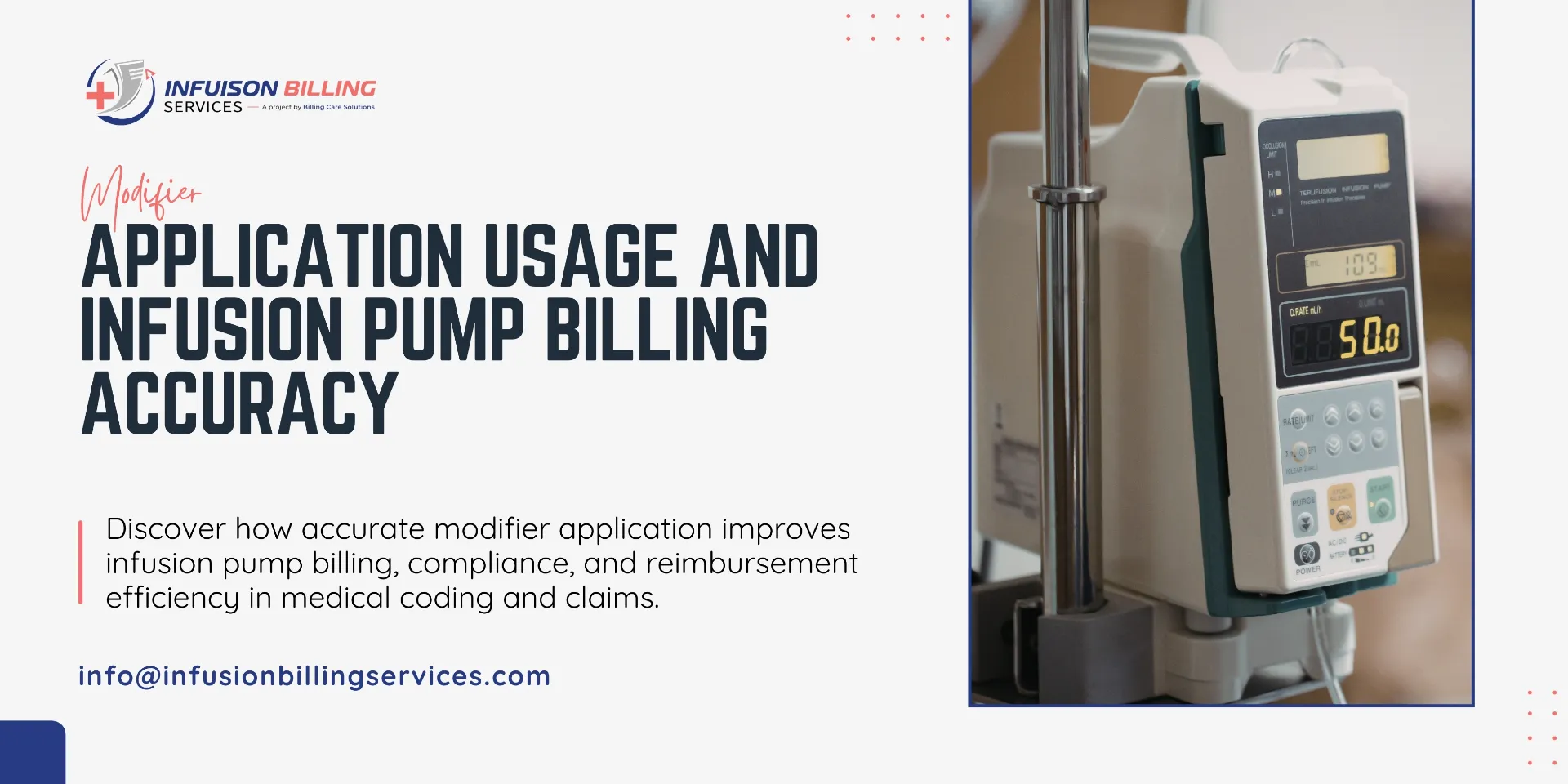
Modifier Application Usage and infusion pump Billing Accuracy
Discover how accurate modifier application improves infusion pump billing, compliance, and reimbursement efficiency in medical coding and claims.
Infusion therapy has taken its place in patient care as a place of delivering medications, fluids and nutrition. Although these forms of treatment are vital as far as medicine is concerned, proper billing is a threat to many healthcare professionals. Inaccurate coding, mistakes in the use of a modifier and ineffective documentation may result in loss of revenue and claims and regulator inspection.
Precise billing is essential in healthcare practices which are dependent on infusion therapy. A crucial component of this process is an infusion pump, and knowledge of the correct manner of coding and making modifiers can be used so that services can be reimbursed. The article discusses the best practices in the use of modifiers, pitfalls when billing and how technology and professional assistance can help to improve accuracy.
Understanding Infusion Pump Billing
Infusion pump is a medical equipment that injects fluids, drugs, or food into the blood of a patient. These are applied in the hospitals, outpatient clinics and home health settings. The services, which involve infusion pumps, should be billed, based on extensive knowledge of CPT and HCPCS codes, and applications of modifiers in various cases.
Common billing codes are:
- 96365: First intravenous drug infusion.
- 96366: Every consequent infusion.
- 96367: Further sequential intravenous no-drug therapy.
Although these codes are simple in nature, most of the providers encounter problems related to overlapping infusions, multiple sessions per day, or emergency services. Errors in these sections may lead to refusal or late payments of claims.
The Role of Modifiers in Medical Billing
Modifiers are two character codes in both CPT and HCPCS billing codes that are used to give further details about a service. They help to explain situations which influence payment but no alterations to the main concept of the code.
In the case of infusion services, these modifiers can be used to mean:
- Whether several services had been done.
- In case services were different in other processes.
- Special payment considerations: the necessity.
Proper use of the modifiers will mean that the billing is correct and represents the care given. The misuse of modifiers may lead to audits and could be subject to expensive appeals.
Common Modifier Application Scenarios
Infusion billing may involve the use of modifiers that differ as per the needs of the patients, their frequency of treatment, and their documentation. Examples of common situations are:
|
Scenario |
Modifier |
Explanation |
|
Separate service |
59 |
Indicates the infusion is distinct from other procedures provided |
|
Multiple sessions |
76 |
Second or subsequent infusion on the same day |
|
Emergency infusion |
22 |
Service involved additional complexity or intensity |
|
Concurrent infusions |
25 |
Separate evaluation and management service performed the same day |
|
Home infusion |
NU |
A new infusion pump device was supplied |
|
Device replacement |
RL |
Replacement of a previously issued infusion pump |
The knowledge of such situations assists providers to avoid the typical mistakes resulting in the denial of claims.
Enhancing Accuracy in Infusion Pump Billing
In accurate billing, proper coding should be combined with proper use of modifiers as well as documentation. To be more precise, one can take the following steps:
Confirm the type of infusion pump: The various pumps can be of different codes and billed differently.
Document infusion information: The start and end time of record, and drug names and amount.
Choose the right codes: Choose the right CPT and HCPCS codes depending on the service provided.
Apply modifiers judiciously: Take care of the modifiers being warranted by the documentation.
Review claims before submission: Check to ensure no information is missed or conflicting.
With these steps, practices will decrease the chances of claims being denied and increase revenue capture.
Audit Risks and Compliance
CMS and commercial insurer regulatory standards require a high level of compliance. Ordinary audit triggers in infusion billing are:
- Several infusions were coded without the necessary modifiers.
- Imperfect records of emergency or urgent services.
- Mismatch between drug record administration and bill code.
The internal audit should be performed regularly by the providers, and the policies of proper documentation should be established. It is crucial to train the staff on the use of the modifiers and code appropriately the use of the infusion pump to stay in the line and avoid any punishment.
Technology Solutions for Accurate Billing
Accuracy can also be enhanced by incorporating technology in billing processes. Code selection can be automated, and the suggested modifiers are suggested as well as the inconsistencies are flagged by software solutions prior to the claims being made.
- Technology has benefits in infusion billing, which include:
- CPT and HCPCS code real-time validation.
- Record keeping of several infusion sessions.
- Manual entry errors reduction.
When combined with well trained employees, automation will make sure that claims to infusion pump services are complete, accurate, and audit ready.
Case Studies and Real-World Examples
A number of practical examples prove the necessity of the correct use of the modifiers and their documentation.
Example 1: Outpatient oncology clinic
The clinic was initially facing a repeated refusal of claims due to lack of sequential infusion coding with 76 modifiers. Once the staff was trained and changed the workflow:
- Each session has been appropriately modified.
- All details on drug and infusion times were documented.
- The number of denials decreased by 40, which increased the cash flow.
Example 2: Home health nutrition therapy
A home health agency had issues with claims of replacing the devices and new infusion pumps. Following the adoption of a billing checklist and use of device-specific codes training:
- On the initial claim, replacement gadgets were accepted.
- Missing modifier errors were removed.
- Infusion pump services also generated high revenue.
These examples show that the accuracy and compliance can be greatly improved by paying attention to detail in the billing and educating the staff on the matter.
Why choose Infusion Billing Services
Some of the providers tend to outsource infusion billing to dedicated services. Professional infusion pump billing companies deal with proper coding, the use of the modifiers, and documentation procedures.
Services typically include:
- Claim checking and charge capturing.
- Claims and claims submission and follow up.
- Audit support and reporting
- Educating employees on how to use the modifiers.
The outsourcing provides the healthcare providers with the ability to concentrate on the services provided to patients and retain revenue integrity. Through the usage of professionals, providers minimize the risk of rejected claims, simplify the working process, and accept the requirements of payers.
Conclusion:
Correct billing on services of infusion pumps is not only an accurate choice of code but also the proper use of modifiers, comprehensive documentation, and even the assistance of technology or other professional billing services. Errors in any of these aspects may lead to claims being denied, revenue being lost and compliance.
Best practices, staff training and use of technology or external billing services would ensure infusion therapy is billed correctly and efficiently. Those providers who invest in these strategies do more than safeguard their income, they enhance the care of their patients, and remain in regulatory compliance. Learning the art of infusion pump billing, medical professionals are able to maximize revenue cycles and provide quality and continuous care to patients.