

How Pre Auth Checks Eliminated PR-243 Denial Code Issues
May 14, 2026
96360 Coding Mistakes That Lead to Claim Rejections in Infusion Billing
May 15, 2026How Pre Auth Checks Eliminated PR-243 Denial Code Issues
May 14, 202696360 Coding Mistakes That Lead to Claim Rejections in Infusion Billing
May 15, 2026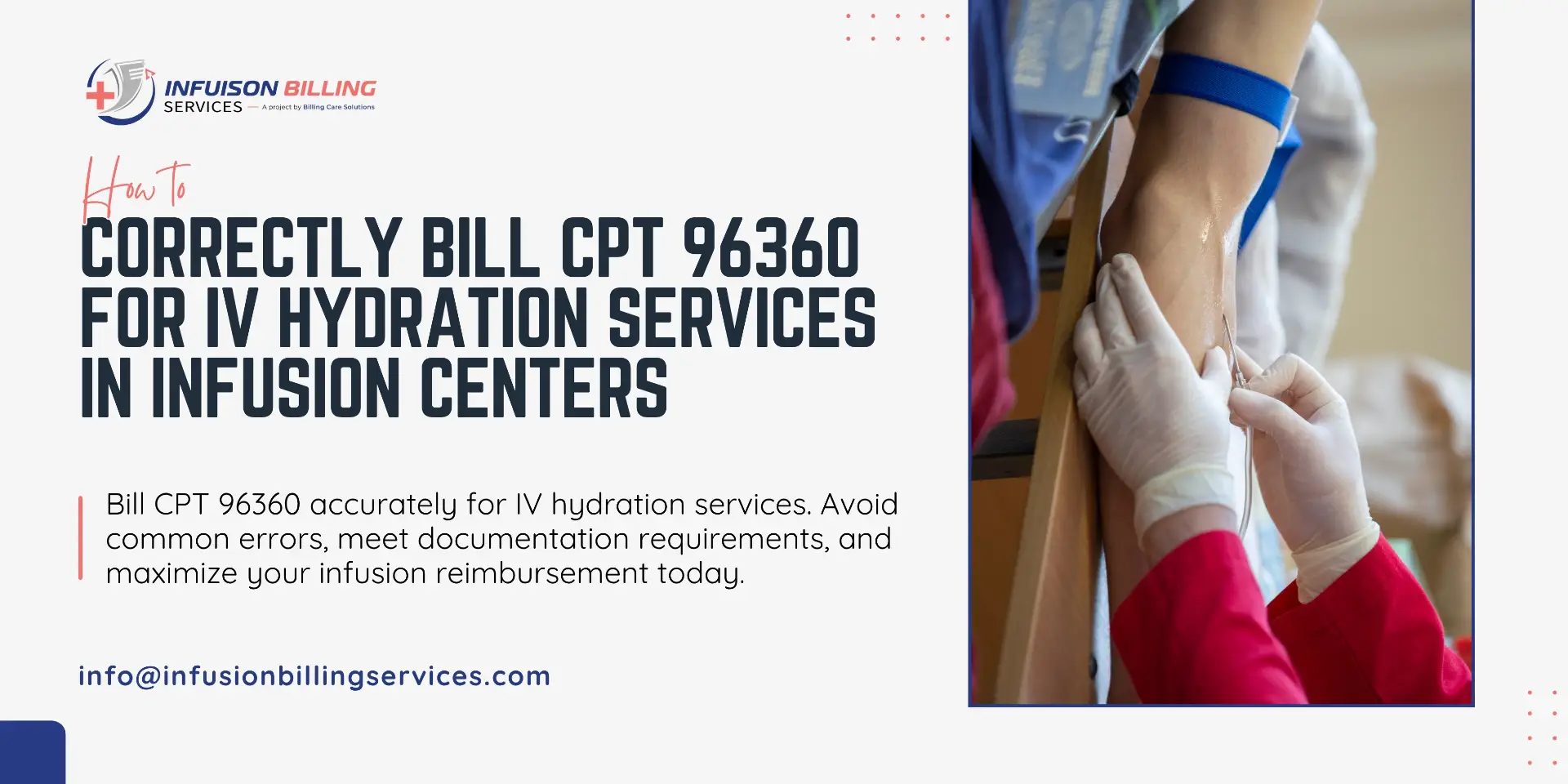
How to Correctly Bill CPT 96360 for IV Hydration Services in Infusion Centers
One of the most common infusion services performed today is IV hydration therapy. Correct billing of this, however, demands accuracy and expertise at correctly applying the rules governing coding. CPT 96360 is the main code that is applied to report IV hydration infusion services, and inaccurate use of the code can result in denied claims, audits or lost revenue.
Infusion billing is not a one-size-fits-all process. Billing teams must be familiar with the rules, documentation requirements and reimbursement thresholds of each payer. If you make a single coding or documentation error, you run the risk of a denial and your payment may be delayed, or you could be subject to a compliance audit and the entire billing operation will be called into question.
Every infusion center that wants an efficient and compliant center and wants to avoid disrupting the revenue cycle that it has earned for itself must take it as a financial and operational priority. This guide takes infusion billing professionals through everything they need to know to accurately bill this code.
What Is CPT 96360 in Infusion Billing?
CPT 96360 is a hydration infusion code used to report the administration of a pre-packaged fluid and electrolyte solution delivered intravenously. It includes the first 31 minutes to one hour of hydration therapy. This code is used for services when the primary service provided is water or hydration, not when it is a secondary service provided with another infusion service.
This code is used for therapeutic, prophylactic and diagnostic infusion, according to the American Medical Association classification. It is frequently used in hospital outpatient clinics, infusion centers and physician’s offices. It is a key component in any billing team’s understanding of applying it properly to ensure clean claims and consistent reimbursement.
CPT 96360 Medical Necessity and Coverage Criteria
Proper medical necessity and documentation are required for reimbursement of CPT 96360. This code will not be reimbursed by payers (including Medicare and commercial plans) just for having been used. If the patient was not allowed to drink fluids orally, the treating provider’s explanation of why this occurred must be justified.
The following are examples of acceptable clinical indications:
Excessive fluid loss from vomiting or diarrhea. Nausea and vomiting or diarrhea that causes dehydration.
- Factors which hinder oral hydration.
- During chemotherapy, patients experience a loss of fluids.
- Known electrolyte disturbances that need correction with fluids or electrolytes.
- Any fluid deficits ordered by the doctor following surgery.
Medical necessity must be evidenced by a physician order, documented clinical assessment and clear documentation in the chart indicating the reason for providing IV hydration. This provides payers with justification to deny or recover payments authorized based on these claims.
Documentation Requirements for CPT 96360 Claims
When submitting a claim using CPT 96360, it is essential that it be well documented. A thorough record must be kept of each IV hydration session billed under this code at infusion centers. A lack of documentation or documentation that is incomplete is one of the most common issues that causes these claims to be denied or flagged during audits.
- A physician order in place prior to the start of the infusion.
- Accurate recording of infusion start/stop time during infusion session.
- The nature and amount of fluid given during the encounter.
- A clinical indication with medical necessity in the patient chart.
- Overall treatment plan to be signed off by the physician.
- Distinct identification of any extra services rendered on the same day.
Infusion centers should also make sure that the physician overseeing the treatment has read and approved the treatment plan. If the same day services are required, they should be clearly delineated in the documentation to prevent complication of “bundling”.
CPT 96360 vs 96361 Key Billing Differences
One of the most common areas of confusion in hydration billing involves knowing when to use CPT 96360 versus CPT 96361. The table below breaks down the key differences between these two codes.
| Billing Factor | CPT 96360 | CPT 96361 |
| Code Type | Primary / Initial code | Add-on code |
| Time Covered | First 31–60 minutes | Each additional hour beyond the first |
| Units Per Encounter | One unit only | One unit per additional hour |
| Can Bill Independently | Yes | No, requires 96360 as the base |
| Typical Use Case | Starting hydration session | Extending hydration beyond one hour |
It is also important to note that CPT 96360 is only reported once per encounter, regardless of how many separate hydration bags are administered. Billing multiple units of this code for a single visit is a common error that leads to claim rejections.
Common CPT 96360 Billing Errors to Avoid
Infusion centers can lose a lot of money if there are billing errors in this service. Billers can determine how to prevent common issues and decrease denial rates by identifying the most common errors. 96360 is one of the most common errors – this is billed as an independent code when the hydration was a part of a concurrent drug infusion.
- Billing 96360 when hydration occurred but it was not a separate service provided.
- Providing more than one unit of this code for one encounter when it is not the correct add-on code
- Unbundling: This code can be combined with other codes which already contain hydration as an embedded feature.
- Billing for sessions with fewer than 31 minutes of documented infusion time.
- Using this code for push services or bolus injections, which are completely different codes
- Failure to submit claims with medical necessity documentation in the patients chart.
Also, some billing groups incorrectly use this code for bolus injections or push services, which should be billed under other codes. Access to the most up-to-date payer bulletins and AMA guidelines is important to keeping your coding team up to speed and compliant. Understanding CPT 96360 rules helps prevent revenue loss. In our 96360 denial case study, learn how improper hydration billing created repeated claim rejections and how the issue was corrected.
Payer Specific Rules for CPT 96360 Reimbursement
Reimbursement for CPT 96360 differs greatly from payer to payer, so it is important for billing teams to know each payers’ requirements prior to claiming. This code is covered by Medicare under the Hospital Outpatient Prospective Payment System and the Physician Fee Schedule, and is only covered if you have proper medical necessity documentation. CPT code 96360 will not be reimbursed by Medicare when it is used as a convenience service or for general well-being reasons.
Each State has its own Medicaid policies. There are hydration infusion prior authorization requirements in some state programs, and there are caps on the number of units that can be billed in some programs per month. Private payers may also have specific coverage policies, coverage bundling policies, or preferred modifier policies.
Infusion centers should keep a billing reference sheet for each payer that lists this code. By monitoring LCDs and payer portals regularly, your billing staff can be in step with any updates that could impact reimbursement.
How Infusion Centers Can Maximize CPT 96360 Revenue
To maximize revenue from CPT 96360, it’s important to have a combination of proper coding, clear documentation, and proactive denial management. Investing in these areas at infusion centers is a formula for higher clean claim rates and faster reimbursement cycles.
Before anything else, make sure that clinical employees are able to record time of infusion start and stop times on all occasions when this code is billed. A denial can still be issued for a small time gap in the time documentation. Establish a pre-billing audit process to check claims for completeness prior to submission.
Ensure that physicians are closely involved in capturing medical necessity language clearly in the patient chart. Documentation that is not specific or targeted will not meet the payers’ requirements. Use clinical language that is specific to the patient’s condition and reflects the use of this service.
Denial management is also a key element of the process. If a claim is denied, investigate the claim’s denial as soon as possible, and appeal the decision with supporting documentation if needed. Trends of denial over time can indicate systemic problems that can be fixed in the billing process.
Why Outsource Your CPT 96360 Billing Services?
This billing work is a strain on infusion center staff, especially as payer requirements become more complex. There are a number of benefits that outsourcing the infusion billing process to a specialized infusion billing service affords that directly affect revenue and compliance.
A focused billing team has extensive experience with the coding rules for CPT 96360, payer policy, and proper documentation. This decreases the chances of errors resulting in denials or audits. Also, specialized billing companies keep current on any changes to the Medicare, Medicaid and commercial (private insurance) guidelines so your inner team doesn’t need to handle the strain.
Outsourcing also enhances turnaround on claims, minimizes administrative burden and provides infusion center management more time to focus on patient care. When claims are processed by a trusted billing partner, you can be sure that every dollar will be recorded and that all claims are compliant.
Conclusion
With the right processes in place, it is not hard to correctly bill for CPT 96360. Whether it’s setting up medical necessity, keeping good records, or knowing the rules of each payer and the tricks of the trade to avoid common claim coding mistakes, each part of the workflow is essential to clean claims and revenue. Billing accuracy differs as much between infusion centers that take billing as a priority rather than an afterthought as between those that do both, and even between those that don’t.
It is important in hydration billing to have the details. Failure to include a start time, a less specific physician note, or a misapplied add-on code can all lead to a denied claim, or a compliance issue that is many times more expensive to correct than it is to prevent. Good habits are the first place to start in protecting revenue loss within a business; habits should naturally be created internally.
Partnering with a professional Infusion Billing Services to ensure each claim for hydration with precision and compliance. With proper billing, infusion centers can concentrate on what really matters is providing quality patient care with a healthy, financially sound practice.
Frequently Asked Questions
What does CPT 96360 actually cover?
CPT 96360 is for the infusion of intravenous fluid in the form of prepackaged fluids or electrolyte solutions, and is reported for the first 31 minutes of infusion service through one hour.
How many units can be billed?
CPT 96360 is a one time charge per encounter. If the hydration continues for more than one hour, use the add-on code (CPT 96361) for each additional hour.
Is a physician order always required?
Yes, there needs to be a valid physician order to start the infusion. If it is lacking, it will not have medical necessity support and thus not be covered by payers.
Can CPT 96360 be billed independently?
Yes, CPT 96360 is a standalone primary code. It can not be coded as a hydration secondary to a current infusion of a drug during the same encounter, however.
Does Medicare cover hydration infusion services?
CPT 96360 is only applicable to Medicare when there is a clear demonstration of medical necessity. It doesn't cover hydration that is done for general wellness or as a convenience service.
What is the minimum infusion time required?
The infusion should be at least 31 minutes and be coded CPT 96360. Sessions that are under this amount of time should not be billed as they will not meet the time requirement.
How does 96361 differ from 96360?
The first hour hydration code is CPT 96360. CPT 96361 is an add-on code that must be used in conjunction with 96360 and can only be used for additional hours.
What documentation prevents CPT 96360 denials?
Essential documentation includes physician order, infusion start and stop times, fluid type and volume, medical necessity statement, and physician sign-off on the treatment plan.
Do commercial payers follow Medicare guidelines?
Not always. Coverage and prior authorization criteria, and even bundling rules, may vary among commercial payers. They are not always the same as the criteria used by Medicare and Medicaid for hydration billing.
Why outsource infusion hydration billing services?
Outsourcing will contribute to fewer coding errors, help your staff stay up-to-date on payer policy changes, boost claim turnaround time and ensure that all CPT 96360 claims are compliant and reimbursed.