

Outpatient Infusion Revenue Cycle: How to Improve Billing Accuracy and Reimbursement
August 11, 2026
PR-242 Denials Cost an Infusion Practice $120,000. Here’s How We Fixed Them
August 12, 2026Outpatient Infusion Revenue Cycle: How to Improve Billing Accuracy and Reimbursement
August 11, 2026PR-242 Denials Cost an Infusion Practice $120,000. Here’s How We Fixed Them
August 12, 2026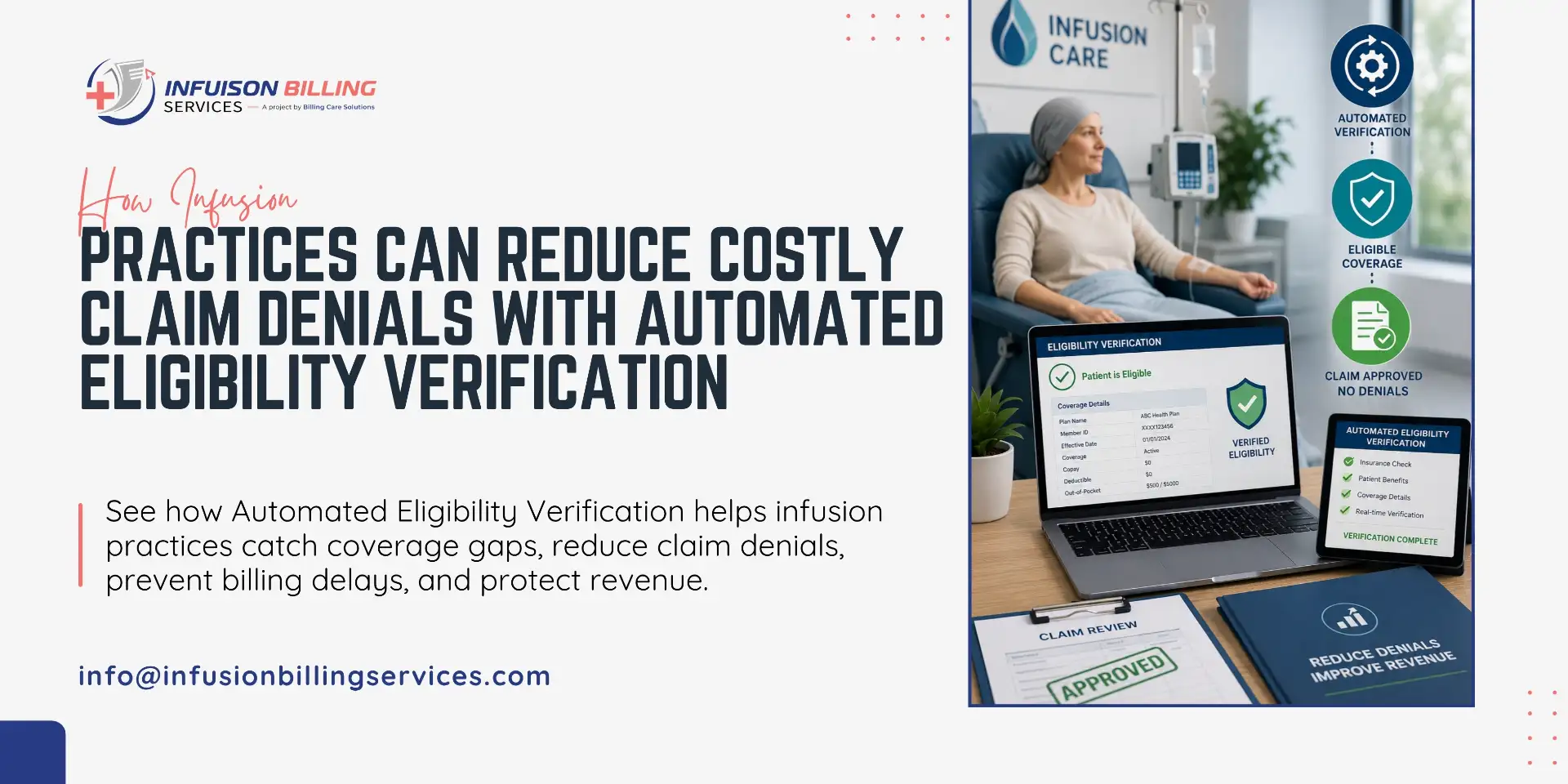
How Infusion Practices Can Reduce Costly Claim Denials With Automated Eligibility Verification
The initial step in preventing claim denials in infusion revenue cycle management is eligibility verification. One ineligibility that is not addressed can mean thousands of dollars in denied claims. It’s even more critical for infusion practices that are responsible for high-cost biologics and specialty medications. Automated eligibility verification takes the manual and error-prone process to heart and turns it into a streamlined and reliable process.
It verifies patient coverage prior to treatment, facilitates early identification of any problems, and avoids denials that would otherwise cause a treatment delay. This guide delves into the advantages of automated eligibility verification in reducing infusion revenue cycle waste and making it an absolute must-have for infusion practices in 2026.
Why Automated Eligibility Verification Matters More in 2026
Infusion billing sits at the crossroads of costly medications, complicated payer policies and rigorous authorization requirements. A single infusion claim can cost over $20,000, while routine office visits are not that costly. The financial consequences of the failure to verify eligibility are immediate and significant.
The High-Value Reality
The cost of a single infusion of a biologic can range from $10,000-50,000 or higher. If a claim is denied for eligibility, then there’s significant lost revenue to the practice and rework expenses. Manual eligibility checks can lead to mistakes that create costly downstream issues.
The Timing Challenge
Infusions are frequently planned for a time. Coverage may be subject to change from scheduling to date of service. Patients can lose their coverage, switch to other coverage or coverage can end. If claims are not verified on the day of service, the claim will be posted to inactive policies.
The Split-Benefit Complexity
The infusion therapies may be covered under medical benefits or pharmacy benefits (or both) depending on the payor. Every benefit comes with its own set of eligibility criteria, coverage conditions and prior authorization rules. Automated eligibility verification can help get through the complexity.
The Cost of Manual Eligibility Verification
Hidden Financial Losses
| Impact Area | Annual Cost Estimate |
| Eligibility-related denials | 15-24% of all denials |
| Rework costs per denial | $118 average |
| Delayed reimbursement | 30-60 days |
| Administrative labor | 20-30% of billing staff time |
Manual eligibility verification is time-consuming and prone to mistakes. Staff will need to call callers, set up phone trees and wait on hold for callers. Facts could be misinterpreted. Coverage details could be over-looked. Every mistake adds the work downstream and must be fixed at a high cost.
The Staffing Burden
Manual eligibility verification takes up lots of staff time. Billers spend hours on the phone with payers rather than revenue recovery. This decreases productivity and administrative costs.
The Patient Experience Impact
If eligibility is denied, patients are given unexpected bills. This generates confusion and frustration. Patients might also put off seeking care in the future or go to another provider. Patient experience and satisfaction are impacted by the financial experience.
What Is Automated Eligibility Verification?
Automated eligibility verification is the process of verifying patient coverage through technology, in real time. It integrates with scheduling, registration and billing systems. Verification is automatic at critical stages of the revenue cycle.
How It Works
Automated eligibility verification uses a clearinghouse or direct interface to connect to payer systems. It verifies coverage, benefits and authorization. Real-time return of results and documentation in patient’s record.
Key Capabilities
Real-Time Verification: Coverage is verified at scheduling and on the day of service. This picks up mid-cycle changes of cover that manual checks are unable to see.
Benefit Detail: Each of the automated eligibility verification systems gives comprehensive benefit information, such as deductibles, copays, and coverage limits. This helps in patient estimates and will help them avoid any shocks in the bill.
Authorization Integration: Automated eligibility verification is connected to pre-authorization workflows. Systems can set up services to be pre-authorized before scheduling.
Payer-Specific Rules: Payer- Specific Rules are automatic rules for eligibility and coverage. This way, mistakes are minimized and accuracy is increased.
Where Automated Eligibility Verification Fits in the Revenue Cycle
Pre-Service
Scheduling: Eligibility is determined at the time of scheduling. This can help uncover coverage problems prior to treatment planning.
Pre-Registration: Detailed verification of benefits prior to patient’s arrival. This includes deductibles, copay and limits.
Prior Authorization: Prior Authorization Eligibility data is available for prior authorization submissions. Systems can make decisions on whether or not authorization is needed, and what documentation is required.
Point of Service
Day-of-Service Verification: Eligibility Re-checked on Day of Service. This will catch coverage changes that happened between the scheduled date and the date the coverage is actually provided.
Patient Financial Responsibility: Accurate benefit information allows for an accurate estimate of costs to the patient before the service is provided. Patients know about their financial obligation prior to treatment.
Post-Service
Claim Submission: Accurate claim submission with eligibility data. Eligibility denials are less likely to be denied.
Denial Prevention: Denial Prevention is achieved by the use of Eligibility data. When claims come in with potential eligibility issues, they are flagged for review before submission.
The Financial Impact of Automated Eligibility Verification
Revenue Protection
Eliminate denials proactively with automated eligibility verification. With an annual infusion of $10 million, a 50 percent decrease in the percentage of practice denials for being ineligible saves $500,000 to $1,000,000 in revenue.
| Annual Infusion Revenue | Eligibility-Related Denials | After Automation | Revenue Protected |
| $5,000,000 | $250,000 – $500,000 | $125,000 – $250,000 | $125,000 – $250,000 |
| $10,000,000 | $500,000 – $1,000,000 | $250,000 – $500,000 | $250,000 – $500,000 |
| $25,000,000 | $1,250,000 – $2,500,000 | $625,000 – $1,250,000 | $625,000 – $1,250,000 |
Cost Reduction
Automated eligibility verification reduces admin costs. Less manual verification time and more revenue recovery time for staff. Practices say they’ve saved 20 to 40 percent on verification labor expenses.
Cash Flow Improvement
The sooner the revenue is verified, the sooner it can be collected. Automated eligibility verification information is correct when claims are submitted. Denials are reduced. Reimbursement is faster. The days in AR are reduced by 5 to 15 days.
Benefits Beyond Eligibility Verification
Improved Patient Financial Experience
Correct eligibility information helps to provide early cost estimates. Patients are aware of their financial liability before treatment. That is helpful to avoid billing surprises and enhance patient satisfaction. The number of patient collections is 15-20% higher in practices with accurate estimates.
Enhanced Staff Productivity
Automated Eligibility Verification lessens the administrative load on billing personnel. Staff save time and focus more on revenue recovery. This increases productivity and helps to prevent burnout.
Better Data Quality
Automated Eligibility Verification systems can collect accurate eligibility information as it is generated. This minimizes the risk of data entry errors and enhances data quality. Cleaner data for accurate claim submissions and fewer denials.
Stronger Payer Relationships
Automated verification systems enable rules and requirements that are specific to payers. This helps minimize claim denials and enhances customer relationships. Higher reimbursement rate for practices that have good payer relationships.
Technology Considerations for Automated Eligibility Verification
Integration With Existing Systems: Eligibility verification should be automated and connected to EHR, practice management and billing systems. Integration helps to have data flow smoothly and minimizes manual data entry.
Payer Connectivity: All major payers should be connected via clearinghouses or direct connections. Payer coverage for comprehensive means that verification will be available for all patients.
Real-Time Capabilities: Verification time is at the scheduling time and during the service day. Coverage changes are detected in real time and denied coverage is avoided.
Scalability: Systems should grow with practice. There should be no need for substantial new investment by additional providers, locations and patients.
How Infusion Billing Services Strengthens Eligibility Verification
Infusion Billing Services provides full automated Eligibility Verification services as a part of our revenue cycle management solutions. We use automated technology and skilled billing personnel.
Our Eligibility Verification Services
Real-Time Verification: We verify eligibility at scheduling and on the day of service. This will flag coverage changes and avoid denials.
Benefit Detail: We gather detailed benefit information such as deductibles, copays and coverage limits. This aids in the correct estimation of patients.
Payer-Specific Rules: We apply payer-specific rules for eligibility and coverage. This reduces errors and improves accuracy.
Authorization Integration: Income and benefit eligibility and coverage are subject to payer-specific rules. This minimizes errors, thereby increasing accuracy.
Patient Financial Engagement: We connect the eligibility verification process with the prior authorization workflows. This guarantees that authorization is being acquired prior to treatment.
Our Approach
Technology-Enabled: We have tools in our billing systems to automatically identify eligibility.
Experienced Staff: Our experienced staff will review eligibility data and work on resolving issues in advance of claims.
Proactive Prevention: Identifying potential eligibility issues prior to treatment and addressing them proactively.
Conclusion
Automated eligibility verification is a vital part of infusion revenue cycle management. It avoids denials and lowers administrative expenses, and enhances cash flow. The financial burden is significant when dealing with infusion practices that use high-cost drugs.
Companies with automated eligibility verification enjoy:
- Fewer eligibility-related denials
- Faster reimbursement
- Lower administrative costs
- Improved patient satisfaction
- More efficient revenue cycle performance
Manual eligibility is just not capable of meeting the requirements of today’s infusion billing demands. A combination of automated systems offers the accuracy, speed and reliability that infusion practices require to safeguard revenue and maximize performance. When it’s time to improve the automated eligibility verification process, Infusion Billing Services can assist. Talk to us today to receive a full revenue cycle analysis.
Frequently Asked Questions
What is automated eligibility verification in healthcare?
Automated eligibility verification involves the timely and accurate verification of patient coverage via technology. Examines benefits and authorization prior to service delivery.
Why is eligibility verification critical for infusion practices?
The price of infusion treatment is often more than $20,000 per treatment. One eligibility mistake could lead to a claim denial and huge lost revenue.
How does automated verification reduce claim denials?
Automated verification identifies coverage problems prior to treatment. This avoids denials which would otherwise be provided as eligibility issues.
What is the cost of manual eligibility verification?
The manual checking takes anywhere from $20 to 40 per check in staff time. Denials, rework and delayed reimbursement are extra costs resulting from errors.
How often should eligibility be verified for infusion patients?
Check eligibility for scheduling and on the day of service. Scheduling and treatment coverage changes often occur and are expensive.
Can automated verification integrate with existing EHR systems?
Yes, most of the automated verification tools are compatible with both EHR and practice management systems. Integration means that data flows smoothly and manually is minimized.
What is the ROI of automated eligibility verification?
Practices save 20-40% in verification labor costs. Everything from 3-7% of annual infusion revenue is protected by denial reductions.
How does eligibility verification affect patient financial experience?
Precise verification helps to provide patients with an estimate of upfront costs. This helps to minimize billing shock and patient satisfaction is much better.
What happens when eligibility verification fails before infusion?
Denied claims and delayed payments due to failed verification. Patients can also be sent unexpected bills that can be confusing and frustrating.
How can Billing Care Solutions help with eligibility verification?
Billing Care Solutions offers real-time verification in a billing workflow. We identify and address eligibility problems proactively by our experienced team.