
Acute Kidney Failure ICD 10 Coding Guide for Infusion Billing
August 21, 2026
How Proactive Medical Necessity Review Cut Infusion Claim Denials by 95%
August 21, 2026Acute Kidney Failure ICD 10 Coding Guide for Infusion Billing
August 21, 2026How Proactive Medical Necessity Review Cut Infusion Claim Denials by 95%
August 21, 2026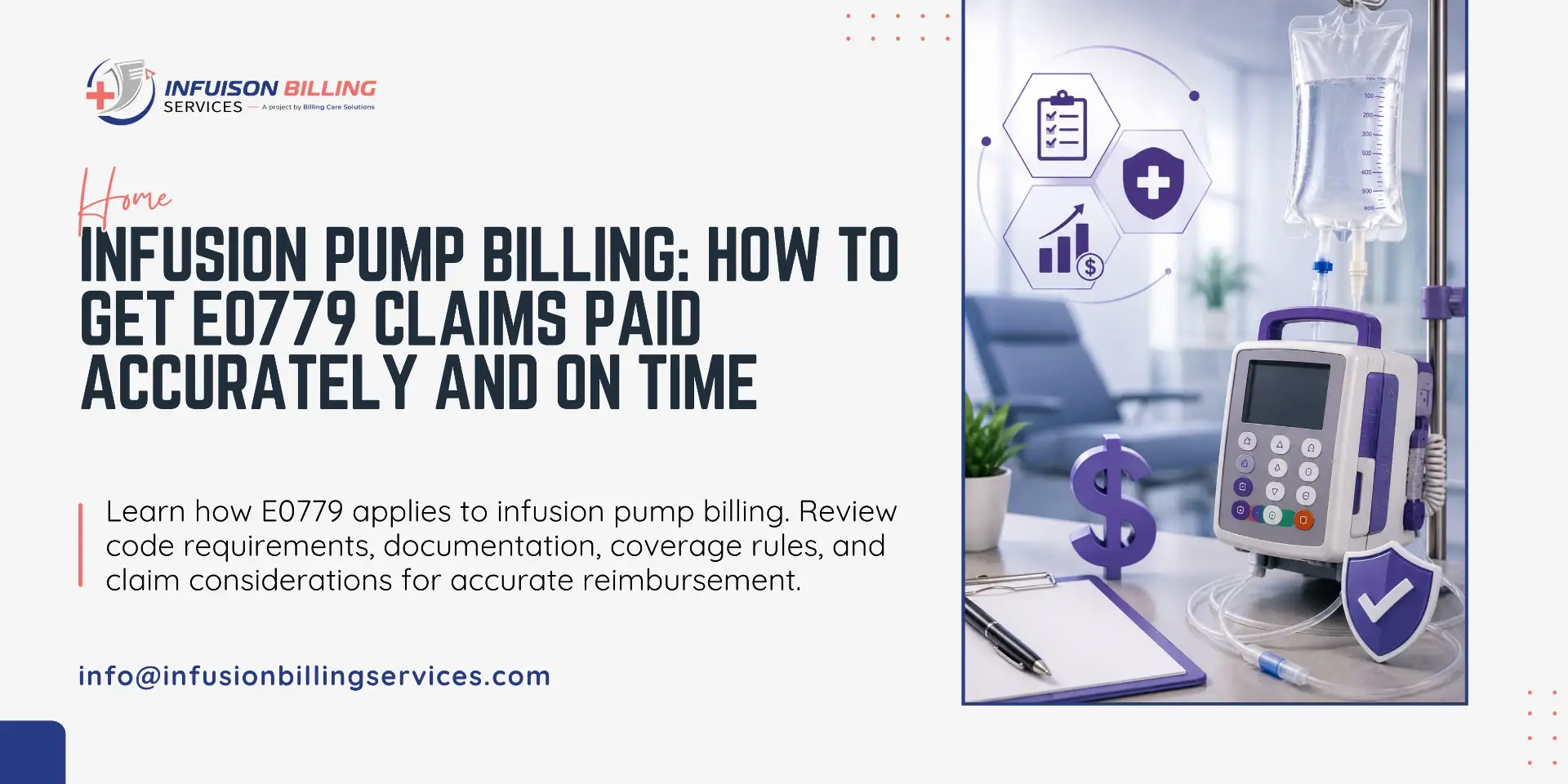
Home Infusion Pump Billing: How to Get E0779 Claims Paid Accurately and On Time
The E0779 HCPCS code refers to a specific infusion pump for home infusion therapy. HIPAA compliant coding aids infusion providers to report durable medical equipment accurately. It also enables the proper reimbursement and discourages unnecessary claim issues.
Selecting the right HCPCS code is just the beginning of infusion pump billing. Providers are responsible for documenting, coverage criteria, medical necessity, and payer-specific billing rules. Any mistakes can lead to denials, delayed payments, or further documentation requests.
This guide will provide you with an explanation of the E0779 HCPCS code, what it requires to be billed, what to consider for reimbursement, common errors, and documentation expectations. It also outlines what the successful DME and infusion billing workflows look like and how they contribute to improved revenue performance.
What Is the E0779 HCPCS Code?
The E0779 HCPCS code is for ambulatory infusion pumps with administration set, continuous or intermittent administration, including portable or implantable pump applications (as described under the code definition). HCPCS Level II codes are codes for medical equipment and supplies, drugs, and services that are not part of the CPT code structure. These codes are used by DME suppliers and healthcare organizations in the claiming process for eligible DME. Providers are reminded to check the HCPCS Code Descriptor prior to claiming. Equipment eligibility for coverage and reporting related services are dependent on the policies of the payers.
What Are the E0779 Billing Requirements?
Billing for E0779 requires accurate documentation and appropriate coverage verification. The claim should demonstrate that the equipment meets the patient’s medical needs. Supporting records should also establish the clinical reason for the infusion pump.
Before billing, teams should verify several key elements:
| Billing Area | What To Verify |
| HCPCS code | Confirm the correct E0779 code |
| Medical necessity | Confirm the pump supports documented treatment |
| Physician order | Verify a valid order or prescription |
| Patient information | Confirm demographics and insurance |
| Payer coverage | Review applicable DME benefits |
| Documentation | Ensure required records are complete |
| Modifiers | Apply applicable modifiers correctly |
| Billing frequency | Follow payer-specific rental or purchase rules |
| Authorization | Confirm prior authorization when required |
| Claim submission | Validate all claim details before submission |
These checks are to take place prior to claim transmission. A pre-billing review can help find coverage issues and missing documents early.
When Does E0779 Meet Medical Necessity?
Medical necessity is dependent on the patient’s treatment needs and the criteria on payment coverage by payers. The clinical record should justify the need for an infusion pump in the therapy prescribed. The documentation should connect the patient’s condition with the prescribed infusion treatment. It should also support the need for pump-assisted administration rather than an alternative method.
Payers often review medical necessity before approving DME claims. Coverage requirements differ among Medicare, Medicaid, and commercial insurance plans. Providers should never assume that a documented prescription automatically guarantees reimbursement. Coverage verification remains an important step before equipment delivery and claim submission.
What Documentation Supports E0779 Claims?
Strong documentation supports both medical necessity and claim accuracy. Missing records create unnecessary delays during payer review. Infusion providers should maintain consistent documentation throughout the billing process.
Important documentation often includes:
| Documentation | Purpose |
| Physician order | Establishes the prescribed equipment |
| Diagnosis documentation | Supports medical necessity |
| Treatment plan | Explains the infusion therapy |
| Infusion schedule | Establishes administration requirements |
| Equipment details | Supports the billed DME |
| Patient records | Confirms clinical circumstances |
| Coverage verification | Documents payer eligibility |
| Authorization records | Supports required payer approval |
| Delivery documentation | Confirms equipment provision |
| Claim records | Supports submitted billing information |
Documentation requirements vary by payer. Billing teams should follow the applicable Medicare, Medicaid, or commercial payer policy.
How Does E0779 Apply to Home Infusion?
Home infusion therapy creates unique billing challenges because several services might occur within one treatment episode. Equipment, drugs, supplies, nursing services, and professional services often involve different billing rules. The E0779 HCPCS code should therefore be evaluated within the complete home infusion workflow. Billing teams should distinguish equipment charges from drug and administration services.
A single infusion episode might involve multiple claim lines. Each line requires appropriate coding and supporting documentation. Teams should avoid combining unrelated services under one billing code. Payer contracts also influence reimbursement. Commercial plans might establish different coverage rules than Medicare or Medicaid. Verification should occur before services begin whenever possible.
What Affects E0779 Reimbursement?
Reimbursement for E0779 is subject to the patient’s eligibility, the criteria for coverage, payment methodology, billing status, and also to the policy of the payer. The billed amount will not be the final amount that may be allowed for reimbursement. DME billing often involves specific rules for rental periods, purchase options, modifiers, and documentation. These requirements vary based on payer and equipment classification. Infusion providers should monitor reimbursement at the claim level. Comparing expected payment with actual remittance amounts helps identify recurring underpayments and billing problems.
A strong reimbursement workflow should track:
- Submitted charges
- Allowed amounts
- Contractual adjustments
- Patient responsibility
- Denials
- Payment delays
- Underpayments
- Appeals
- Final collections
This analysis helps providers identify financial leakage associated with infusion pump billing.
What E0779 Billing Errors Cause Denials?
Billing errors frequently happen because teams do not take the time to read the whole claim, and just rely on the HCPCS code. To have accurate reporting of E0779 requires coordination between clinical documentation and billing operations.
Incorrect HCPCS Code Selection: The incorrect DME code may lead to claim rejection or denial. Teams are advised to check the current code descriptor before submitting claims.
Missing Medical Necessity Documentation: Payers require documentation of the equipment’s clinical necessity. Without documentation, there may be further requests for information or denials of claims.
Incorrect Modifiers: DME claims frequently require specific modifiers depending on billing circumstances. Unsupported or missing modifiers can affect claim adjudication.
Billing Without Coverage Verification: Providers should verify coverage before supplying equipment. Patient eligibility alone does not confirm coverage for every infusion pump.
Missing Authorization: Some payers require prior authorization for DME equipment. Failure to obtain required approval can place reimbursement at risk.
Incorrect Billing Frequency: Rental and purchase rules can affect billing frequency. Teams should follow the specific payer’s requirements rather than applying one standard workflow.
How Can Providers Prevent E0779 Denials?
Denial prevention should begin before the claim reaches the payer. Infusion providers should establish a consistent verification process for every pump claim. Start with insurance eligibility and benefits verification. Then confirm DME coverage and authorization requirements. Review the physician order and supporting clinical documentation before equipment delivery. After the claim is prepared, conduct a final coding review. Verify the HCPCS code, modifiers, diagnosis codes, units, dates, and payer-specific requirements. Denial data should also feed back into the billing process. If the same issue appears repeatedly, correct the workflow instead of handling each denial separately.
How Does E0779 Affect Revenue Cycle Performance?
E0779 billing affects revenue cycle performance beyond individual claim reimbursement. Coding errors can increase denials, rework, payment delays, and accounts receivable balances. For CFOs, recurring billing problems can create measurable revenue leakage across infusion operations. A structured workflow helps identify these problems before claims reach the payer. For management, E0779 performance should connect billing accuracy with financial outcomes. Teams should monitor documentation gaps, authorization issues, coding errors, and payer-specific problems. These metrics help identify whether revenue leakage comes from isolated claims or recurring workflow failures.
| KPI | Industry Reference or Example | Recommended Management Target |
| Clean claim rate | 98% or higher | At least 98% |
| Initial denial rate | Below 5% | Below 5% |
| A/R days | 42 days, HFMA Q1 2025 data | Below 40 days |
| Denial overturn rate | Above 60% | Above 60% |
| Denial write-offs | 1.4% of net patient revenue | Below 1.4% |
| Appeal efficiency | Above 75% | Above 75% |
| E0779 underpayment rate | Provider-specific measurement | Establish payer baseline |
HFMA materials recognize an initial denial benchmark of <5% and a clean claim benchmark of ≥98%. Additionally, HFMA’s KPI data for Q1 2025 showed 42.0 A/R days and denial write-offs of 1.4% of net patient revenue. These are general revenue cycle benchmarks, not E0779-specific reimbursement standards. Actual performance may differ depending on the payer contracts, number of patients, coverage rules and the provider’s billing model.
Consider an illustrative provider submitting 500 E0779 claims monthly. Reducing the denial rate from 8% to 5% lowers denied claims from 40 to 25 monthly. Using an illustrative $500 average allowed amount, this represents $7,500 less revenue entering the denial workflow each month. The goal is not simply increasing claim volume. Providers should ensure each E0779 claim meets coding, documentation, coverage, and authorization requirements. Strong controls reduce preventable leakage and improve the financial performance of infusion billing.
How Infusion Billing Services Supports E0779 Billing
Infusion Billing Services offers dedicated billing solutions for infusion providers and healthcare companies. There has to be coordination between coding and documentation, payer requirements, claims submission, and reimbursement follow-up to achieve effective billing.
The E0779 HCPCS code is just a step in the process of invoicing for infusion. Drug billing, administration services, DME, authorizations, claim edits, and payer-specific rules are among the other areas that teams need to handle.
Providers can benefit from infusion billing services by incorporating billing processes that prioritize claim preparation and follow-up for reimbursement. This method can minimize preventable billing mistakes and enhance visibility of the revenue.
Our Infusion Billing Approach
| Billing Area | Focus |
| Eligibility verification | Confirm active coverage |
| DME coverage | Review equipment benefits |
| Authorization | Verify payer approval requirements |
| Coding | Validate applicable HCPCS codes |
| Documentation | Review medical necessity records |
| Claims | Submit accurate billing information |
| Denials | Identify root causes |
| A/R | Follow up on outstanding balances |
| Underpayments | Compare payments against expectations |
| Reporting | Monitor revenue cycle performance |
Equipment billing should be part of the revenue cycle for infusion providers. A collaborative effort results in better claim quality, enhanced reimbursement transparency, and better claims control.
Final Takeaway
The E0779 HCPCS code requires accurate coding, complete documentation, and payer-specific billing knowledge. Providers should verify medical necessity and coverage before submitting claims. Strong billing processes reduce preventable denials and payment delays. They also help identify underpayments and recurring payer issues. For infusion providers, equipment billing should remain connected to the broader revenue cycle. A coordinated approach improves claim quality, reimbursement visibility, and financial control. Infusion Billing Services provides providers with specialized infusion billing and revenue cycle support to help them meet these needs.
Frequently Asked Questions
What does the E0779 HCPCS code cover?
The code E0779 is used for an infusion pump for certain therapy administration. Coverage is subject to medical necessity, documentation, equipment necessary and payer policies.
What documentation supports E0779 billing claims?
The equipment and medical necessity need to be documented for E0779 billing. Providers should keep orders and treatment records, coverage information, authorization records, and delivery documentation.
Does E0779 require prior authorization from payers?
Requirements for prior authorization differ among payers and patient coverage. Providers should check on the eligibility for DME benefits and any specific authorization requirements prior to providing the equipment and claiming DME.
How does E0779 affect infusion reimbursement?
The reimbursement of E0779 is subject to applicable payment rules, authorization, documentation, and payer coverage. Failure to meet requirements could result in delayed payment or in claims being denied.
What causes E0779 claims to get denied?
Typical issues are improper coding, incomplete documentation, authentication issues, coverage restrictions, wrong modifiers, and not meeting certain medical necessity requirements that are specific to the payer.
How should providers verify E0779 coverage?
Billing teams should ensure that the patient is eligible for this equipment, the DME benefits are covered, medical necessity guidelines are satisfied, authorization guidelines are met, and coverage policies are followed by the specific payers prior to delivery and claim submission.
Can E0779 billing involve different payers?
Yes, E0779 claims might involve Medicare, Medicaid, or commercial insurance. There are specific requirements in terms of coverage, documentation, authorization and reimbursement for equipment billing requirements for each of the payers.
How can providers reduce E0779 denials?
All of this should be confirmed prior to submitting claims: coverage, authorization, documentation, coding, modifiers and payer requirements. The need to improve workflow and educate staff should be driven by trends of denial.
Which metrics should track E0779 performance?
Providers should be looking for clean claim rate, denial rate, A/R days, underpayment rate, appeal success and net collections. They indicate recurring financial losses.
How does E0779 affect revenue cycle performance?
E0779 billing impacts denials, A/R, payment delays, staff workload and collections. Precise workflows minimize the risk of preventable mistakes and offer greater visibility when it comes to infusion revenue performance.