
How We Reduced N30 Denials by 78% and Recovered Delayed Payments
August 17, 2026
Missed Infusion Charges Caused $145K in Lost Revenue. Here’s How We Fixed Them
August 18, 2026How We Reduced N30 Denials by 78% and Recovered Delayed Payments
August 17, 2026Missed Infusion Charges Caused $145K in Lost Revenue. Here’s How We Fixed Them
August 18, 2026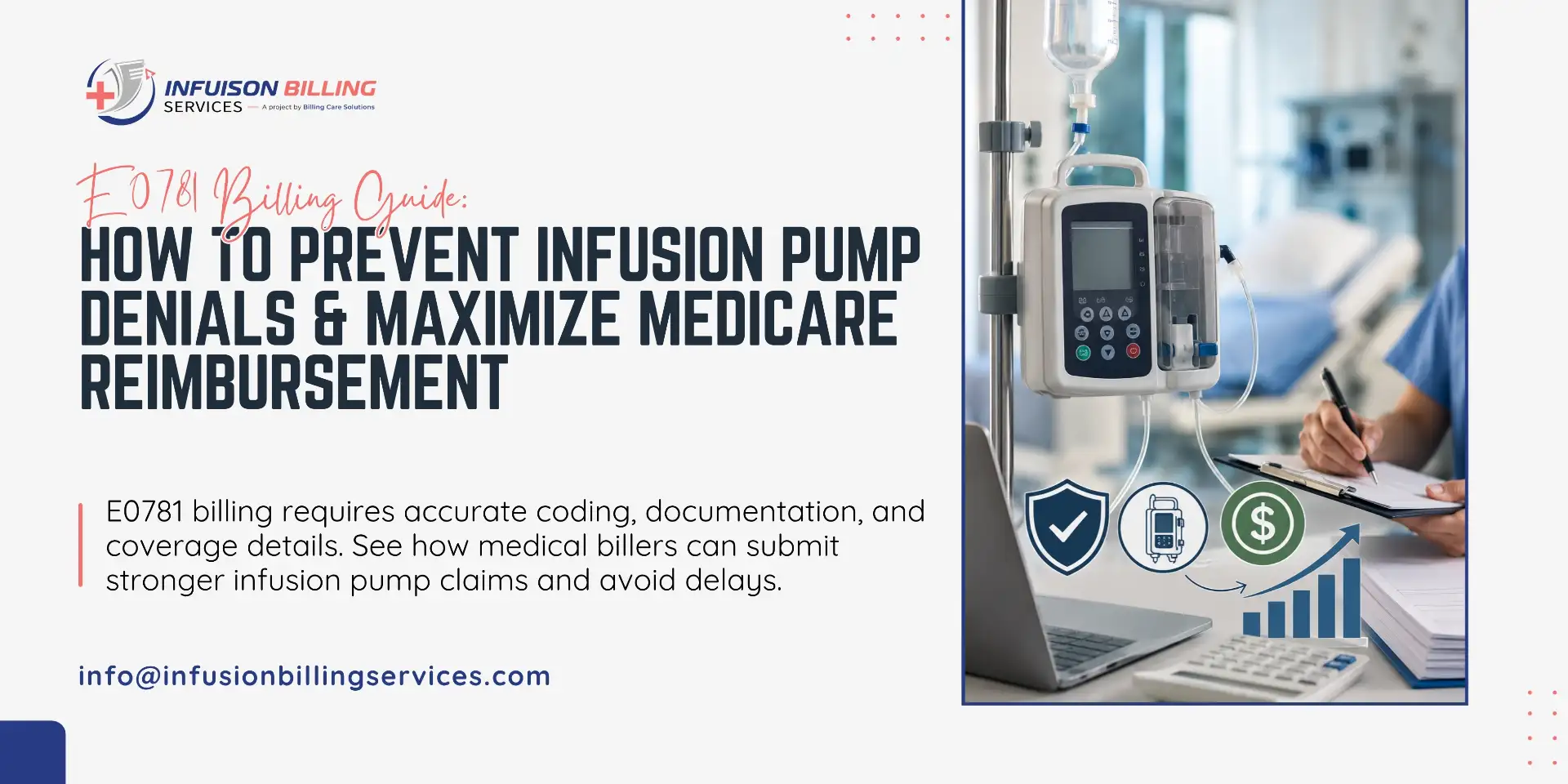
E0781 Billing Guide: How to Prevent Infusion Pump Denials & Maximize Medicare Reimbursement
Infusion pump billing requires more than selecting the correct HCPCS code. The claim must be supported by the pump, the medication, the supplies, medical necessity, medical documentation and the modifiers. For infusion providers and DME suppliers, any incorrect billing for the E0781 poses a number of financial risks. Claims may be denied due to missing modifiers, wrong supply codes, lack of medical necessity, or lack of consistency in documentation.
The impact continues after the initial claim. Billing errors, if repeated, result in higher A/R, rework, slow reimbursement and make collection forecasting less reliable. This guide provides an overview of the billing requirements for E0781, supplies associated with this code, modifier rules, documentation requirements and common denial risks.
What Is E0781 in Infusion Pump Billing?
The HCPCS level 2 code for an external ambulatory infusion pump is E0781. The device is defined as producing single or multiple channels, being electric or battery powered, and for delivering parenteral drugs at a regulated flow rate, according to CMS. It is compact, lightweight and portable to be carried by the beneficiary. This code is for the infusion pump. It does not represent the infused medication.
If the drug is separately billable it must be reported with its HCPCS code. Related infusion supplies also have separate HCPCS codes. This distinction aids billing teams to distinguish the key claim components:
| Billing Component | What It Represents | Billing Consideration |
| E0781 | External ambulatory infusion pump | Reports the qualifying pump |
| Drug HCPCS | Medication administered or supplied | Report the applicable drug code |
| A4222 or K0552 | External pump supplies | Select the applicable supply code |
| A4221 | Catheter maintenance supplies | Report when applicable |
The billing record should ensure consistency of the pump, drug, supplies, diagnosis and clinical documentation.
When Is E0781 Used?
E0781 is for a qualifying external ambulatory infusion pump for covered ambulatory infusion treatments under the applicable Medicare coverage requirements. An infusion pump is not the only signifier of use. The billing staff is responsible for deciding if the pump, therapy, indication, and documentation meet the coverage criteria. The currently available External Infusion Pumps LCD from CMS lists covered indications for this code and other codes assigned to external pumps. Specific therapies including certain chemotherapy, cancer related pain therapy and other specified indications. Coverage is dependent on the requirement for the specific indication.
E0781 also should not be separately reported in every setting where a pump is used. For example, hospital outpatient billing follows different payment rules when the pump functions as a supply during an outpatient service. The billing team should review the applicable OPPS guidance before separately reporting the pump.
E0781 vs. Other Infusion Pump Codes
Selecting the correct pump code requires identifying the device type and intended use.
| HCPCS Code | Pump Type | Key Distinction |
| E0779 | Ambulatory infusion pump | Mechanical ambulatory pump |
| E0780 | Ambulatory infusion pump | Mechanical pump for shorter infusion periods |
| E0781 | External ambulatory infusion pump | Electric or battery-operated pump |
| E0784 | External ambulatory insulin pump | Designed for insulin |
| E0791 | Stationary infusion pump | Larger pump typically mounted on a pole |
The billed HCPCS code should match the actual equipment furnished and the applicable coverage requirements.
E0781 Billing Requirements
Accurate billing requires more than confirming the pump model. The billing team should validate the pump, therapy, coverage criteria, documentation, drug, supplies, and applicable modifiers before claim submission. CMS requires the appropriate KX, GA, or GZ modifier on applicable external infusion pump claim lines. Claims submitted without one of these modifiers are rejected as missing information.
A practical pre-billing review should include:
| Billing Requirement | What to Verify | Revenue Risk |
| Pump | Device matches E0781 | Incorrect coding |
| Coverage | Applicable criteria are met | Medical necessity denial |
| Drug | Medication matches treatment | Claim inconsistency |
| Diagnosis | Supports the applicable therapy | Coverage review |
| Documentation | Records support the claim | Payment delay |
| Modifier | Correct modifier is reported | Claim rejection |
| Supplies | Correct associated code is used | Coding error |
This review helps identify discrepancies before claims reach the payer.
E0781 Modifier Requirements
Modifier accuracy is critical for E0781 claims. The modifier should reflect the actual coverage and administration circumstances.
KX Modifier
The KX modifier indicates the applicable coverage criteria have been met. CMS requires KX on applicable external infusion pump claim lines when all requirements in the related LCD have been satisfied. Suppliers must retain evidence supporting the KX modifier and provide it to the DME MAC when requested. Do not append KX automatically. The underlying documentation must support its use.
GA Modifier
GA applies when a medical necessity denial is expected and a properly executed Advance Beneficiary Notice has been obtained. The ABN must support the applicable Medicare requirements before GA is reported.
GZ Modifier
GZ applies when a service is expected to be denied as not reasonable and necessary and a valid ABN was not obtained. CMS requires GA or GZ when the applicable coverage criteria are not met, depending on whether a valid ABN was obtained.
JB Modifier
JB has a specific role for certain immune globulin claims. For immune globulin J1551, J1558, or J1575 and the associated with this code pump, CMS requires the JB modifier when the route of administration is subcutaneous. The JB modifier should be added to each applicable HCPCS code. This requirement is route-specific. It should not be applied to every claim of this code.
Common E0781 Billing Errors
This codes claims often fail because billing elements are reviewed separately instead of as one claim workflow.
Billing the Wrong Pump
A supplier might report E0781 when the furnished device belongs to another pump category. This creates a coding mismatch. The HCPCS code should correspond with the equipment actually furnished.
Reporting Incorrect Supply Codes
CMS identifies A4221 as a catheter maintenance supply code applicable during covered pump use. A4222 and K0552 are external infusion pump supply codes. The current CMS policy lists K0552 as associated with E0781. This is an important correction from older billing guidance. For E0781, suppliers should also recognize the distinction between A4222 and K0552. CMS states that either A4222 or K0552 may be billed for applicable pumps, but not both. Using insulin pump supply codes with an E0781 claim also creates an incorrect coding issue. CMS states that A4224 and A4225 are not appropriate for external infusion pumps other than E0784.
Missing Required Modifiers
Applicable claims require KX, GA, or GZ based on the coverage circumstances. Missing the required modifier results in rejection as missing information.
Unsupported Medical Necessity
Its coverage depends on the applicable indication and medical necessity requirements. When documentation does not establish those requirements, the claim becomes vulnerable to denial.
Incorrect Drug and Pump Pairing
The medication should match the treatment record and applicable billing requirements. A mismatch between the drug, diagnosis, pump, and documentation creates unnecessary payer scrutiny.
Incorrect Supply Selection
Supply billing requires attention to the type of external pump and the supplies actually furnished. For example, CMS bases A4222 and K0552 coverage on the applicable cassette, bag, or syringe used with the external pump.
How E0781 Denials Affect Infusion Revenue
Denials create more than delayed payments. Each rejected or denied claim requires staff time for investigation, correction, resubmission, or appeal. Repeated errors also increase A/R and reduce the predictability of monthly collections.
The financial impact typically appears in four areas:
| Revenue Impact | What Happens | Financial Consequence |
| Claim rejection | Missing or incorrect information | Delayed payment |
| Medical necessity denial | Coverage requirements are unsupported | Revenue recovery work |
| Coding error | Incorrect pump or supply code | Claim correction |
| Payment delay | Claim requires additional review | Higher A/R |
If the claim is denied again, there is also a work flow issue. When several claims are failing on the same issue, fixing each claim won’t fix the issue as a whole. There should be a focused edit/review point in the billing pr
E0781 Documentation Requirements for Infusion Billing
Documentation should be supportive of the Pump, Therapy, Medical Necessity and pertinent Claim Data. This will vary with the therapy and Medicare coverage criteria that are involved.
A good documentation review should be able to verify:
| Documentation Element | What It Should Support |
| Diagnosis | Condition requiring treatment |
| Treatment plan | Medical reason for therapy |
| Drug information | Medication being administered |
| Pump information | Device furnished to beneficiary |
| Administration details | How therapy is delivered |
| Medical records | Applicable coverage criteria |
| ABN documentation | GA reporting when required |
CMS states that evidence supporting the KX modifier must be retained in the supplier’s records and made available to the DME MAC upon request. The documentation should tell the same story as the claim. If the clinical record describes one treatment while the claim reports another pump, drug, or supply, payment becomes harder to defend.
How to Prevent E0781 Claim Denials
Preventing denials starts with validating the claim before submission. Billing teams should confirm the pump, therapy, documentation, supplies, and modifiers align with Medicare requirements.
Verify Pump and Therapy
Confirm the equipment meets its requirements and supports the documented therapy. Review the drug, diagnosis, route of administration, and treatment record together. This reduces mismatches between clinical documentation and claim data.
Review Documentation and Medical Necessity
Ensure clinical records support the applicable coverage indication and medical necessity requirements. Do not treat documentation review as a final administrative step. It should occur before the claim reaches the payer.
Validate Supplies and Modifiers
Check whether A4222 or K0552 applies to the supplies furnished. Confirm the selected supply code matches the pump and actual equipment used. Review KX, GA, GZ, and any applicable drug-specific modifier requirements before submission.
Scrub and Monitor Claims
Run claims through pre-submission edits designed around recurring errors. After payment, monitor denials, adjustments, and reimbursement variances. Track recurring patterns by payer, pump, drug, modifier, and denial reason. This creates a feedback loop between claim submission and revenue recovery.
How Infusion Billing Services Supports E0781 Billing
Infusion Billing Services supports infusion providers with specialized revenue cycle workflows built around infusion-specific billing requirements. Billing requires coordination between equipment coding, drug billing, supply reporting, documentation, modifiers, and payer requirements. A specialized billing workflow connects these elements before submission.
| RCM Area | E0781 Support | Financial Benefit |
| Coding review | Validates pump and supply codes | Fewer coding errors |
| Documentation review | Checks coverage support | Lower denial risk |
| Modifier review | Validates applicable modifiers | Fewer claim rejections |
| Claim scrubbing | Identifies predictable errors | Better claim quality |
| Denial management | Investigates denials | Stronger revenue recovery |
| A/R follow-up | Tracks unpaid claims | Faster collections |
| Payment analysis | Reviews reimbursement variances | Underpayment identification |
The objective is not simply to submit claims. The objective is to maintain consistency between the pump, drug, supplies, documentation, modifiers, and payer requirements throughout the revenue cycle.
Conclusion
E0781 billing requires coordination across coding, documentation, coverage review, and revenue cycle management. The code describes an external ambulatory infusion pump. The medication and applicable supplies require separate billing under their respective HCPCS codes.
Claims should be monitored by infusion providers following adjudication. A claim that is processed doesn’t necessarily get reimbursed properly. Infusion Billing Services makes it easy to link coding review, documentation validation, claim scrubbing, denial management, A/R follow-up and payment analysis. This workflow is designed to minimize avoidable billing errors and to help with the ability to control reimbursement.
Frequently Asked Questions
Can E0781 and A4222 bill together?
A4222 and K0552 both represent applicable external infusion pump supplies for covered therapy. CMS requires suppliers to report one applicable supply code, rather than both when applicable.
Is K0552 required with every E0781?
K0552 is an associated supply code for applicable E0781 claims under current Medicare policy. Its use depends on furnished supplies and applicable coverage requirements for billing.
When does E0781 require modifier JB?
JB applies when specific immune globulin drugs are administered subcutaneously through an E0781 pump. CMS identifies J1551, J1558, and J1575 for this route-specific billing requirement on applicable claims.
Can hospitals separately bill E0781 pumps?
Hospital outpatient departments should review applicable OPPS payment rules before separate E0781 billing decisions. Pump costs might already receive payment through the outpatient service under OPPS rules.
What supplies are associated with E0781?
Associated supplies include A4221, A4222, and K0552 for applicable external pump billing circumstances. The correct supply code depends on equipment furnished and applicable coverage requirements for claims.
Does E0781 cover the infused medication?
E0781 represents the external ambulatory infusion pump itself, rather than the medication administered. Separately billable drugs require appropriate HCPCS codes and supporting coverage documentation when separately billable.
How does KX support E0781 reimbursement?
KX indicates applicable external infusion pump coverage requirements have been satisfied for the claim. Supporting documentation should remain available for DME MAC review during claim review.
When should GA replace KX on E0781?
GA applies when a medical necessity denial is expected and a valid ABN exists. The claim should follow applicable Medicare reporting requirements for GA billing situations.
What causes E0781 supply code denials?
Supply denials often involve incorrect code selection, duplicate reporting, or mismatched supplies on claims. Missing documentation also creates additional payment review and reimbursement delays for providers.
How should teams audit E0781 claims?
Teams should audit pump codes, supplies, modifiers, documentation, and coverage criteria before submitting claims. They should also review drug pairing, denials, and payment variances after adjudication.