

Site-of-Care Restrictions Are Costing Infusion Providers Millions: Here’s How One Turned It Around
September 30, 2026
How an Infusion Provider Renegotiated PPO Contracts and Recovered $180K in 12 Months
October 1, 2026Site-of-Care Restrictions Are Costing Infusion Providers Millions: Here’s How One Turned It Around
September 30, 2026How an Infusion Provider Renegotiated PPO Contracts and Recovered $180K in 12 Months
October 1, 2026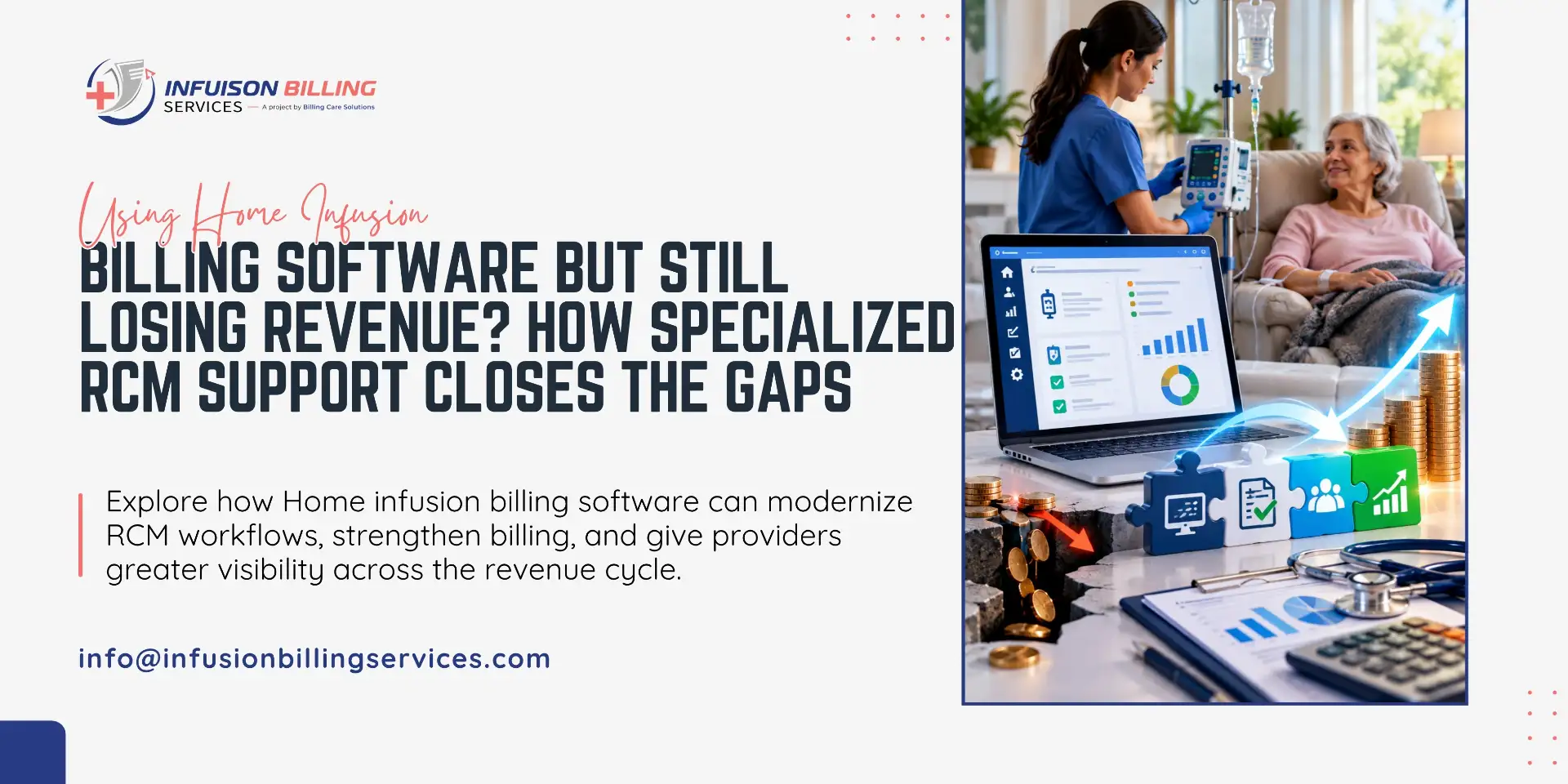
Using Home Infusion Billing Software But Still Losing Revenue? How Specialized RCM Support Closes the Gaps
The claims are visible in your home infusion billing software as submitted, denials are tracked and A/R balances are outstanding. However, revenue can be lost if the authorization is not available for the units billed, documentation is not available for the service rendered, or the payer pays less than the biller expects.
A software is used to conduct the transaction. The team still needs to decide why a high-value claim went bad, if a payment is correct, and what they need to do to recover the balance. If not followed up at regular intervals, unresolved claims will be added to older A/R and repeated claims issues will persist.
Specialized RCM support comes into play here, as it helps close that automated billing to revenue recovery gap. Infusion Billing Services will integrate with your current home infusion billing software and audit claims, resolve payer problems, handle denials, find variance with payment amounts, and chase missing revenues.
What Does Home Infusion Billing Software Already Automate?
Modern Home infusion billing software integrates clinical, pharmacy, operations and financial workflows. The specifics of what can be accomplished vary from platform to platform, but most look to minimize manual effort and enhance billing transparency. Knowing these abilities will enable you to determine where technology’s limitations and specialized RCM execution meet.
Brightree Pharmacy
Brightree Pharmacy supports home infusion and pharmacy workflows across referrals, patient intake, billing, receivables, reporting, clinical workflows, analytics, and pharmacy operations. Its platform connects multiple activities across the revenue cycle. This gives organizations a technology foundation for managing information from intake through billing and receivables. However, centralized information does not automatically resolve payer exceptions. Someone still needs to review claims requiring additional documentation, authorization clarification, correction, or payer follow-up.
WellSky CareTend
WellSky CareTend supports home infusion and specialty pharmacy operations. Its published capabilities include intake, dispensing, delivery, billing, revenue management, scheduling, reporting, compliance, and patient care management. This shows how home infusion billing software can connect clinical and financial workflows. It also demonstrates why billing technology remains only one component of the broader revenue cycle. A system can process information according to configured rules. It cannot independently resolve every payer-specific exception.
AlayaCare Home Infusion
AlayaCare integrates referral management, clinical documentation, scheduling, care delivery, pharmacy coordination and billing. This integration can help decrease information gaps for organizations that are working with home infusion billing software in link with clinical systems. Clinical and operational data can be closer to billing more efficiently. The only other hurdle is making sure the information is complete, accurate and authorized for submission to payers.
WeInfuse
WeInfuse takes an infusion-specific approach to billing automation. Its platform can generate procedure and medication billing codes using clinical documentation, inventory selections, and administration times. It also provides billing visibility for completed treatments and their billing status. This allows home infusion billing software to support more of the process between treatment documentation and claim submission. Automated coding doesn’t eliminate the need for professional review, however. Complex claims still need to be claimed with payer rules, documentation, authorization, units, and reimbursement still to be considered.
If Your Software Handles Billing, Where Is Revenue Still Being Lost?
A home infusion billing software platform cannot automate the claim workflow without ensuring that there is a 100% reimbursement. Revenue can still be lost due to incorrect authorizations, coding mistakes, missing documentation, payer’s requirements, denials, under payments and A/R follow up delays. This is where software capability and RCM execution come into play.
Automated Claims Still Need Expert Review
While claim automation cuts down repetitive tasks, it does not ensure that each claim captures the actual services rendered. ICD-10-CM diagnosis information, HCPCS codes, CPT services, units, modifiers, place of service, authorization details and supporting documentation may be required for a home infusion claim. The system can process configured edits. An experienced RCM team still needs to determine whether the claim information supports reimbursement under applicable payer requirements.
Authorization Mismatches
Authorization tracking is useful when approved services match the services being billed. Problems occur when an authorization expires, approved units differ from billed units, the drug changes, or service dates fall outside the approved period. Your home infusion billing software can display authorization information. It cannot replace staff responsible for resolving mismatches with the payer or authorization team.
Software Displays Denials But Someone Must Recover Them
A denial dashboard provides visibility into unpaid claims. It does not necessarily determine the correct recovery strategy. A dedicated RCM team investigates claims, reviews claims, verifies documentation, decides if a claim can be corrected or appealed, and takes follow-up actions with the payer. The difference is simple. Software identifies the problem. RCM execution works toward resolving it.
What Home Infusion Billing Software Cannot Do Alone?
| Software Capability | Remaining RCM Requirement |
| Claim scrubbing | Complex claim review |
| Authorization tracking | Authorization resolution |
| Denial alerts | Denial recovery |
| A/R dashboard | Payer follow-up |
| Payment posting | Underpayment analysis |
| Coding automation | Expert coding review |
| Claim status tracking | Escalation and resolution |
| Financial reporting | RCM interpretation |
| EHR integration | Data-quality oversight |
| Workflow automation | Exception management |
Your home infusion billing software provides the infrastructure for these activities. Specialized RCM support provides the human review and follow-through required when automated workflows encounter exceptions.
Where Revenue Leakage Happens After Software Implementation?
Implementing home infusion billing software changes how information moves through your organization. It does not eliminate every point where revenue can be delayed, reduced, or lost.
The most important gaps often appear between automated steps.
Authorization Leakage
Authorization leakage starts when approved services and billed services stop matching. A claim might contain an authorization number but still fail because the units, drug, dates, or services differ from the approved request. Your RCM team should review these details before submission whenever possible. Recurring authorization problems should also be tracked so the organization can address their underlying causes.
Coding Leakage
Even if the claim successfully passes through the billing system, there may be coding errors that impact reimbursement. Diagnosis specificity, HCPCS codes, CPT codes, units, modifiers, place of service, supporting documentation are all elements of the review. Part of this process can be automated with home infusion billing software. Even for more complex cases, there is a need for experienced review as payers have not standardized the requirements to be simply automated.
Documentation Leakage
Clinical documentation supports the services reported for reimbursement. Missing administration details, incomplete treatment notes, inconsistent dates, or unsupported services can create problems after submission. Your home infusion billing software can connect documentation with billing workflows. It cannot independently determine whether every clinical record adequately supports the specific claim.
Denial Leakage
Denial leakage occurs when unpaid claims after the first claim payment response. Denial reporting delivers visibility, but it’s only the beginning of the recovery process. As it’s about investigation, correction, reviewing documentation to recover, appeals where applicable, communicating with the payer and continued tracking. Your infusion revenue cycle should therefore measure more than denial volume. It should also measure recovery, turnaround time, recurring causes, and unresolved balances.
Underpayment Leakage
A paid claim is not automatically a correctly paid claim. Payment review compares expected reimbursement with actual payment received. Significant variances can then be investigated for contractual, coding, authorization, processing, or other reimbursement issues. This becomes especially important for high-value infusion services. Small payment differences can accumulate when they occur repeatedly across large claim volumes.
A/R Leakage
A/R dashboards show outstanding balances. They do not perform payer follow-up. Older claims often require documentation review, corrected claims, appeals, payer escalation, or additional status checks. A home infusion billing software platform can organize these balances. Your RCM team must still determine which accounts require action and complete that action.
How Do Major Software Platforms Approach Billing Differently?
Different platforms automate different portions of the home infusion workflow. Their published capabilities show different approaches to connecting clinical, pharmacy, operational, and billing activities.
| Platform | Published Billing and Workflow Focus |
| Brightree Pharmacy | Referrals, intake, billing, receivables, reporting, clinical workflows, and pharmacy operations |
| WellSky CareTend | Intake, dispensing, delivery, billing, revenue management, reporting, scheduling, and compliance |
| AlayaCare | Referral management, documentation, care delivery, pharmacy coordination, and billing |
| WeInfuse | Infusion documentation, automated procedure and medication coding, billing status, claims, and EHR or EMR integration |
The comparison is not about selecting a universal platform. It shows why your RCM strategy should consider what happens after automated workflows complete their tasks. Your home infusion billing software may successfully generate a claim while the payer still requires additional action. That remaining work becomes an RCM responsibility.
Why Does Software Configuration Matter as Much as Selection?
Your software can only automate the rules and workflows configured within it. Payer requirements, billing rules, code configurations, authorization workflows, claim edits, work queues, reporting settings, and integrations all influence the quality of the billing process. Your home infusion pharmacy software also depends on accurate data flowing between clinical, pharmacy, inventory, authorization, and billing functions. Configuration problems can therefore create recurring issues that look like billing problems but actually originate upstream. An RCM team can identify those patterns and work with operational or technology teams to correct them.
How Does Infusion Billing Services Work With Existing Software?
The objective is not to replace your technology. The objective is to add specialized RCM support around your existing workflow. This allows your home infusion billing software to handle automation while experienced billing professionals manage exceptions.
Before Claim Submission
Revenue protection starts before the claim reaches the payer.
The RCM process can include:
- Eligibility verification
- Authorization review
- Diagnosis review
- HCPCS and CPT coding review
- Units and modifier validation
- Place of service review
- Drug and administration charge validation
- Documentation review
- Payer-specific requirement review
- Claim quality review
This approach identifies problems before they become avoidable denials.
After Claim Submission
Once claims leave your system, the revenue cycle continues. Specialized support can manage rejected claims, investigate denials, prepare corrected claims, coordinate appeals, monitor claim status, and communicate with payers. This creates an active response to reimbursement problems rather than simply recording them inside the system.
After Payment
Payment posting shouldn’t be the last check. The RCM process should also be used to examine payment accuracy, determine if there are meaningful variances, follow-up on overdue payments, and address A/R aging. This creates a connection between claim processing and actual cash collection.
Home Infusion Billing Software vs Specialized RCM Support
Software and RCM support perform different functions within the same revenue cycle.
| Home Infusion Billing Software | Specialized RCM Support |
| Automates workflows | Manages RCM workflows |
| Stores billing data | Reviews billing accuracy |
| Generates or supports claims | Reviews complex claims |
| Tracks authorization information | Resolves authorization issues |
| Displays denials | Investigates and works denials |
| Provides A/R visibility | Performs payer follow-up |
| Records payments | Reviews payment accuracy |
| Produces reports | Interprets RCM performance |
| Connects systems | Manages exceptions |
This model lets your home infusion billing software handle repetitive workflows. Specialized RCM professionals then manage decisions, exceptions, payer communication, and revenue recovery.
What RCM Metrics Should Your Software and Billing Team Track?
Your software can make revenue cycle reporting easier. The value comes from connecting those metrics with corrective action.
| Metric | What It Helps Identify |
| Clean claim rate | Claim quality before payer adjudication |
| First-pass acceptance | Claims processed without rework |
| Denial rate | Revenue exposed to payer denials |
| Days in A/R | Speed of reimbursement |
| A/R over 90 days | Aging revenue requiring attention |
| Unbilled revenue | Services not converted into claims |
| Payment variance | Potential underpayments |
| Appeal recovery | Revenue recovered through appeals |
| Claim turnaround time | Speed from service to submission |
| Net collection rate | Overall collection effectiveness |
Your infusion revenue cycle services should use these metrics to identify recurring problems, assign ownership, and measure resolution. A rising denial rate alone does not explain the underlying problem. Your team needs to examine denial categories, payer patterns, authorization issues, coding problems, documentation gaps, and recurring workflow failures.
When Should You Add Specialized Infusion Billing Support?
You may need additional support when your technology provides visibility but your team lacks the capacity to resolve what it finds.
Common warning signs include:
- Denials remain high despite automated claim workflows.
- Staff repeatedly correct the same billing problems.
- Authorization issues recur for similar therapies.
- High-value claims remain unresolved.
- A/R continues aging despite regular reporting.
- Payer follow-up consumes significant staff time.
- Payment variances are rarely reviewed.
- Reports identify problems without assigned corrective action.
- Clinical documentation does not consistently reach billing.
- Staff repeatedly enter the same information into multiple systems.
- Corrected claims continue appearing for recurring issues.
These patterns suggest an RCM execution gap rather than an immediate need to replace your software.
How Does Infusion Billing Services Close the Gaps?
Infusion Billing Services can work around your existing technology to support the revenue cycle from front-end verification through payment recovery. The process begins with eligibility and authorization. It continues through coding review, claim validation, submission, denial management, payment review, A/R follow-up, and revenue reconciliation. This creates a specialized layer around your home infusion billing software instead of forcing your organization to rebuild its technology infrastructure.
The same approach supports organizations considering outsourcing home infusion billing services. Outsourcing doesn’t have to be about leaving your platform behind or replacing your internal technology. Rather, there are billing specialists that can support the workflows your company is already utilizing. They can focus on revenue cycle tasks that require payer knowledge, billing judgment, follow-up, and resolution.
Conclusion
Your home infusion billing software may be functioning exactly as designed. The remaining revenue leakage may sit outside the automated workflow. Coding exceptions, authorization mismatches, documentation problems, payer denials, underpayments, and aging A/R still require active management. Your infusion EHR system may capture valuable clinical information. Your billing platform may convert that information into claims. Your RCM process still needs to make sure the information is complete, accurate, supported, and followed through to payment.
Replacing functional technology does not necessarily solve these problems. The more important question is whether your current RCM process has enough specialized expertise to manage everything that happens before and after automated billing. Your home infusion billing software provides the infrastructure. Specialized RCM support provides the execution around that infrastructure. Even when your organization has the technology, if claims are not being solved, denials are happening repeatedly, payments are different, or A/R is stuck. Specialized infusion revenue cycle services can fill in the gaps that your software can’t.
Frequently Asked Questions
Can software prevent every infusion denial?
No, software can flag configured errors, but complex payer exceptions still require expert review. Specialized RCM teams investigate documentation, authorization, coding, and appeal requirements thoroughly and consistently.
Why do authorized claims still get denied?
Authorization details may not match billed drugs, units, dates, or services accurately enough. RCM review identifies these mismatches before submission or during denial recovery processes consistently.
Can billing software identify infusion underpayments?
Software can record payments and highlight financial differences against expected reimbursement amounts automatically. Specialized review determines whether contractual or processing issues caused the payment variance identified.
What happens after software flags are denied?
Your team must investigate each denial, determine corrective action, and submit responses promptly. Follow-up continues until the payer resolves or appropriately adjudicates each claim completely and correctly.
Does automation replace specialized infusion billing expertise?
Automation eliminates repetitive tasks, but doesn't take the place of billing judgment altogether. Experts consistently handle complex coding, authorization exceptions, appeals, payment discrepancies and aging balances over time.
How does software configuration affect infusion reimbursement?
Incorrect rules or mappings can repeatedly create billing problems across similar claims. Regular configuration review helps align workflows with current payer and organizational requirements consistently across operations.
When should practices consider outsourcing infusion billing?
Outsource when denials, aging A/R or follow-up with payers always taxes internal resources. Specialized teams offer specialized expertise without the need for replacing current technology systems.
Can existing systems work with RCM teams?
Yes, specialized RCM teams can work around established billing and clinical systems. They strengthen review, follow-up, denial management, and payment processes without replacing core technology platforms.
What metrics reveal hidden infusion revenue leakage?
Regularly monitor denial rates, days in A/R, payment variances, unbilled revenue, and appeal recovery. These metrics capture the flow of revenue, whether it is delayed, lowered or missed, throughout workflows.
How does home infusion software support RCM?
Home infusion billing software organizes billing data, workflows, claims, and financial information efficiently. Specialized RCM support handles exceptions requiring payer communication, investigation, and revenue recovery promptly.