

Complete Guide to 96365 CPT Code for Infusion Billing Accuracy
March 11, 2026
How to Accurately Code Dehydration ICD 10 for Infusion Billing
March 13, 2026Complete Guide to 96365 CPT Code for Infusion Billing Accuracy
March 11, 2026How to Accurately Code Dehydration ICD 10 for Infusion Billing
March 13, 2026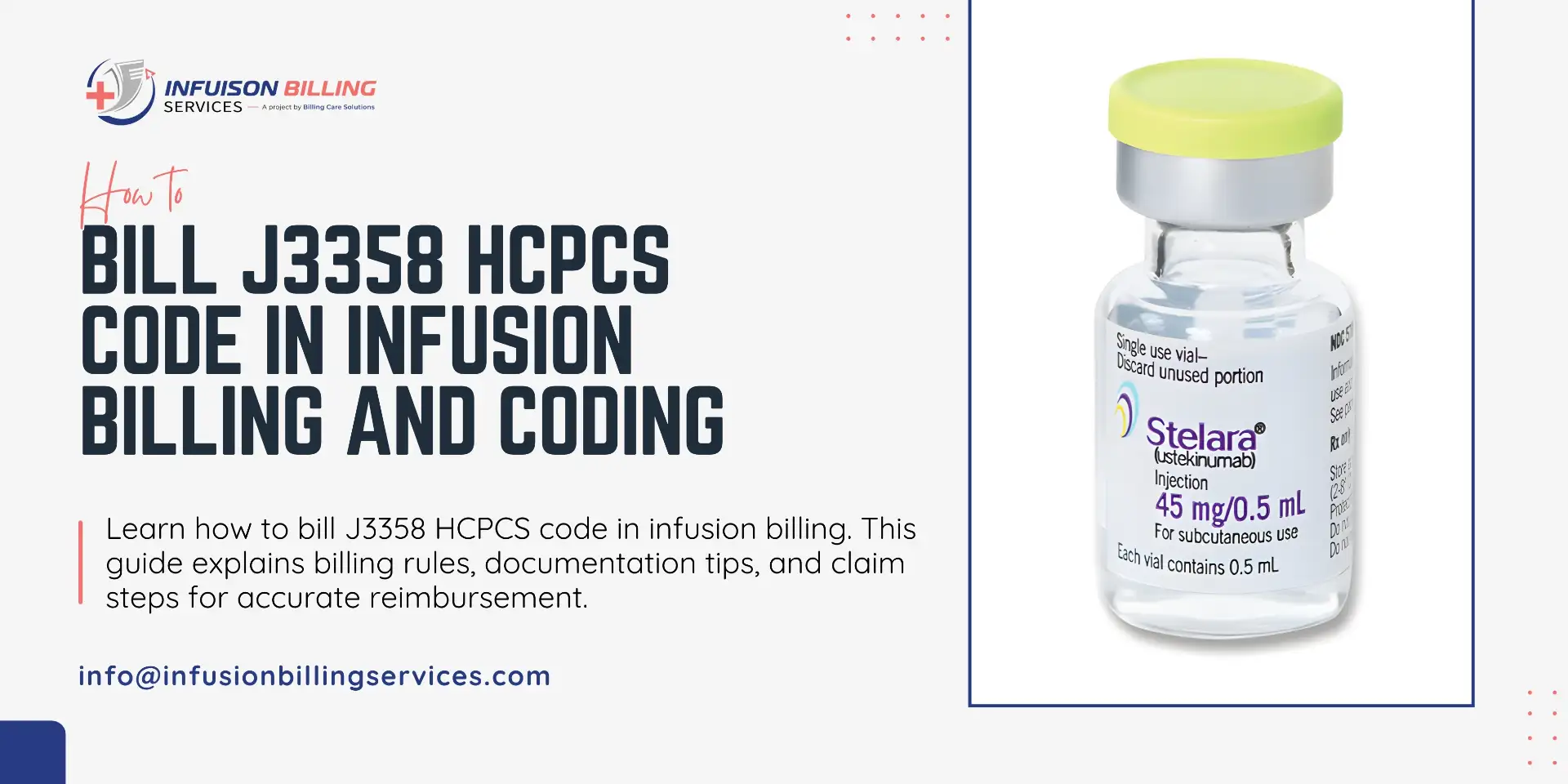
How to Bill J3358 HCPCS Code in Infusion Billing and Coding
Learn how to bill J3358 HCPCS code in infusion billing. This guide explains billing rules, documentation tips, and claim steps for accurate reimbursement.
The issue with infusion medication billing is a complicated procedure that demands accuracy and thorough knowledge of coding rules. Ustekinumab Injection is not a drug that has minimal challenges and opportunities to medical billers, coders, and practice managers. The HCPCS code J3358 depicts the intravenous type of this biologic, which is used in the treatment of such conditions as Crohn’s disease or ulcerative colitis. It is vital to your revenue cycle in the practice.
This guide will take you through each process when billing Ustekinumab Injection under this code. The details of the code in particular, distinguishing it between the subcutaneous version, the correct computation of units, and the increasing number of biosimilars will be discussed.
What is HCPCS Code J3358?
Level II HCPCS code J3358 is a code that is used to bill Ustekinumab Injection on intravenous administration. The official comprehensive name of this code is "Ustekinumab, to be infused intravenously, 1 mg" . It implies that you charge a unit of this code in case you inject a milligram of the drug infused.
The code is most likely to be related to the brand-name medication Stelara, although it is also utilized in association with its approved biosimilars in cases when they are used through the IV route to perform induction therapy. This code is specifically on the intravenous infusion route which is normally applied in a one-time, weight based loading dose to rapidly reach therapeutic levels in the blood to treat Crohn disease or ulcerative colitis.
The main aspects of this code, according to the CMS data, are its effective date (1 st January 2018) and its pricing indicator (51), which stipulates that it is a drug of the type. It also can be paid in the Ambulatory Surgical Centers (ASCs) as well. To begin with the process of correct billing of Ustekinumab Injection, understanding of these fundamentals is a requirement.
J3358 vs. J3357: Avoiding Critical Coding Errors
One of the most common and costly mistakes in infusion billing is confusing J3358 with J3357. While both codes are for Ustekinumab Injection, they are for completely different routes of administration and are not interchangeable. The table below outlines the key differences.
|
Feature |
HCPCS J3358 |
HCPCS J3357 |
|
Description |
Ustekinumab, for intravenous injection, 1 mg |
Ustekinumab, for subcutaneous injection, 1 mg |
|
Route |
Intravenous (IV) |
Subcutaneous (SubQ) |
|
Typical Use |
One-time loading dose (for Crohn's, UC) |
Ongoing maintenance doses |
|
Billing Units |
1 mg = 1 unit |
1 mg = 1 unit |
It is essential to make a clinical differentiation. A patient undergoing an Ustekinumab Injection due to Crohn disease will nearly always be started with one IV infusion as a service that is billed as this code. The further doses of maintenance are to be made as a subcutaneous injection and billed as J3357. Any submission of a claim with this code of a subcutaneous injection or vice versa is a sure way of being denied.
Moreover, the IV form this code is close to the medical benefit of a patient, and the subcutaneous form J3357 may be occasionally considered under the pharmacy benefit, and this depends on the site of service and the payer policy. This difference does not only affect the code, but your location and the method of submitting the claim of Ustekinumab Injection.
Calculating Dosing and Billing Units for J3358
The J3358 billing unit is a simple unit that has to be paid close attention to. It is charged by 1 mg, as it is indicated in the code description. In case a patient undergoes 260 mg of Ustekinumab Injection, you will charge 260 units of this code. The problem is how to properly determine the dosage with regards to the weight of the patient.
- In the case of intravenous induction dose of Ustekinumab Injection, the dosage is calculated using the weight of the patient at the dosing point.
- In the case of a patient with a weight of 55 kg and below, the dosage is 260 mg.
- In a patient with a weight of above 55 kg to 85kg, three hundred ninety mg should be used.
- In the case of a patient with a weight of over 85kg the dose is 520mg.
Ustekinumab Injection 130 mg in 26 mL of solution is found in each vial of the intravenous formulation. Accordingly, four vials would be needed to obtain a 520mg dose.
Also, you will be required to include the specific National Drug Code (NDC) in the claim in addition to the HCPS code. The NDC gives the payer a detailed information of the exact item consumed such as the manufacturer and package size . Well, as an example, the NDC of a 130 mg bottle of the brand name drug is 57894-0054-27. Proper reporting of J3358 and the appropriate NDC is essential to achieve appropriate reimbursement of Ustekinumab Injection.
The Rise of Biosimilars: New Codes and Payer Preferences
Ustekinumab Injection market is fast changing as several biosimilars are entering the market. This directly affects your billing procedures. Although most of these products are permissible in both IV and SubQ routes, payers are instituting policies to direct providers to lower cost biosimilars .
It would not be possible to charge J3358 every intravenous dose of Ustekinumab Injection. You need to ensure that you confirm the exact product that is being used and the most preferred code by the payer. Although certain IV biosimilars might continue to be billed under J3358, a large number of them have been given their own specific product-based Q codes to enable them to be tracked and reimbursed differently. For example:
- The code used with Imuldosa (ustekinumab-srlf) is code Q5098.
- Wezlana and Yesintek have different Q codes of their biosimilars, Steqeyma, Wezlana and Yesintek.
The medical policy of Aetna is clear that most of these biosimilars are said to be more expensive, and they have introduced step therapy which should be followed and fulfilled before their approval is granted . Lists of new biosimilar codes are also constantly updated by Medicare contractors. You need to ensure that you are using the correct product and that the correct HCPCS code has been established with the correct insurance plan of the patient before administering and billing any dose of Ustekinumab Injection.
Administration and Modifiers: Infusion Coding Best Practices
The cost of the drug is covered under billing J3358. You should also charge professional service for giving the infusion in. This is carried out employing CPT codes under the medicine section.
The major code of an infusion service is the code 96365, which includes the first hour of an intravenous infusion as a treatment. In case the infusion lasts more than an hour, you may charge +96366 per hour. Infusion of this code should be done in more than one hour with an infusion set with an in-line sterile low protein-binding filter.
Another thing you should know is wastage modifiers, particularly in a drug which is expensive such as Ustekinumab Injection. The IV vials are single-dose vials thus there is sometimes some unused medication left over. This code has been proposed by CMS to be used as a single-dose container, i.e. wastage modifiers are necessary.
JW Modifier: This modifier is utilized to charge the dose of the drug that was discarded. You charge the sum of the amount administered and the sum discarded and attach the JW modifier to the line item representing the discarded amount.
JZ Modifier: This modifier ensures that no waste has taken place due to a single dose vial. You have to prove that the full amount of the vial was taken.
There is an appropriate way to use these modifiers, which can make you reimbursed the full price of the Ustekinumab Injection you have purchased and prepared. At the same time remaining not in violation of the payer rules.
Optimizing Your Infusion Revenue Cycle with Infusion Billing Services
It is a big administrative burden to keep up with the complexities of J3358. The error factor is wide between keeping the track of new biosimilar codes, managing previous authorizations, weight based doses, and the application of the right modifiers. Every mistake may result in refusal, payment delay and hours of labor time lost in appeals.
Here specialized knowledge will be of value. Infusion Billing Services specializes in the specifics of the reimbursement of infusion. We are aware of the particularities of billing Ustekinumab Injection and can assist your practice in the following major ways:
- Coding Accuracy: Our team will make sure that J3358 is only utilized in cases of IV administration, units are computed accurately and NDCs are reported correctly on each claim.
- Claims Management: We have the skills to use the variation between medical and pharmacy benefits to be sure your claims to Ustekinumab Injection are in the right location the first time.
- Denial Management: In the case of denials, we possess the specific expertise to promptly solve the problem of prior authorization, medical necessity, or coding mistakes.
- Compliance: We will keep track of the new biosimilar entrants and policy changes with your payers and CMS requirements to ensure that your practice is profitable.
Conclusion:
To understand how to learn the billing procedure of J3358, any practice that performs Ustekinumab Injection requires learning the procedure. To get rid of denials, cut down on the administration pains, and get the most out of infused drugs such as Ustekinumab Injection, you must have someone who knows the field inside and out.
Contact Infusion Billing Services to get a free practice analysis. We would like to demonstrate how our specialized billing support can streamline your revenue cycle and allow you to concentrate on what is the most important: your patients.