

Understanding 96413 Code for Accurate Infusion Billing
March 6, 2026
Understanding NDC Units for Accurate Infusion Billing Codes
March 10, 2026Understanding 96413 Code for Accurate Infusion Billing
March 6, 2026Understanding NDC Units for Accurate Infusion Billing Codes
March 10, 2026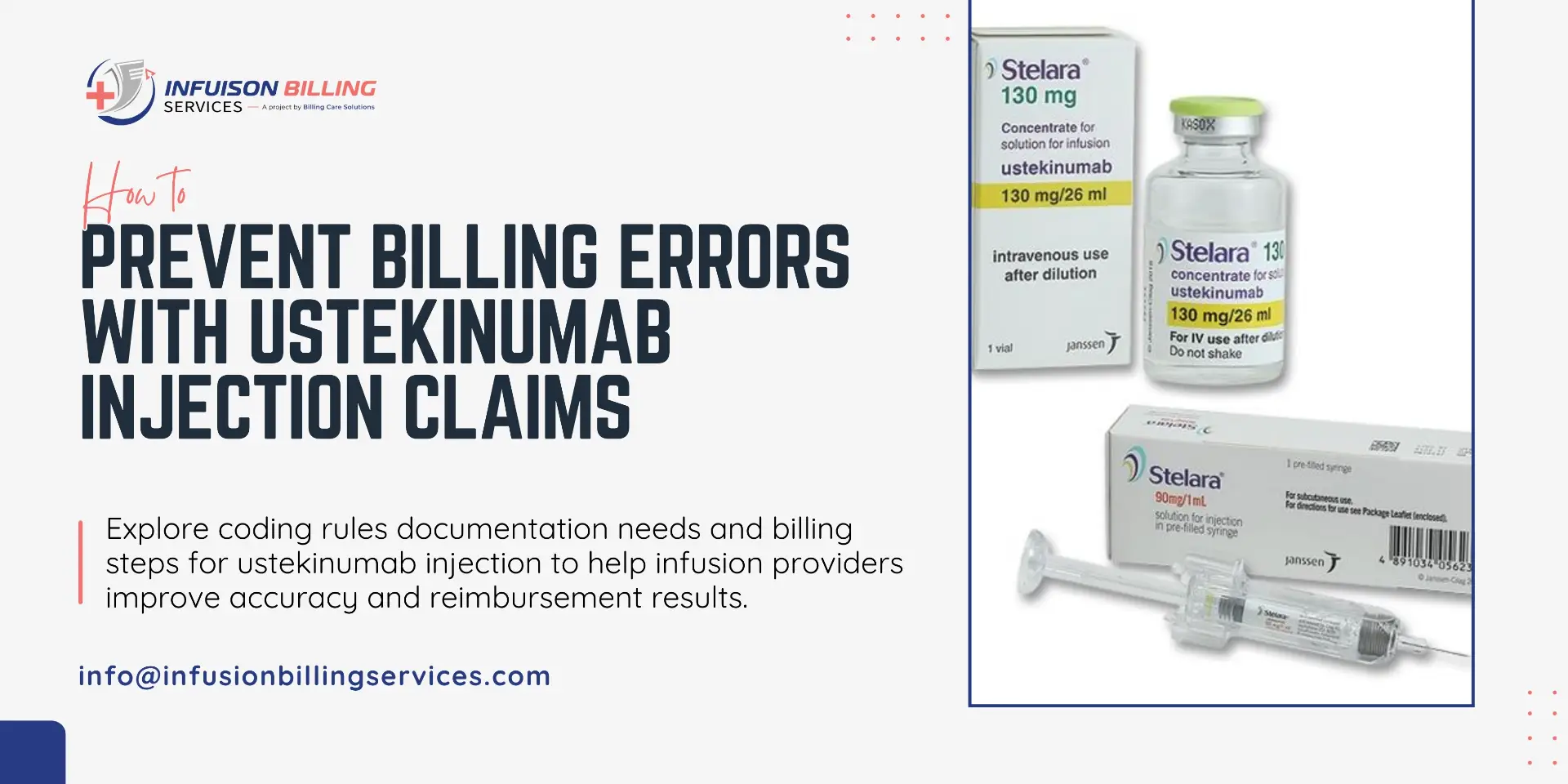
How to Prevent Billing Errors with Ustekinumab Injection Claims
Explore coding rules documentation needs and billing steps for ustekinumab injection to help infusion providers improve accuracy and reimbursement results.
Clean claims determine the financial well-being of an infusion center. In the case of drugs such as Ustekinumab, there is a sliver margin of error. As a result of the patent cliff producing an influx of new biosimilars such as Yesintek, Otulfi and Wezlana, billing of this therapy has become more complicated. Practices that are not adjusted to it experience a chain reaction of claims declined, payments delayed, and lost revenues. Knowing how to negotiate the Ustekinumab Injection specific coding, medical necessity policies, and payer edits is no longer a choice. It is a financial imperative.
The billing of Ustekinumab Injection is also distinctively difficult since the drug is in some gray area. It would be billed under the medical benefit with J codes of infusion or under the pharmacy benefit with NDCs of self injectables. Confusion between them is an instant denial. Nevertheless, understanding the unique peculiarities and payer conditions of Ustekinumab Injection, the providers can greatly diminish the refusal and get payments in time. This guide will be a step by step guide on the key steps to avoid mistakes and streamline your revenue cycle.
Knowing the Core Ustekinumab Injection Coding Landscape
J Codes vs Q Codes: Identifying the Right Drug
The initial barrier toward denials is awareness of the underlying coding landscape. Over the years, the providers used Stelara using originator codes J3357 and J3358. The market has however changed. New biosimilars need certain Healthcare Common Procedure Coding System codes. One of the greatest mistakes that will result in a rejection is to bill the originator code of a bio similar product. Before the assignment of the relevant HCPCS code, it is essential to check the specific National Drug Code and assign it. A red flag of compliance is using the incorrect code indicating that you gave a different drug to the patient than the one on the invoice.
In order to assist in explaining the existing situation, the following is a breakdown of the proper coding.
|
Drug Name (Biosimilar/Reference) |
HCPCS Code |
Route of Administration |
|
Stelara (Originator) |
J3357 / J3358 |
Subcutaneous / Intravenous |
|
Wezlana (Ustekinumab auub) |
Q5138 |
Intravenous |
|
Otulfi (Ustekinumab aauz) |
Q9999 |
Subcutaneous or Intravenous |
|
Yesintek (Ustekinumab kfce) |
Q5100 |
Subcutaneous or Intravenous |
|
Steqeyma (Ustekinumab stba) |
Q5099 |
Intravenous |
The need to keep up with these codes is critical, and a denial will be received in case a J code is used to access a biosimilar of Ustekinumab Injection. Before making your claim, always compare the product given against this list.
Route of Administration Modifiers: JA and JB
In addition to the drug code, the route of administration modifiers are crucial to Ustekinumab Injection claims. JA modifier refers to the fact that the drug was injected through intravenous infusion. JB modifier is used to show that the drug was injected subcutaneously. These modifiers are examined by payers. The cost of intravenous infusion is generally charged at a higher rate and it takes into consideration other sites of care issues compared to a simple subcutaneous injection. You will be underpaid, in case you use the JB modifier to a service which was of an infusion. When you provide the JA modifier in case of a subcutaneous injection, chances are high that you will not be given a match between the code and service provided. Making sure that these modifiers are correct is an easy but effective means of avoiding denials.
Preventing Denials Through Medical Necessity and Proper Diagnosis Coding
Linking ICD 10 Codes to Supported Indications:
Correct coding is, however, half the battle. You are also required to demonstrate medical necessity. Payers apply prospective edits software to make sure that Ustekinumab is utilized on clinical conditions that are covered. This implies that your diagnosis codes should be accurate to the FDA approved indications.
The key contraindications of Ustekinumab Injection are the plaque psoriasis (ICD 10 L40.0), psoriatic arthritis (L40.50 L40.59), Crohn’s disease (K50.xx), and ulcerative colitis (K51.xx). A request of Ustekinumab Injection that is connected to such a diagnosis as general inflammation or a nonspecific skin condition will ensure that it is denied.
The Importance of Weight Based Dosing Documentation:
The dose of induction which is intravenous is computed according to the weight of the patient. When the weight of the patient has not been explicitly noted in the medical record to justify 390mg or 520mg dose, the edits of the payer on the amount quantity will end. An automatic denial of the claim will be made as unprocessable. To avoid this, it is important to make sure that the chart notes indicate the weight of the patient during the time of the infusion. This guide will justify the billing units you report and demonstrate that you followed the FDA approved instructions of Ustekinumab Injection.
Navigating the Biosimilar Transition to Avoid Payer Edits
The reasons why Biosimilars are leading to Claim Errors
Another level of complexity has been added by the shift towards biosimilars. The HCPS codes vary though the active ingredient is identical. With new entrants into the market with new biosimilars, the payer systems might need time to revise their processing policies. You should also confirm with the particular payer on which of the originator J code or the biosimilar Q code they would want to use during the transition period. The error of billing the originator J code to a biosimilar form of Ustekinumab Injection is a common yet expensive error.
Staying Updated on Payer Specific Edits
Also, the payers are implementing duplicate therapy or concurrent therapy edits. A patient is not chargeable with an intravenous infusion and a subcutaneous self injection of Ustekinumab Injection within one treatment period. Recuperation should be prevented by setting up your billing system to check this. It is important to keep track of such payer specific edits to keep Ustekinumab Injection clean claims.
Optimizing Reimbursement: Medical Benefit vs. Pharmacy Benefit
The Financial Report: ASP vs. AWP:
The other strategic option that will influence the reimbursement is the decision between pharmacy benefit and the medical benefit. Ustekinumab Injection may be frequently billed in either channel. The benefit in pharmacy pays an amount containing Average Wholesale Price and a discount. The medical benefit is paid on the basis of Average Sales Price in addition to a percentage. Based on your individual payer contract, a medical benefit with J code could have a better profit margin in office administrations. It is a strategic measure that can go a long way in affecting your bottom line. A professional billing partner will be able to review your contracts to identify which route provides the greatest reimbursable amount on every Ustekinumab Injection claim.
Site of Service Mandates:
There is also a site of service mandates. Site of care initiatives are being implemented by many of the commercial payers. They can prescribe Ustekinumab Injection to be administered in the home of a patient or in a cheaper ambulatory environment instead of an outpatient department of a hospital. In case you submit a billing at a non contracted site, it will be rejected. It is necessary to confirm the benefits of the patient and the location of care requirements of the payer before scheduling the infusion of Ustekinumab Injection.
Mastering the Prior Authorization and Appeals Process
Common Ustekinumab Denial Reasons and Fixes
With perfect coding, you still have to know how to operate the prior authorization process. Other typical causes of denial of Ustekinumab Injection are the absence of a screening of tuberculosis. Make sure that the documentation of the TB screening through the use of QuantiFERON Gold or PPD is presented with the previous authorization request before the initial dose is administered. Step therapy not attempted is another most common denial. Before making the claim, you have to write down failure, intolerance, or contraindication to the preferred formulary alternatives such as anti TNF agents.
Crafting a Strong Medical Necessity Letter
In case of denial, the most useful instrument is a good medical necessity letter. It must have the diagnosis, the severity measures, such as PASI in case of psoriasis or CDAI in case of Crohn’s, a history of previous treatment and references to clinical guidelines. In this letter, the reasons why Ustekinumab Injection is prescribed to that patient will have to be explained.
How Infusion Billing Services Ensures Ustekinumab Injection Compliance
This is what we do at Infusion Billing Services. Our team is ahead of the curve of new biosimilar Q codes and payer edits. To avoid mistakes, our process is aimed at the prevention of mistakes in advance. A pre coding review is done to ensure the particular drug used is either Wezlana or Steqeyma to assign the appropriate Ustekinumab Injection HCPCS code. To perform the cross-reference of ICD 10 codes to payer medical necessity guidelines, we perform diagnosis validation prior to submission. We make sure the modifiers are accurate, we use JA and JB modifiers and use them properly according to the encounter notes. And where there may be a denial, we offer aggressive appeal services with support of clinical documentation.
Conclusion:
Conclusively, proper coding, good documentation and good choice of benefits are the pillars of error free Ustekinumab Injection billing. Through proper attention to the HCPCS codes, they are to be used properly with the right modifiers, and by demonstrating that it was necessary with the most accurate ICD 10 linkage, you can also save the revenue of your practice. Stop complex Ustekinumab Injection billing sucking the income out of your practice. Create an agreement with Infusion Billing Services to optimize your reimbursements and reduce compliance risks. Call us today to get a billing audit.