

How to Resolve CPT 96366 Claim Denials in Infusion Billing
June 3, 2026
Fixing Infusion Billing Denials That Cost Florida Providers Money
June 4, 2026How to Resolve CPT 96366 Claim Denials in Infusion Billing
June 3, 2026Fixing Infusion Billing Denials That Cost Florida Providers Money
June 4, 2026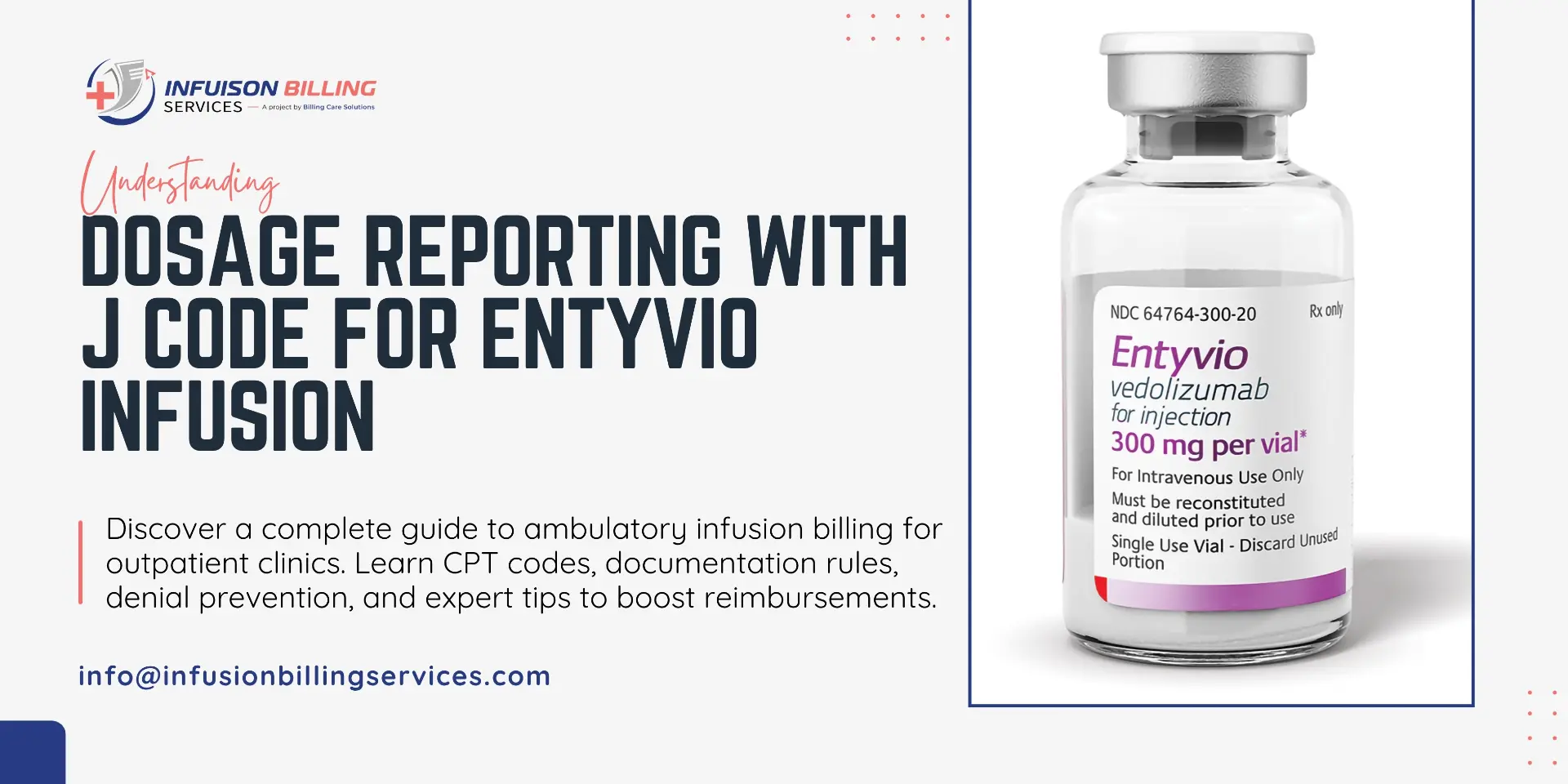
Understanding Dosage Reporting With J Code for Entyvio Infusion
One of the most critical components in infusion revenue cycle management is billing for medications. Even if the clinical care is provided correctly, the dosage may be incorrect and cause claim denials, delayed payments and compliance issues. Correctly reporting drug units is vital to healthcare providers using Entyvio for clean claims and accurate reimbursement.
J Code for Entyvio Infusion is a key component in reporting the dose of Entyvio during treatment. Billing staff needs to be aware of the unit calculations, the documentation process to support claims and the impact of payers’ requirements on reimbursement. Reporting dosage mistakes may lead to great financial difficulties in infusion centers and specialty practices. This guide provides the main considerations for dosage reporting, billing units, documentation requirements and best practices related to J Code for Entyvio Infusion.
What Is J Code for Entyvio Infusion
J Code for Entyvio Infusion is J3380. This code is associated with the intravenous administration of the drug, vedolizumab, and is reported by 1 mg of the drug administered. This code is used by healthcare professionals when invoicing for Entyvio infusions administered in an approved clinical setting. The recommended uses for Entyvio in adults include treatment of moderate to severe ulcerative colitis and Crohn’s disease when other treatments are not effective enough to control symptoms. Given the fact the medication is given via infusion, coding is essential to ascertain appropriate reimbursement.
The J Code for Entyvio Infusion provides the insurance payers with the code of the drug administered and the quantity administered for the treatment. It is a widely used billing system in many healthcare providers. It is important for billing professionals to stay up to date with HCPCS coding guidelines as changes may occur over time. Keeping up to date prevents coding mistakes and assists compliance.
Why Accurate Entyvio Dosage Reporting Matters?
Proper reporting of doses impacts reimbursement and compliance. Insurance payers require claims to be filed with their actual amount of medication administered to a patient. Misreported units can lead to claim denials, delays, and/or claim reviews. The J Code for Entyvio Infusion needs to be reported accurately, owing to the direct association between the number of units billed and payment. Dose issues can occur if there is a discrepancy between the documented dose and billed dose.
Good dosage reporting also helps in meeting regulatory requirements. Healthcare providers will be expected to keep records that are clearly showing that the infusion services were medically necessary, and showing administration details.
There are a number of advantages to proper reporting:
- Faster claim processing
- Reduced denial rates
- Improved reimbursement accuracy
- Better audit readiness
- More effective revenue cycle performance
Companies that focus on proper billing tend to have less payment hassle and better financial results.
Understanding HCPCS Units for Entyvio Billing
One of the most frequently confused concepts is relating to HCPCS units and Entyvio. The J Code for Entyvio Infusion is considered to be 1 mg per billing unit. This implies that the number of units listed should be consistent with the total mg of infused.
In the instance above, the claim for a 300 mg dose of Entyvio would most likely be 300 units of J3380. Each unit will be 1mg and it should be easy to calculate. Units must never be estimated. Rather, they should use documentation of administration records and pharmacy information as a basis for determining the correct amount.
Understanding HCPCS units helps prevent common billing mistakes such as:
- Underreporting drug units
- Overreporting medication quantities
- Entering incorrect claim values
- Creating mismatches between documentation and billing records
Consistent unit calculations help ensure accurate reimbursement for each infusion encounter.
Difference Between Single Dose and Maintenance Dose Reporting
| Feature | Single Dose Reporting | Maintenance Dose Reporting |
| Definition | First or initial dose given to start therapy | Regular scheduled doses to sustain remission |
| Typical Dosage | 300 mg as a one-time induction dose | 300 mg every 8 weeks |
| J Code Used | J3380 | J3380 |
| Billable Units | 30 units (300 mg ÷ 10) | 30 units per maintenance visit |
| Frequency | One time only per treatment initiation | Recurring every 4, 6, or 8 weeks |
| Documentation Focus | Prior authorization and first administration record | Consistent dosing intervals and patient response |
| Common Billing Error | Billing maintenance frequency instead of single dose | Missing dose schedule changes or gaps in care |
| Payer Expectation | Medical necessity for starting biologic therapy | Proof of continued response and stability |
Accurately Documenting the J Code for Entyvio Infusion
Step 1: Verify the Correct J Code
Vedolizumab is the correct J code for Entyvio infusion, which is J3380. Claims will be denied if any other code, other than a biosimilar or other biologic agent is used. When assigning the code, always check the drug label and doctor’s order in case of any mistakes. This is the primary factor that makes infusion billing services important to avoid rework.
Step 2: Record the Exact Dosage Administered
Record the exact number of milligrams administered to the patient during the infusion. The normal adult dose of Entyvio is 300 mg, but doses may be adjusted based on weight or otherwise. Never estimate the dose. Accurate documentation assures J code for Entyvio infusion accurate drug use, and medical necessity for the payer.
Step 3: Calculate Billable Units
The cost per 10 mg unit of Entyvio. Each milligram is equivalent to 10ths of the total. Report 30 units of J3380 for a standard dose of 300 mg. Report 15 units for a 150 mg dose. A number one denial reason is incorrect unit calculation. Please check your math before making claims to infusion billing services.
Step 4: Document Start and Stop Times
Note the exact time of infusion and end. This supports the dose reported with the J code for Entyvio infusion. Consistency in units and duration is what payers are searching for. Time and dosage mismatch can lead to audits. Add infusion time, breaks, and flush time to make a comprehensive and viable medical record.
Step 5: Link Dosage to Patient Diagnosis
Pair the J3380 units with a covered diagnosis, such as ulcerative colitis or Crohn’s disease. A medical record should indicate the dosage is suitable for the condition. The claim will be denied if there is no diagnosis link. Well, linkage means you’re safeguarding your practice and ensuring clean claims via infusion billing services.
Common Modifiers Used Alongside the J Code for Entyvio Infusion
The J Code for Entyvio Infusion (J3380) specifies what medication is being administered, but some modifiers may be necessary based on the payer, drug wastage, and billing situation. The right modifier will ensure proper claim submission and minimize claim denials.
Modifier JW for Drug Wastage
Modifier JW is used when a portion of a single dose vial is discarded and not administered to any patient. The discarded amount must be reported on a separate claim line and supported by documentation in the medical record. For Entyvio, providers may use modifier JW when a portion of the drug from a single dose vial is wasted after the administered dose has been provided to the patient. The amount reported with JW should reflect only the discarded units.
Modifier JZ for No Drug Wastage
Modifier JZ indicates that no amount of the drug was discarded during administration. CMS requires JZ reporting for applicable single dose drugs when there is no wastage. Claims that omit the required JZ modifier may be rejected by some payers. Since Entyvio is supplied in a single dose vial, billing teams should verify whether JZ reporting is required by the payer when the full amount is utilized without waste.
Modifier JA for Intravenous Administration
Modifier JA identifies drugs administered intravenously when a payer requires route of administration reporting. Since Entyvio infusions are delivered through the intravenous route, some health plans may request the JA modifier with J3380. Providers should review payer specific billing policies before submission.
Payer Specific Modifiers
Certain commercial payers may require additional modifiers based on medical necessity, authorization requirements, or unique reimbursement policies. These requirements can vary significantly between insurance plans. Regular review of payer guidelines helps prevent unnecessary denials and payment delays.
How Infusion Billing Services Improve Coding Accuracy?
Infusion billing services improve coding accuracy in several important ways. The services are relying on specialized software which automatically evaluates your units, and the software recognizes the difference between milligrams and milliliters (or vials) of J code for Entyvio infusion. The system automatically records the waste, and applies a modifier JW to the J code for Entyvio infusion, so that you never miss reporting discarded drugs. This automation makes the proper use of J code for Entyvio infusion much easier.
In addition, these services perform regular audits to find errors before claims go to insurers. They also remain current with all insurer rules, which change with frequency, and promptly change their billing practices. As a result of these measures, a good infusion billing service can minimize denials in some cases, they may achieve less than 5 %. This translates to quicker payments and less hassle for your clinic.
Conclusion
A critical part of the Entyvio reimbursement is the accurate reporting of dosage amounts. While the J code for Entyvio infusion enables providers to pay for vedolizumab with a standardized billing process, it is important to ensure unit calculation and documentation is correct to ensure success. If done correctly with the use of the J code for infusion, denials are avoided and faster payments are received. If the healthcare organization has an understanding of the billing units, has detailed records, and is able to follow the payer requirements, then they are in the position to lower the number of denials and increase reimbursement.
When dedicated attention is given to the J code for Entyvio infusion, compliance is ensured, revenue cycle is improved, and providers can be more focused on providing quality patient care. A robust billing strategy, managed internally or by specialized infusion billing services, can help organizations maximize Entyvio value, achieve coding integrity and reimbursement accuracy while respecting the J code for Entyvio infusion.
Frequently Asked Questions
What is the J code for Entyvio infusion?
J Code for Entyvio Infusion is J3380. It is used to bill IV Vedolizumab. Reporting occurs on milligrams that were given during patient treatment in the clinic.
How is Entyvio dosage reported?
Dose is expressed in the total amount of medication that is administered to the patient. A unit is equal to 1 milligram under J3380. The correct documentation leads to accurate billing, compliance and reimbursement from insurance payers.
Why is Entyvio billing accuracy important?
Claim denials, claim delays, and compliance risks are minimized with billing accuracy. It guarantees proper dosage, documentation, and coding that helps providers get timely reimbursement and keep the revenue cycle running smoothly.
What does HCPCS J3380 represent?
J3380 is the HCPCS code and description for intravenous vedolizumab for the treatment of Entyvio. It is charged according to the amount of use, and is used as a standard code for out-patient or infusion administration of drugs.
Can Entyvio units be estimated?
No, units should not be approximated. Billing to show correct dosage administered in records. Estimation can result in claims being rejected, audit flags and problems with insurance payers.
What documents support Entyvio claims?
Physician orders, infusion records, dosage information and diagnosis information are required documents. These facilitate medical necessity, correct billing and reimbursement of Entyvio infusion procedures.
What causes Entyvio claim denials?
Denials happen when units are wrong or when there's missing documentation or authorization. Coding mistakes or discrepancies in records also cause delayed payment and claim resubmission from payers.
How do modifiers affect Entyvio billing?
When there is drug wastage, it is explained by modifiers such as JW, JZ. They assist in understanding billing information, proper reimbursement, and minimizing claim rejections or payer disputes.
Who manages the Entyvio billing process?
Billing staff, coders, and revenue cycle personnel take care of Entyvio billing. They oversee proper coding, documentation review and claim submission and ensure adherence to payer guidelines and regulations.
How does Infusion Billing Services help?
Infusion Billing Services make sure that providers are accurate with their coding and that their documentation is reviewed and denied when applicable. They help minimize billing errors, faster reimbursement, and overall infusion revenue cycle performance optimization.