

Understanding Units and Dosage Reporting in Rituxan Infusion Coding
May 10, 2026
PR-1 Denial Code Case Study for Accurate Patient Cost Allocation
May 11, 2026Understanding Units and Dosage Reporting in Rituxan Infusion Coding
May 10, 2026PR-1 Denial Code Case Study for Accurate Patient Cost Allocation
May 11, 2026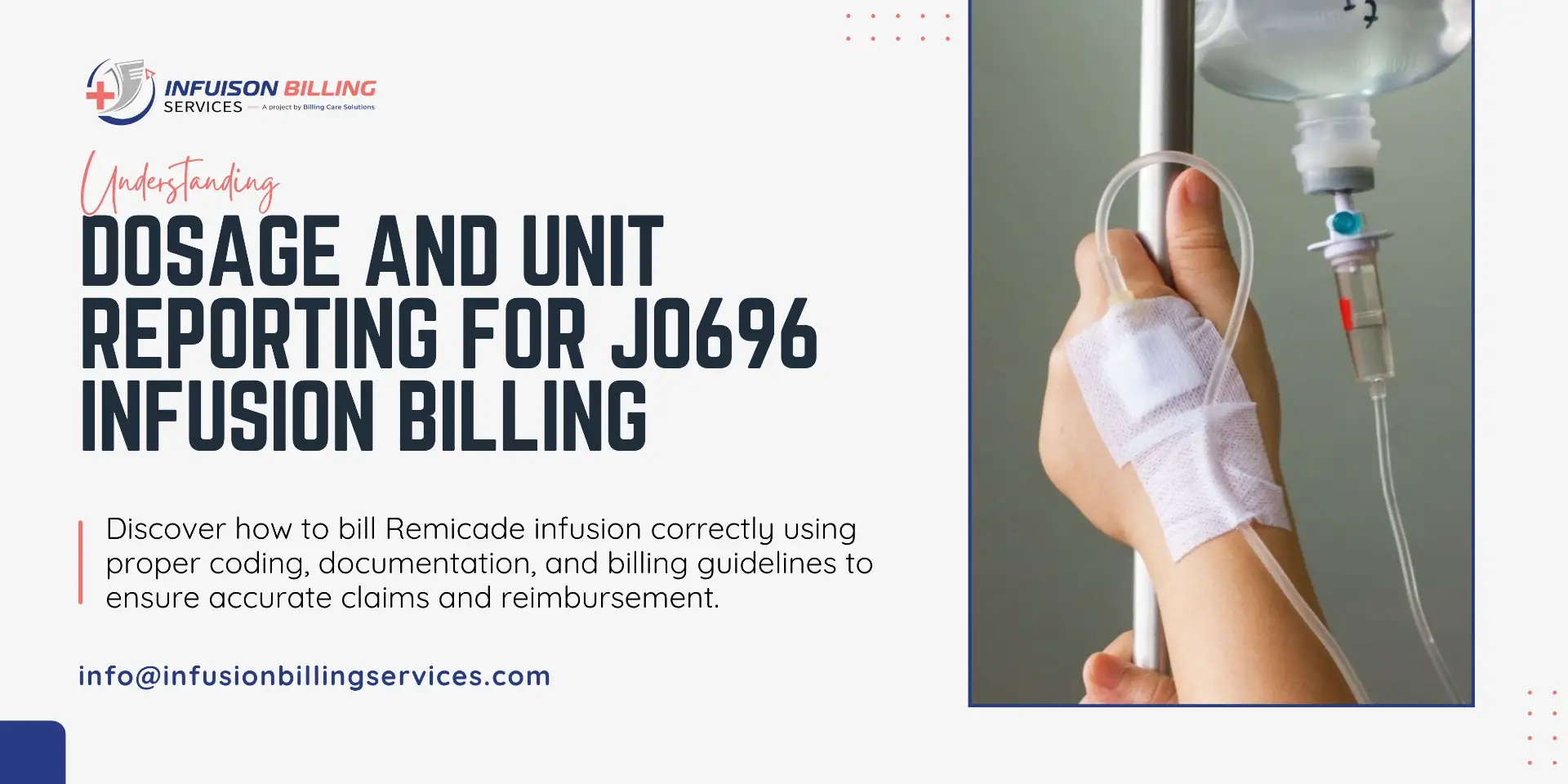
Understanding Dosage and Unit Reporting for J0696 Infusion Billing
Understanding HCPCS codes and dosage calculations, along with payer-specific rules, are essential for accurate infusion billing. A common outpatient and home infusion code is J0696, which is for ceftriaxone sodium injections. Claim denials or overpayment recovery may be the result of errors in the reporting of this code. This blog explains everything billing pros must know about J0696 and submitting clean, compliant claims.
Defining J0696 Code for Ceftriaxone Sodium Injections
J0696 is a HCPCS Level II code for the injection of ceftriaxone sodium, a broad-spectrum antibiotic medication. Which is prescribed for a variety of infections including Lyme disease, urinary tract infections, sepsis and pneumonia. This HCPCS Level II code is available in 250 mg per each billing unit. If that patient is given 1,000 mg, the provider will have to report four units for this code. Knowing this per-unit measurement is the first step to proper infusion billing. The drug is injected intravenously or intramuscularly and the route of administration is clearly recorded with the dose administered.
Importance of Accurate J0696 Dosage Unit Reporting
It is not merely a matter of the bill, reporting correct units for J0696 is essential. It has a direct impact on reimbursements and compliance ratings. Reduced billing can result in a loss of revenue, and excessive billing can result in an audit and allegations of fraud. This code is only available in 250 mg units, so even a minor rounding error in the dosage could lead to the incorrect number of units on the claim.
The units should always be double-checked by billing staff with the actual milligrams that were given. Accurate unit reporting is critical for payers to ensure the claim is correct and meets the patient’s diagnosis and documented medical necessity. Common errors in this section are one of the top reasons for claims to be rejected.
Standard Medical Necessity Guidelines for J0696 Claims
Infusion has to be shown to be medically necessary by the payer in order to be reimbursed. In general, the patient should have a diagnosis that justifies using ceftriaxone sodium and other oral options should be discussed or have been tried. Common ICD-10 diagnosis codes associated with J0696 are pneumonia, septicemia, meningitis and other bacterial infections. Most commercial insurers and Medicare will need a prescription from the treating physician and clinical documentation to substantiate the prescription. Claims of this code may still be denied if not medically necessary even when coded correctly, without a valid medical necessity justification. Ensuring that claim diagnosis codes match patient record clinical notes is key.
Calculating Correct Billing Units for Ceftriaxone Infusions
Billing units for J0696 are computed in a simple fashion. Each unit = 250 mg so divide the total mg given by 250 to find the number of units given.
For instance, 500 mg is the equivalent of 2 units of this code and 2,000 mg is equivalent of 8 units of J code. If the dose ordered is not a number that can be evenly divided by 250, round to the nearest unit per payer guidance.
Some payers will accept rounding up to the next whole unit in the case of waste. Record the exact dose ordered and dispensed always, to ensure that units can be checked during audit. The use of consistent and transparent calculation methods safeguards the practice from billing disputes.
Avoiding Common Coding Errors with J0696 Billing
There are several common errors that can be made when billing J0696, and these errors can be avoided by training and review. A common mistake is the incorrect unit billing so as to result in high billing. One of the most frequently made errors is using the HCPCS code for a different cephalosporin antibiotic. You can get a compliance risk if a different drug code that is similar to ceftriaxone sodium is used instead of ceftriaxone sodium as it is specifically associated with the drug code.
Another frequent error is not listing the correct National Drug Code (NDC) on claims for some payers. Also, some billers will not consider the total dose if a patient receives a number of infusions within a day. All of these errors can be identified with a well-designed pre-submission claims review procedure.
Proper Documentation Requirements for J0696 Infusion Services
| Documentation Category | Required Elements | Purpose |
| Physician Order | Order for ceftriaxone sodium, date, and time of administration | Confirms drug authorization and administration timeline |
| Clinical Details | Exact dose in milligrams, route of administration, administering clinician’s name | Supports accurate unit billing and clinical accountability |
| Infusion Records | Start and stop times of infusion, bundled administration codes (96365 or 96366) | Required for correct infusion administration code pairing with J-CODE |
| Home Infusion Records | Home health referral, nursing visit notes, pharmacy dispensing records | Meets additional payer requirements specific to home infusion settings |
| Organizational Standard | All documentation kept organized and easily accessible | Ensures J0696 claims can withstand payer scrutiny |
| Audit Readiness | Complete and consistent records across all categories | Protects against post-payment audits and claim recoupment |
Understanding Payer Policies for J0696 Reimbursement Rates
J0696 has different reimbursement amounts depending on the payer and care setting. Medicare will reimburse this J-CODE based on the average sales price (ASP) methodology, with rates that are updated quarterly. The rates for Medicaid and commercial payers can differ from state to state, and commercial rates are usually determined through contract agreements. The fee schedule might differ from the one used in outpatient hospital settings rather than physician office or home infusion settings.
Billing staff should ensure that the biller understands the correct fee schedule for each individual payer prior to submitting claims. Some payers have quantity limits per claim or limit quantities per day as well; checking the policies specific to each payer will help ensure that denials don’t happen because the number of units is too high. Practices that routinely bill this code should keep up to date with the CMS quarterly ASP updates.
Managing Waste and Discarded Units for J0696
Ceftriaxone sodium is a single dose vial and sometimes the entire dose is not administered to one patient. In such instances, the unused portion can be deemed as waste. Medicare and many other payers will permit providers to bill the amount of the discarded item, J0696, as long as the waste is documented. The JW modifier means that some of the drug was thrown away and not used for another patient.
The provider will need to record how much was given and how much was lost in the patient’s chart. Certain payers also mandate that the JZ modifier is used to establish that no drug was wasted. When waste is reported properly, providers are getting reimbursed fairly and still meeting the requirements of waste billing.
Why choose Infusion Billing Services for the Infusion Drug Billing?
Infusion Billing Services provides a wealth of expertise to every facet of infusion drug billing, helping healthcare providers minimize denials, maximize accuracy, and maximize reimbursements. The company has a staff that is well-equipped to deal with all of the complexities associated with HCPCS drug codes, payor-specific policies and documentation requirements to ensure that every claim is submitted correctly the first time. Whether it’s exact billing units or tracking of waste reports or modifier usage, Infusion Billing Services takes care of the details that matter. Providers can rest assured their revenue cycle is in capable, experienced hands that are dedicated to compliance and consistent billing performance so they can focus on patient care.
Best Practices for Submitting Clean J0696 Infusion Claims
To submit accurate J0696 claims time and time again, it’s essential that staff members are trained, workflows are defined, and they’re monitored through internal audits. Billing staff should always have access to current payer policies and fee schedules for this J-CODE. Errors can be minimized with a pre-submission checklist to verify the dose, units, diagnosis codes, modifiers and NDC information.
Regularly internal audit of this codes claim to detect any trends of underbilling / overbilling which can be rectified before it becomes a compliance issue. A timely and well documented appeals process must be established when claims are denied. One of the best methods for increasing the clean claim rate, is to work closely with the clinical staff to ensure that the documentation is submitted to support billed units. Educating coders in drug billing and infusion services gets a good return on investment in the form of more reimbursement and less audits.
Conclusion
Billing professionals dealing with ceftriaxone sodium infusion services need to be careful about the dosage and unit reporting of J0696. Each billable unit is 250mg and any reporting must be exact on the total milligram quantity given. A 1000mg infusion will need 4 units, for instance. For partial vials, proper waste documentation must be provided, including amount discarded, and the signature of the witness, for complete claim reimbursement and compliance. There are additional complexities due to Payer specific rules.
Commercial and Medicare plans may vary in how any unused doses are disposed of after the prescription is filled. If not met, the consequences may include denials, audits and/or loss of revenue. Standardized dosage calculations, complete and accurate documentation of all waste, and keeping up to date with payer guidelines safeguard provider revenue and provide consistent billing quality. Understanding these details helps minimize claim inaccuracies and ensures proper and streamlined infusion care for ceftriaxone sodium.
Frequently Asked Questions
How does dosage affect J0696 reimbursement accuracy?
The minor mistakes in dosage calculation mean underpayment and overbilling, resulting in claim rejections. And also, audits which directly impact your practice's revenue cycle and compliance reputation.
What happens if J0696 units are overbilled?
Overbilling can lead to allegations of fraud, post-payment audits and recoupment requests. If the unit is reported incorrectly every time. It could result in a prepayment review or the termination of the contract. Inaccurate unit reporting can result in prepayment review or contract termination.
When should the JW modifier be applied?
Use JW when any part of the ceftriaxone vial is used up and cannot be used again for another patient. Providers otherwise risk not getting legitimate reimbursement that is fully entitled under payer guidelines without proper waste documentation.
Can J0696 be billed without infusion administration codes?
Many administration codes are left out, like 96365. The administration code is reimbursable separately, and several of the most common and expensive billing errors on infusions are missing the administration code.
How do quarterly ASP updates impact J0696 billing?
If Medicare's quarterly rate changes are not tracked, claims submitted at the incorrect reimbursement rates can lead to payment differences and possible compliance problems that can be easily avoided if a bill policy review process is conducted routinely.
Why do payer policies differ for J0696 reimbursement?
The quantity limits and fees paid for J0696 vary by each fee schedule and set by each payer. Assuming that the rules of payers are the same as other payers results in unearned reimbursement delays and excessive denials and appeals caused by not verifying specific rules before submission.
What role does diagnosis coding play here?
The biggest reason for J0696 denials is the misalignment of billed diagnosis codes and the documentation in the medical record, which takes up staff time and delays reimbursement for services rendered that are clinically appropriate.
How does poor documentation affect J0696 claim outcomes?
The absence of physician orders, undocumented infusions, or nursing notes provide reasons for payers to deny or recoup claims. Even if the physician had actually ordered ceftriaxone and it was properly medically necessary for the patient.
Are there unit limits per day for J0696?
Some payers have daily unit limits that need prior authorization that exceed a certain limit. Failure to adhere to these limits results in automatic denial which would have been easily and completely avoided had there been proper pre-submission payer policy review.
How can internal audits improve J0696 claim accuracy?
Frequent audits provide a way to uncover recurring unit omissions, missing modifiers and documentation issues early, enabling billing teams to correct workflows, retrain staff and ensure that they are preparing and submitting cleaner claims to better support long-term reimbursement.