

When to Use J7170 for Clean Infusion Billing and coding
May 30, 2026
Best Practices for Myasthenia Gravis ICD 10 in Infusion Billing
May 31, 2026When to Use J7170 for Clean Infusion Billing and coding
May 30, 2026Best Practices for Myasthenia Gravis ICD 10 in Infusion Billing
May 31, 2026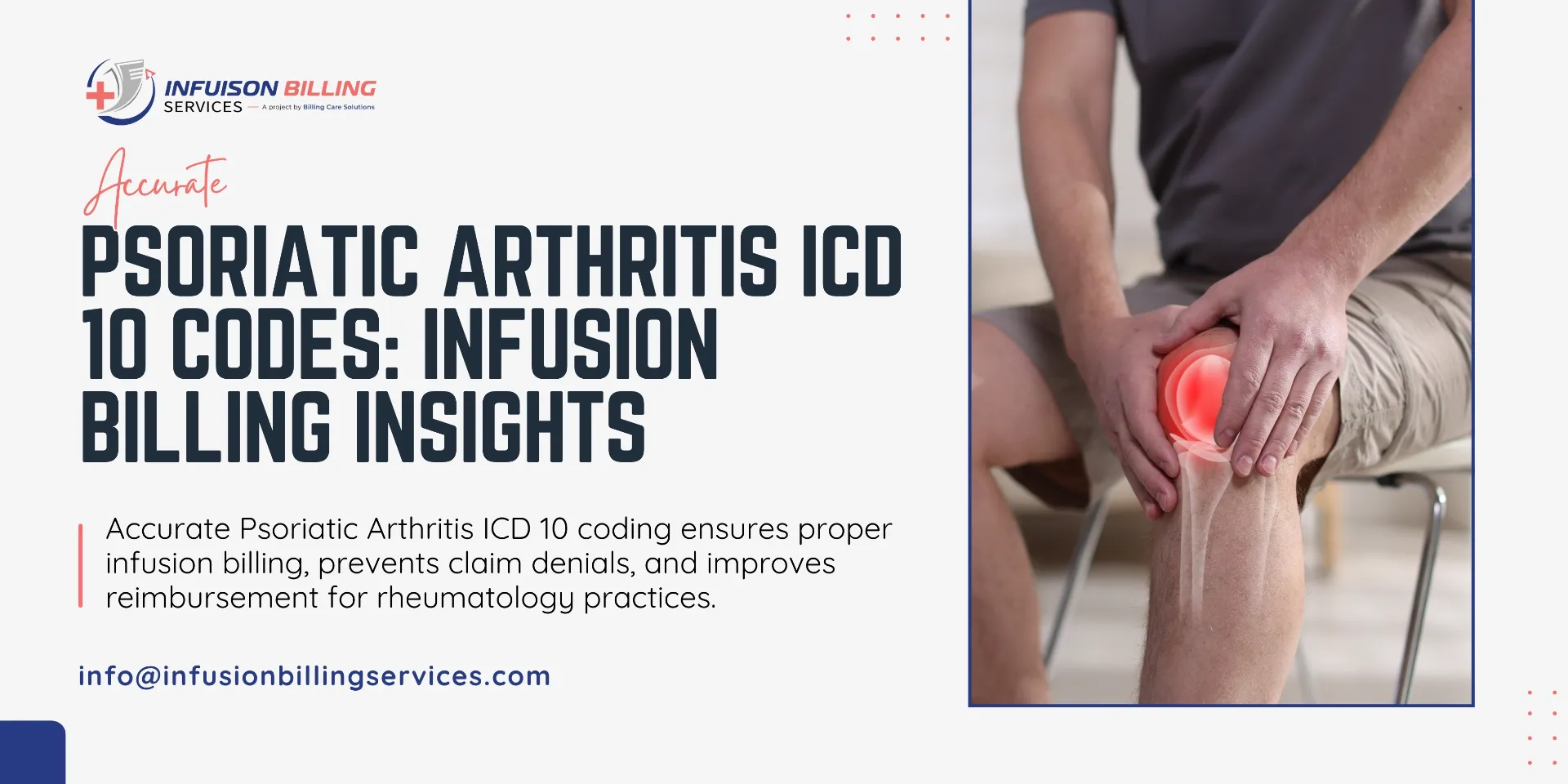
Psoriatic Arthritis ICD 10 Codes: Infusion Billing Insights
Psoriatic Arthritis, or PsA, is a skin and joint disease that is a chronic autoimmune disease. PsA patients usually complain of the presence of joint pain, joint stiffness, swelling, and skin psoriasis. This condition should be appropriately diagnosed and treated to gain control. To healthcare practitioners, proper ICD-10 coding is a vital aspect of the treatment procedure particularly in terms of infusion therapy.
Proper billing, compliance with insurance demands and prompt reimbursement are guaranteed by correct coding. It also assists the practices to evade claim denials and audits and enhances the overall patient care. Knowing the use of Psoriatic Arthritis ICD 10 codes in infusion billing is significant to healthcare and billing personnel as well as rheumatology practices.
Understanding Psoriatic Arthritis ICD 10
ICD-10 codes are universal codes in classifying diseases, conditions, and symptoms. Such codes are required to record diagnoses in the records of a patient and insurance billing. Psoriatic arthritis possesses its own codes of ICD-10 that it is differentiated with other types of arthritis such as rheumatoid arthritis and osteoarthritis. Typical codes are M07.0 Psoriatic arthritis with psoriasis vulgaris, M07.1 Psoriatic arthritis with unspecified psoriasis, M07.2 Psoriatic juvenile arthritis and M07.3 Psoriatic arthritis with other types of psoriasis. The code is extremely important to use because it influences the treatment approval, infusion coverage, and reimbursement. The providers must be made aware of the differences between these codes, and the clinical documentation of the selected code must be maintained.
Why Psoriatic Arthritis ICD 10 Accuracy Matters in Infusion Billing?
Accuracy with the Psoriatic Arthritis ICD 10 code L40.54 directly decides if your infusion claims get paid or denied. When you submit the correct Psoriatic Arthritis ICD 10 code, the payer understands that the patient has a condition that may qualify for biologic infusion therapy. But if you use a wrong code like L40.5 (which is too general) or M06.09 (which is for rheumatoid arthritis), the payer will deny the claim with error CO 151. This denial means the diagnosis does not match the infused drug.
Even a small mistake such as a missing secondary code can cause partial payment or trigger an audit. Infusion billing for biologics like infliximab or abatacept requires an exact match between the Psoriatic Arthritis ICD 10 code, the J code for the drug, and the doctor’s notes. Without this precision, you face delayed payments, extra work on appeals, and even payers taking back money already paid. For any infusion billing service, protecting revenue starts with one simple rule: the Psoriatic Arthritis ICD 10 code must be correct on every single claim.
Common Psoriatic Arthritis ICD 10 Codes for Infusion Billing
In the process of billing infusion therapy it is crucial to choose the appropriate ICD-10 code. The table below contains some common PsA codes, description and billing notes:
| ICD-10 Code | Description | Notes |
| M07.0 | Psoriatic arthritis with psoriasis vulgaris | Most common in adults with classic skin lesions |
| M07.1 | Psoriatic arthritis with unspecified psoriasis | Used when skin involvement is not specified |
| M07.2 | Psoriatic juvenile arthritis | Applicable for pediatric cases |
| M07.3 | Psoriatic arthritis with other psoriasis types | Covers less common psoriasis subtypes |
| L40.5 | Arthritis mutilans | Severe form of PsA affecting multiple joints |
The right code will be selected based on the clinical presentation of the patient. The providers are to record the symptoms, laboratory findings, and radiographic examinations to support the ICD-10 choice. Proper coding will assist in gaining insurance coverage of an infusion therapy and proper reimbursement.
Documentation to Support Psoriatic Arthritis ICD 10 for Infusions
It is important to have good documentation in addition to the Psoriatic Arthritis ICD 10 code L40.54 for your infusion claims. Insurers will not pay for high-cost biologic infusions using just the diagnosis code alone. The patient’s record must show that their psoriatic arthritis is of such a severity that it warrants IV administration of the treatment.
Firstly you need to establish the correct Psoriatic Arthritis ICD 10 L40.54 through a rheumatologist. After which you need to include definite clinical evidence such as counts of swollen joints, CRP or ESR blood results as well as evidence from X-ray or MRI scan showing joint damage, you also need to show evidence that the patient has failed oral medication such as methotrexate or leflunomide before considering treatment by infusion.
On each infusion visit the Psoriatic Arthritis ICD 10 code should appear in three locations which are on the physician’s order, the encounter form, and the nurse’s infusion notes. An absence of one of these will cause denials such as CO 50 (not medically necessary) or CO 180 (missing documentation). Without solid documentation to support the Psoriatic Arthritis ICD 10 code your infusions will continue to be denied and lost revenue.
Challenges in Psoriatic Arthritis ICD 10 Coding
The infusion billing of Psoriatic Arthritis has difficulties in being coded with standardized codes using the ICD-10 codes. A typical issue is that they are confused with the rheumatoid arthritis codes since they are both associated with inflammation of the joints. The other complication is incomplete records in which the nature of psoriasis or the degree to which the joints have been involved is not clear.
Codifying errors may lead to reimbursement and compliance risks as well as failure to cover claims. In order to overcome these challenges, the billing employees and providers are to work closely. Looking into the records of patients, checking their diagnoses, and revising these codes as the patient changes his conditions are all important practices. Training and coding audits periodically will also decrease the errors and enhance the accuracy of billing.
CPT Codes Considerations for Psoriatic Arthritis Infusions
The CPT codes are also used to explain the exact services offered during infusion therapy in addition to the ICD-10 codes. In the case of PsA infusion therapy, CPT codes are applied to drugs, infusion time, and its services. The frequently used CPT codes will be 96365, first infusion, 96366, every extra drug infusion, and 96413, infusion of chemotherapy or biologic therapy. It is important to ensure that the right ICD-10 code is combined with the right CPT code to be able to bill correctly.
As an example, Psoriatic Arthritis involving psoriasis vulgaris and CPT 96365 would guarantee the insurance companies that the infusion is necessary medically. MDS codes The correct combination of ICD-10 and CPT codes will avoid claim denials and accelerate reimbursement.
Best Practices for Psoriatic Arthritis ICD 10 Documentation
Documentation is important as it helps to make correct billing and to comply with it. Joint symptoms, laboratory findings, imaging, and skin involvement should be documented by the providers. The nature of psoriasis and the severity of arthritis ought to be well indicated. The billing personnel is expected to go through the records frequently to ensure that the ICD-10 code aligns with clinical documentation.
Rheumatologists and billing teams must coordinate to revise the codes as the condition of the patient changes. Periodic audits and employee training also guarantee the accuracy of coding as well as decreasing the administrative burden. Proper documentation is beneficial both to the practice and the patient as it simplifies the process of approving treatments and reduces the number of rejected claims.
Why Choose Infusion Billing Services for Psoriatic Arthritis ICD 10?
General medical billing companies often mishandle the Psoriatic Arthritis ICD 10 code L40.54 because these companies do not understand infusion specific rules. A general biller may submit the correct diagnosis but fail to link the Psoriatic Arthritis ICD 10 code properly to the J code for drugs like infliximab or abatacept. This mistake leads to denials that a general biller cannot resolve. Infusion Billing Services knows exactly how to apply the Psoriatic Arthritis ICD 10 code for each payer. Different insurance companies have different medical policies. Some payers require a specific secondary diagnosis. Other payers demand documented failure of oral medications like methotrexate before approving an infusion. Infusion Billing Services tracks these payer rules for you.
Infusion Billing Services also manages prior authorizations, drug waste modifiers like JW, and site of care appeals. Infusion Billing Services knows that the same Psoriatic Arthritis ICD 10 code L40.54 may be paid in a doctor’s office but denied in a hospital outpatient setting. When you choose Infusion Billing Services, you reduce denials, speed up payments, and protect your revenue from compliance risks tied to the Psoriatic Arthritis ICD 10 code.
Conclusion
Proper ICD 10 coding of Psoriatic Arthritis is necessary in the infusion billing and efficiency of practices. Appropriate coding is needed to assure documentation assists in the treatment, steers infusion therapy and accomplishes insurance criteria. The ability to match ICD-10 codes with the appropriate CPT codes enhances the accuracy of reimbursements as well as the denial of claims.
Infusion billing can be made smooth, remain uniform, and provide improved patient care by providers and billing units that adhere to best practices, perform regular audits, and seek expert assistance. Using the appropriate Psoriatic Arthritis ICD 10 codes assists the practices to attain monetary stability as well as extend efficient treatment to patients with PsA.
FAQs
What to do in order to avoid PsA infusion claim denials?
Denials usually happen when the ICD-10 codes fail to consider documented severity of diseases and previous therapies. Triangulate clinical notes, establish joint involvement, and compare CPT codes to infusion types to facilitate approval.
At which point should PsA codes be reviewed?
Review/re-examine ICD-10 when there is an evolution of a disease, an affected joint, or change in treatment. Periodic reviews minimize errors on claims and facilitate correct authorization of infusion and insurance requirements.
How would you deal with overlapping arthritis codes?
Distinguish between PsA and rheumatoid arthritis on the basis of skin and joint documentation. Use the specific ICD-10 code of PsA and do not use generic arthritis codes to avoid confusion while billing and rejection of claims.
How to document PsA severity for insurers?
Provide the number of joints, pain, imaging, description of skin lesions, and previous drug history. Efficient documentation is provided to explain the choice of ICD-10 code and explain biologic infusion approvals.
How to integrate ICD-10 with therapy outcomes?
Document clinical changes, laboratory patterns and frequency of flares and ICD-10 code. The results are associated with coding, which justifies continuous infusion therapy and supports value-based billing practices.
How do insurers evaluate PsA infusion necessity?
A review of ICD-10 coding, failed previous therapy, and clinical records is used by the insurers to identify medical necessity. Full and proper documentation enhances the chances of approval and decreases biologic therapy delays.
How to audit PsA infusion claims effectively?
Compare submitted ICD-10 codes with patient charts, verify CPT code accuracy, check prior authorizations and flag inconsistencies. Routine audits detect mistakes in their early stages and avoid the expensive denials or delays.
Why partner with infusion billing specialists?
Experts make sure that there is accurate coding in ICD-10 and CPT coding, take control of insurance provision, and maximize the reimbursement. They have specific experience that lessens administration load, accelerates claims handling and ensures compliance in the intricate PsA infusion therapy.