

IV Infusion Supplies, Equipment, and Billing Essentials
December 11, 2025
Understanding Rheumatoid Arthritis ICD 10 Diagnosis Codes
December 24, 2025IV Infusion Supplies, Equipment, and Billing Essentials
December 11, 2025Understanding Rheumatoid Arthritis ICD 10 Diagnosis Codes
December 24, 2025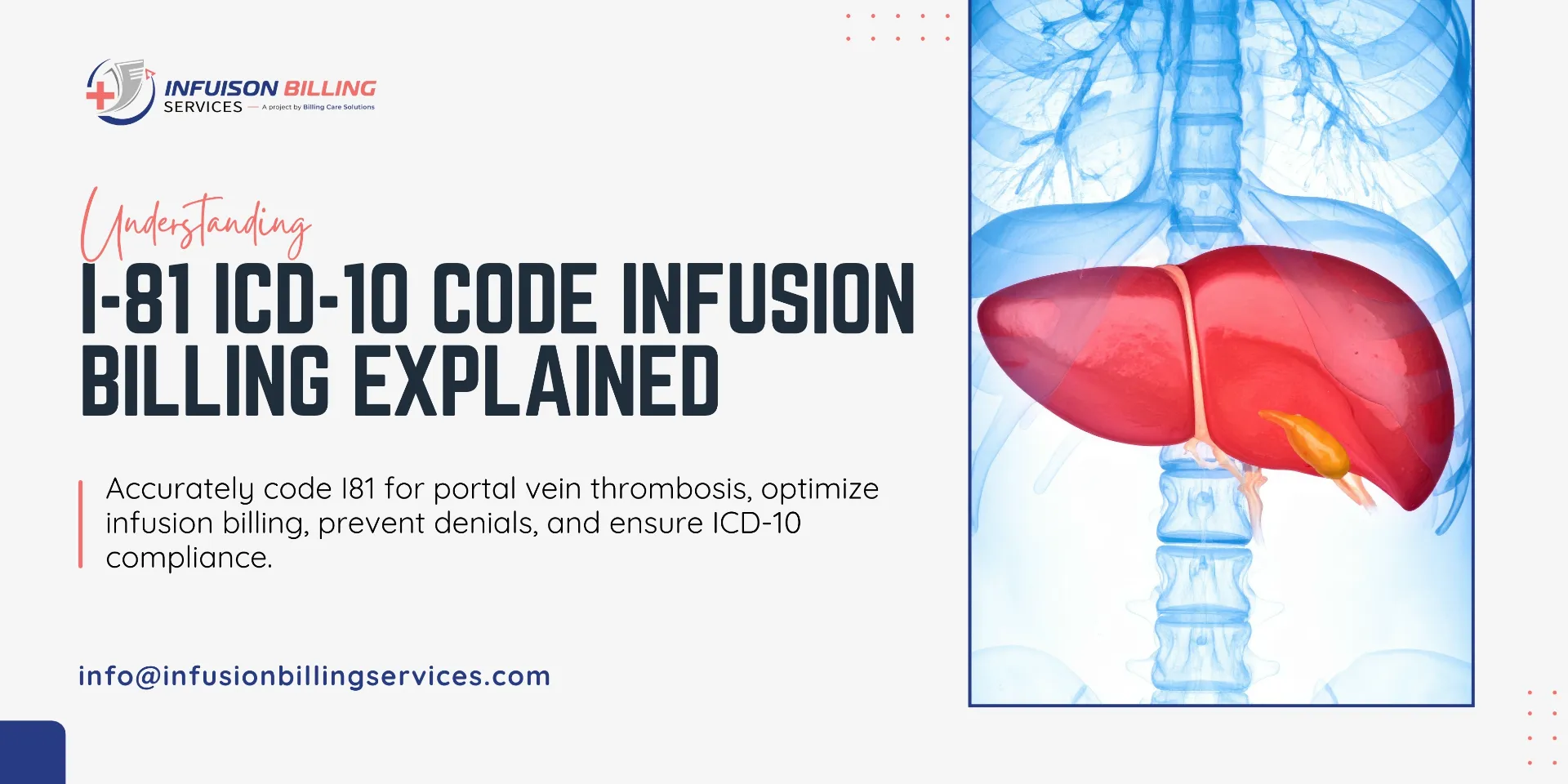
Understanding I-81 ICD-10 Code Infusion Billing Explained
Accurately code I81 for portal vein thrombosis, optimize infusion billing, prevent denials, and ensure ICD-10 compliance.
Infusion-related billing needs to be very accurate if the practice is to be properly reimbursed and if it is to remain in compliance. The I-81 ICD-10 Code becomes very significant for the patients who are suffering from portal vein thrombosis and have some complications that are related to it. The proper use of this code gives the opportunity to coders, billers, and healthcare providers to be very precise in their documentation and billing for infusion therapies.
Infusion services may include the use of anticoagulants or supportive therapies and are commonly required by the medical condition of patients having an I-81 diagnosis. Any mistake in the coding process can be the reason for the rejection of the claims, the delay of the payments, and the arising of regulatory issues. The present manual is dedicated to I-81 coding; it also covers the documentation that is necessary and the best practices that are there to make infusion billing more efficient.
What Does the I81 ICD-10 Code Represent
The I-81 code refers to portal vein thrombosis with complications. Portal vein thrombosis is a condition in which a blood clot blocks the portal vein, which is the main vessel to carry blood from the intestines and spleen to the liver. The I-81 code defines the extent of the disease and enables the healthcare claims to show the level of complexity of care that is needed.
In the case of infusion billing, the proper use of this code is very important as it is the supporting evidence of the medical necessity of the infusion therapies. By assigning I-81 correctly, coders not only facilitate the proper reimbursement process but also help other healthcare providers get a better understanding of the clinical picture of the patient’s condition from the record.
Clinical Overview and Medical Context of I-81
Portal vein thrombosis is capable of affecting the liver seriously and as a result, it may be either a primary acute or a chronic condition. On top of that, this disease may be complicated by portal hypertension, ascites, gastrointestinal hemorrhage, and liver failure. Those people who suffer from liver cirrhosis, coagulation disorders, and cancer are a group of the most vulnerable to this disease.
The I-81 ICD-10 Code defines the cases of portal vein thrombosis as those with an additional complication and without, thus it is very important for accuracy in coding. These patients' infusion treatments are usually accompanied by anticoagulation or thrombolytic medication. Writing down the type of therapy, the amount of the drug, and the length of the treatment is indispensable to justify the coder's working decisions and to provide the care of the highest-risk, most-resource-consuming patients with the reimbursement they deserve.
Common Conditions and Use Cases for I-81
The I-81 coding is being used during various clinical scenarios. Patients with liver cirrhosis, those who have complications after operations, hypercoagulable disorders, or malignancy-related portal vein obstruction are the most common cases in which this code is required. These patients are usually on continuous anticoagulant infusion or supportive IV treatments. Properly coding I-81 is a way in which medical practitioners will receive payments for the services offered to the patients, and insurance companies will get the level of the patient’s condition complexity. On the ground, coders can also use I-81 coupled with the secondary codes to denote the cause of liver disease or the complications that accompany it, making sure that the claim reflects the complete clinical picture.
Essential Codes and Documentation for I-81 Infusion Billing
The table below is a quick guide for coders, billers, and healthcare providers who are handling infusion billing for portal vein thrombosis. It outlines the primary and the secondary ICD-10 codes, the corresponding CPT codes, modifiers, and the key points of the documentation that will help in proper coding, getting the right payment, and following the rules.
| Category | Code | Description | Notes for Infusion Billing |
|---|---|---|---|
| Primary ICD-10 Code | I81 | Portal vein thrombosis with complications | Must specify acute or chronic; document complications such as ascites or varices. |
| Secondary ICD-10 Code | K74.60 | Unspecified cirrhosis of the liver | Pair with I81 if liver disease is present. |
| Secondary ICD-10 Code | D68.9 | Coagulation disorder, unspecified | Pair if the patient has a documented hypercoagulable condition. |
| CPT Code (Infusion) | 96365 | Initial IV infusion, up to 1 hour | Document start and stop times. |
| CPT Code (Infusion) | 96366 | Each additional hour of infusion | Only bill for consecutive therapy beyond the initial infusion. |
| CPT Code (Infusion) | 96401 | Chemotherapy or other therapeutic infusion | Use if indicated for thrombolytic or anticoagulant therapy. |
| Modifier | -25 | Significant evaluation and management service | Use when E/M is performed on the same day as infusion. |
| Modifier | -59 | Distinct procedural service | Use when multiple infusions or procedures are billed separately. |
Why Accurate I-81 Coding Matters in Infusion Billing
It is difficult to overstate how important it is to have accurate I-81 coding. If the coding is incorrect, the claims can be rejected, the payments will be delayed, and there can be problems with compliance. Using the I81 ICD-10 Code appropriately, the coders indicate the extent of the patient's condition, they give reasons for the infusion therapy, and they show that the nursing care provided is of a higher level of complexity. Besides that, the correct coding is a great support in being always ready for an audit, and it is a way of ensuring that the billing reflects the true level of clinical effort. Proper I-81 coding in infusion centers is what makes reimbursement be at the same level as the intensity and the duration of the therapy, and this is a way of assuring financial sustainability while at the same time keeping up the quality of patient care.
Proper Coding Guidelines for I81 ICD-10 Code
Healthcare professionals who want to code I-81 in a proper manner need to pretty much adhere to the ICD-10 standards. The code is supposed to be utilized only when there is portal vein thrombosis with complications, and those who do the coding have to check if the condition is acute or chronic. Moreover, it is significant to describe the lees power or coagulopathy, which may be the cause or the effect of the treatment. In the case of an infusion, the bill must be accompanied by the usual therapy documents, such as the type of medication, the dosage, and the route, along with the I-81 code.
By observing these coding regulations, the frequency of errors is minimized, the risk of denials is kept at bay, and the process of revenue cycle management becomes more efficient.
Compliance and Audit Preparedness for I81 ICD-10 Code
Healthcare organizations need to stay in line with the rules and be ready for an audit at any time while coding I-81. It is necessary to have detailed patient records, follow the guidelines specific to each payer, and continuously train the coders on the ICD-10 updates. Claims must be checked for correctness before they are sent, and infusion therapies should be very detailed to ensure that they are medically necessary. Taking a proactive compliance stance allows infusion centers to be able to provide evidence of their claims when inspected, limit the possibility of losing money, and be able to show that they are following the regulations.
Infusion Billing Services and Best Practices
Infusion Billing Services help to simplify the procedures of coding, documentation, and claims processing for patients suffering from I-81 conditions. Some of the best practices are the utilization of electronic health records to document the details of the infusion therapy, the consistent use of the correct ICD-10 and CPT codes, the checking of the payer requirements, and the conducting of the routine audits for the early detection of errors. By using professional billing services, infusion centers can concentrate on patient care while at the same time increasing their income and maintaining compliance with the rules. The correct use of I-81 coding, along with infusion billing best practices, is a great tool for the improvement of the operational side of the business as well as for better financial results.
Conclusion and Key Takeaways for Accurate I-81 Infusion Billing
The I-81 ICD-10 Code is essential in recording port vein thrombosis with a complication. Proper coding is the basis for appropriate payment, regulatory conformity, and the correct recording of infusion therapies. Medical practitioners and coders must commit to detailed documentation, the right use of codes, and following coding instructions. Paying for infusion services by a professional can, therefore, bring more benefits such as increasing precision, lowering refusal rates, and elevating the financial state of the practice. Proficiency in I-81 coding is one of the ways that infusion centers have the capacity to both keep their standards of care and further their revenue while being compliant with the regulations.