

Infusion Billing Solution to Fix J3247 NDC Denial M119
March 18, 2026
Understanding J-Code Denials and How to Correct Them
March 19, 2026Infusion Billing Solution to Fix J3247 NDC Denial M119
March 18, 2026Understanding J-Code Denials and How to Correct Them
March 19, 2026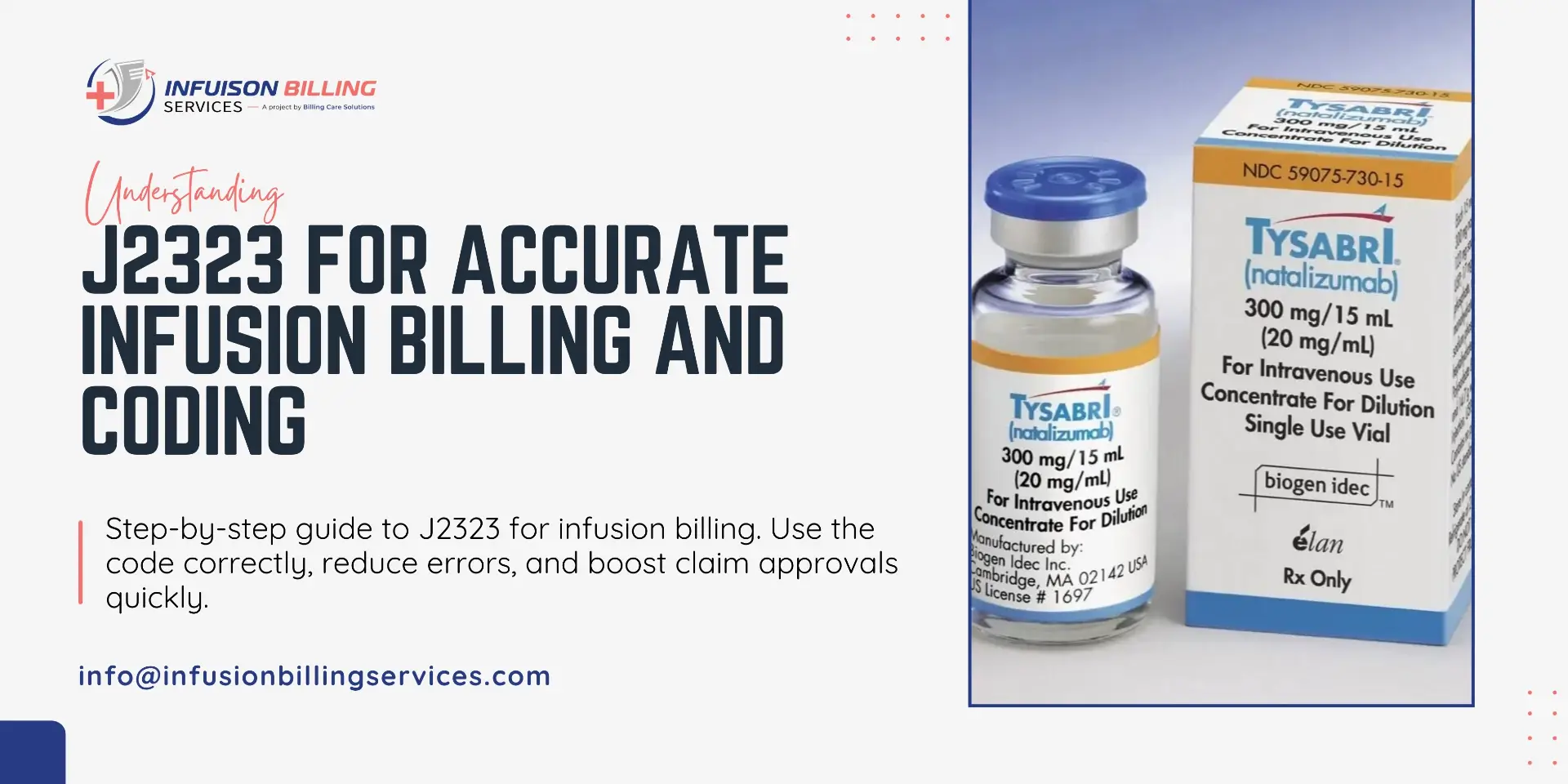
Understanding J2323 for Accurate Infusion Billing and Coding
Step-by-step guide to J2323 for infusion billing. Use the code correctly, reduce errors, and boost claim approvals quickly.
Accuracy in infusion billing is not only an ideal, but also a must in the complicated world of infusion billing. To the providers who use particular biologic therapies, a single code has become a foundation of the revenue cycle, and this is the J2323 code. The given HCPCS Level II code is the particular name of natalizumab, a monoclonal antibody that is used in the treatment of multiple sclerosis and Crohn diseases. The complexity of this code is important to understand since it directly affects a number of major matters:
- It establishes accuracy in claims of high cost biologic drugs.
- It safeguards payment schedules and cash flows.
- It is also in line with the federal laws and payer policies.
- It avoids audits and huge revenue loss through denial.
Just one wrong coding of this medication may result in rejected payments and fines. This guide will take you to know all about J2323, its official description, and its best practices in capturing charges, so your infusion billing is not wrong and profitable.
Official Description and Coding Specifics for J2323
In order to bill properly, you have to know what J2323 means. The formal specifications attached to this code are very simple, yet necessary to memorize:
- Preparation, 1 mg, Injection, natalizumab.
- Brief History: Natalizumab infusion.
- Type: Other than orally administered drugs, chemotherapy drugs.
- Status: Permanent HCPCS code since the beginning of the year 2008.
This code supplanted a provisional Q code, making it permanent in the HCPCS. This code is a product specific code, which is permanent, thus billers should only use it when submitting claims on natalizumab. No space of substitution by miscellaneous or unlisted codes. According to the 2026 updates, CMS still focuses on the use of particular J codes instead of general categories, meaning that the mastery of this code is more topical than ever before in the profession of infusion billing professionals.
Medical Necessity and Covered Diagnoses for J2323
The connection between J2323 and a relevant diagnosis is needed in order to determine medical necessity. Payers need to have a good indication that the drug is utilized in an approved indication. In billing this code, you must know the main uses of this agent:
- Multiple Sclerosis: This is the diagnosis that is associated most with J2323.
- Crohn disease: This is another indication of the drug that has been approved.
The billers should make sure that the diagnosis code provided by the claim corresponds to the medical record of the patient and justifies why the infusion is required. High cost biologics, such as natalizumab, are scrutinized by player auditors and therefore the connection between J2323 and the patient condition should be properly recorded so as not to be denied. Check to ensure that the medical record has substantive clinical details to the diagnosis.
Proper Administration Coding for J2323 Infusions
The challenge only to code the drug is half way. The procedure of the drug administration identified by this code is one that needs certain CPT codes. Since natalizumab is a monoclonal antibody, it will be classified under the codes of chemotherapy administration, despite non cancer diagnosis such as MS. These are the main administration codes that one should keep in mind:
- 96413: The first hour of infusion consists of this code.
- +96415: This add on code is used whenever there is an extra hour over the first one.
It is essential to keep in mind that infusion time is computed as the time of dripping of the drug up to the time of its cessation. Infusion time does not include time spent in either assessing the patient or initiating the IV. Proper time tracking will make sure that you will get fairly compensated because of the effort that will be done in bringing the drug related to J2323. Record start and end times in the medical record of the patient always.
Calculating Billable Units and Managing Drug Waste for J2323
The issue with units is also very important to this code since it is a per 1 mg coding. This implies that the quantity of units billed should be precisely the same as the amount of dose that is given. These are the guidelines to be followed when calculating units and managing waste:
In case a patient is given a dose of 300 mg of natalizumab, the claim will be in terms of 300 units of this code.
- In case of single dose vials, the unused medication should be reported in proper manner.
- Report discarded drug wastes with JW modifier.
- Attest using the JZ modifier that there was no wastage.
This code has been listed as a code by CMS where these modifiers of wastage should be addressed. When these modifiers are used properly, then you are guaranteed to be reimbursed the entire value of the drug purchased and not necessarily what was administered to the patient. The practice will maximize the revenue and also be within payer rules.
Key Modifiers and Compliance Edits for J2323 Claims
In addition to waste modifiers other modifiers can be used with this code to ensure clean claims. To make a billing successful, it is imperative to know these modifiers and why this code has a special status:
- Modifier 25: Can be applied to a significant, distinguishable service of E&M on the same day.
- Restricted Code Status: this code is marked as a restricted code on some Medicare Administrative Contractor lists.
- Effects of Restrictions: In the event of rejection of a claim with this code it may not be subject to correction using normal automated reopening procedures.
This limited position justifies the first pass accuracy. Besides, billers should be aware of Medically Unlikely Edits so that the number of units that are billed in this code does not go beyond the limits. The best method of avoiding problems with this code would be to check out all claims before submitting them.
Common Pitfalls in J2323 Infusion Billing
Claims made under this code can be derailed by a number of common mistakes. The following pitfalls can be prevented with the help of knowing about them and avoiding them in order to make clean claims:
- Missing of administration codes caused by wrong calculation of infusion time.
- Not recording start and stop times in the medical record.
- Poor assignment of the first service in a chain of infusions.
- The third mistake made on claim submission was to submit erroneous units on this code.
- Left out the use of waste modifiers when dealing with single dose vials.
Due to this being a restricted code on a few payers, the mistakes that may slip in through it are more difficult to correct retrospectively. To prevent these pitfalls, one must pay extra attention to detail and to have a full knowledge of the drug code and the administration regulations. This code is always better prevented than corrected.
Best Practices for J2323 Documentation and Charge Capture
Infusion providers need to embrace various best practices in relation to J2323 to maximize revenue and comply with it. The following are some of the critical recommendations:
- Smart time tracking is a usual element of the infusion process.
- Begin and end times of a document directly in the medical record.
- The National Drug Code on the claim should be always adapted to the actual drug being administered.
- Train clinical personnel on the need to record the order dose literally.
- Check the dose that is reported to carry the units of this code.
The following is a quick reference table just to summarize some components of billing of this code.
|
Billing Component |
Description for J2323 |
Key Action for Accuracy |
|
HCPCS Code |
J2323 (Injection, natalizumab, 1 mg) |
Verify code is active in the 2026 HCPCS set. |
|
Units Billed |
Total milligrams administered (e.g., 300 mg = 300 units) |
Calculate units precisely from the medical record. |
|
Waste Modifiers |
JW (waste) or JZ (no waste) for single dose vials |
Apply the correct modifier based on the discarded amount. |
|
Administration Code |
96413 (first hour) and +96415 (each additional hour) |
Track infusion time accurately to select the right codes. |
Conclusion:
J2323 does not involve only learning a code, but rather the whole ecosystem of infusion billing.
These are the main lessons on how to gain optimal revenue cycle:
- Confirm that this code has a right diagnosis to support medical necessity.
- Use the appropriate modifiers of the drug waste in order to obtain the entire reimbursement.
- Accurately track infusion time to choose correct administration codes.
- No single statement should be left unverified as this code has a limited code status.
J2323 is a special code, as it is restricted, so the front-end accuracy is the only possible solution of timely payment. Adhering to the best practices of this guide, infusion providers are able to maximize their revenue cycle, minimize denials, and stay compliant. At Infusion Billing Services, we are experts in the area of figuring out such issues as this code, and you could concentrate on taking care of patients and leave the rest of the job to us to render claims correctly and efficiently.