

How to Bill J3358 HCPCS Code in Infusion Billing and Coding
August 12, 2026
How We Cut Repeat CO-167 Denials From 11% to 2.4% for an Infusion Practice
August 13, 2026How to Bill J3358 HCPCS Code in Infusion Billing and Coding
August 12, 2026How We Cut Repeat CO-167 Denials From 11% to 2.4% for an Infusion Practice
August 13, 2026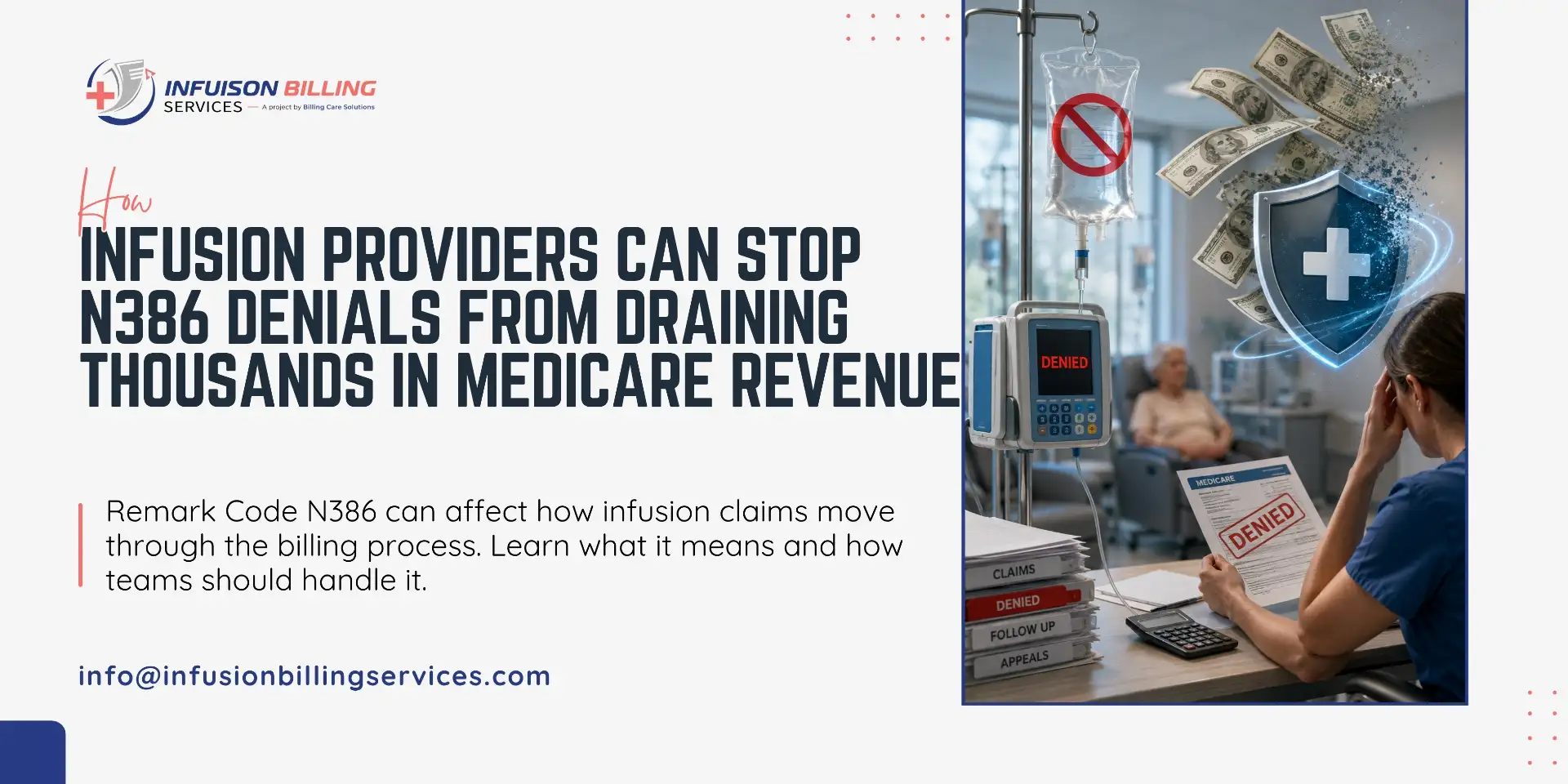
How Infusion Providers Can Stop N386 Denials From Draining Thousands in Medicare Revenue
Thousands of dollars can be lost in denied infusion revenue per one Remark Code N386 on remittance advice. Those who work with infusion providers and deal with high-cost biologics and specialty medications can’t afford not to know these codes. This cannot be overlooked as a way of safeguarding cash flow.
The denial codes listed in this section are among the most important denial codes for infusion claims. It indicates that a National Coverage Determination (NCD) was used to make a decision. An NCD is a national policy that CMS publishes stating whether a particular item/service is covered by Medicare.
If this code is in the remittance advice, the claim was denied or adjusted due to lack of coverage in a national Medicare policy. This can be especially devastating for infusion providers when there are complex NCD requirements associated with biologic therapies that can be easily overlooked.
What Is Remark Code N386?
Remark Code N386 is one of the X12 published standardized Remittance Advice Remark Codes (RARC) that are applied on the X12 electronic Remittance Advice (835). The official description is simple: It was made in accordance with a National Coverage Determination (NCD). NCDs are binding at national level. NCDs differ from Local Coverage Determinations (LCDs) in that they don’t depend on the location. NCDs are not tied to a specific area of the country like Local Coverage Determinations (LCDs). If an NCD excludes an indication or specifies clinical requirements, all Medicare claims for that indication must meet these requirements.
The Remark Code N386 N386 is rarely found without other codes. Usually accompanied by a Claim Adjustment Reason Code (CARC) like CARC 11 (diagnosis inconsistent with procedure), CARC 50 (non-covered services because of lack of medical necessity), or CARC 167 (diagnosis not covered). The RARC gives the background and the CARC gives the specific reason for the adjustment. Infusion providers must recognize that if your remittance includes the Remark Code N386, you’ll have to Look into the attached CARC to determine why the claim was denied.
Common Causes of Remark Code N386 on Infusion Claims
There could be multiple reasons for infusion claims to include Remark Code N386. To prevent the causes, you need to know what they are.
Service Not Considered Medically Necessary Under the NCD:
The most common reason for an Remark Code N386 is that the service or item provided would not be medically necessary under the appropriate National Coverage Determination guidelines. This is typically when the diagnosis is different from the covered indications in the NCD for infusion therapies.
Failure to Check the NCD Before Providing the Service:
Sometimes, the provider doesn’t check the NCD before giving an infusion therapy. This results in what was offered and what is actually covered are not aligned. This denial will be activated when a biologic is used in an indication not covered by the NCD.
Documentation Does Not Justify Medical Necessity:
Documentation submitted with the claim may not justify medical necessity, as per NCD standards. This is especially true for infusion claims, where clinical notes, laboratory results and treatment history are not sufficiently detailed or comprehensive to clearly indicate the need for the therapy.
Service Explicitly Excluded Under the Current NCD:
There are some services and items explicitly excluded under specific NCDs. Exclusion Category: If the infusion therapy is excluded, the claim will be denied with Remark Code N386
Coding or Billing Errors:
Errors in coding or billing can incorrectly suggest that a service should be covered under an NCD when it is not. This includes incorrect diagnosis codes, mismatched procedure codes, or missing modifiers that would have indicated the correct coverage pathway.
NCD Policy Has Been Updated:
Errors in coding or billing may result in an unnecessary claim that a service is covered under an NCD. These can be misdiagnosis codes, matching procedure codes, or missing modifiers that might have clarified the coverage pathway.
The Financial Impact of Remark Code N386 on Infusion Revenue
Remark Code N386 can cost infusion providers a lot of money. Biologic products are frequently a major revenue component of practices, particularly those that are high-cost. Lost reimbursement can amount to tens of thousands of dollars due to a denied claim.
Revenue Leakage
If an infusion claim is denied with Remark Code N386, the revenue is either delayed until the appeal is resolved or lost if the appeal fails. Even for infusion providers with a large volume of claims, a few denials on every Remark Code N386 claim can result in significant revenue leakage.
Administrative Costs
Staff time is required to investigate the denial, collect documentation, and follow-up with an appeal for each Remark Code N386 denial. Denials can add up very quickly and are an expensive way of rework. Providers estimate that a single denied claim costs them $25 to $118 in staff time to rework.
Treatment Disruption
If claims are denied, patients may be temporarily without treatment until the appeal is resolved. This puts the patient at clinical risk and can cause patient dissatisfaction and lost referrals.
Compliance Exposure
If there are repeated N386 denials, this could be a compliance issue. Those providers that fail to meet the NCD requirements routinely can be the target of audit review by Medicare contractors.
For Decision-Makers: The Financial Case for Addressing N386 Denials
The Cost of N386 Denials
One denied claim for infusion services is valued at $5,000 to $50,000. 500 infusion claims per month equates to $25,000 to $250,000 in monthly revenue at risk for a practice with a denial rate of 1% (or N386) per claim. On an annual basis that is $300,000 to $3,000,000 in potential revenue leakage.
| Monthly Infusion Claims | N386 Denial Rate | Monthly Revenue at Risk | Annual Revenue at Risk |
| 500 | 1% | $25,000 – $250,000 | $300,000 – $3,000,000 |
| 500 | 2% | $50,000 – $500,000 | $600,000 – $6,000,000 |
| 1,000 | 1% | $50,000 – $500,000 | $600,000 – $6,000,000 |
| 1,000 | 2% | $100,000 – $1,000,000 | $1,200,000 – $12,000,000 |
The ROI of Prevention
| Investment Area | Annual Cost | Potential Savings | ROI |
| Staff training on NCDs | $5,000 – $10,000 | $50,000 – $200,000 | 400-2000% |
| Pre-claim review process | $10,000 – $25,000 | $100,000 – $500,000 | 300-1000% |
| Outsourced NCD monitoring | $15,000 – $30,000 | $150,000 – $750,000 | 400-1000% |
| NCD compliance software | $8,000 – $20,000 | $75,000 – $300,000 | 275-1500% |
The Cost of Inaction
But if you don’t, you’ll continue losing out on money with regards to N386 denials. Deny each one and it’s permanent revenue loss. A denied claim that needs staff time to resolve will result in additional administrative costs and will not bring back 100% of the revenue. The total cost of inaction in a mid-size infusion practice can be more than $1 million over 3 years.
Decision Framework: In-House vs. Outsourced Management
| Factor | In-House Solution | Outsourced Solution |
| Cost | Variable, with fixed overhead | Predictable, fee-based |
| Expertise | Depends on staff training | Built-in, specialized |
| Scalability | Limited by staff capacity | Unlimited |
| Time to implement | 3-6 months | 1-2 months |
| Staffing requirements | Dedicated FTE needed | No internal staffing required |
| Technology investment | Required for tracking | Included in service |
| Compliance risk | Higher if staff turnover | Lower with dedicated experts |
Recommendation: If you have more than 10 hours weekly involved in NCD appeals or your denial rate on N386 is more than 2% of all your denials, it may be more cost efficient to outsource NCD monitoring & denial management rather than developing internal expertise.
How to Prevent Remark Code N386 Denials
N386 denials will only be denied if you take proactive measures regarding NCD compliance. The following strategies should be used by infusion providers.
Stay Current with NCD Updates:
NCD policies are subject to regular updating. It is the obligation of the provider to keep an eye out for CMS announcements and to check the CMS Medicare Coverage Database for changes that impact their infusion therapies. Compliance can be aided by subscribing to any CMS updates via email and setting up a staff member to monitor them.
Train Staff on NCD Requirements:
Billing and Clinical staff should be made aware of the NCDs applicable to the infusion therapies he/she provides. Errors can be minimized through periodic training on NCD updates and NCD coverage criteria.
Implement a Pre-Claim Review Process:
Claims should be checked against the NCD criteria prior to claiming. This includes confirming diagnosis is appropriate for therapy, accurate and complete documentation, and accurate coding. Pre-claim review may identify problems before the claim gets to the Payer.
Conduct Regular Audits:
Regular audits of billing practices and claims can identify discrepancies with NCD requirements. Audits should target high risk therapies and common denial reasons.
Establish Communication with Contractors:
Ensure a smooth communication link with your Medicare Administrative Contractor to clarify NCD interpretations. If there is any question as to whether the therapy will be covered, ask for a written determination before giving the therapy.
Verify NCD Coverage Before Administering Therapy:
Prior to administering an infusion therapy, determine if the service is covered under the applicable NCD. This includes verifying diagnosis, therapy, and limitations in frequency or dosage.
How to Address a Remark Code N386 Denial
If you receive a denial with Remark Code N386, here are some steps you can take to increase your chances of recovery.
Step 1: Review the Full Remittance Advice:
Check the ERA or EOB for any Remark Codes (RARC) that give more detail of the specific issue. Check the CARC to see the specific reasons for the denial.
Step 2: Identify the Applicable NCD:
Identify the specific NCD that is referred to on the remittance. NCDs are CMS publications and are available on the Medicare Coverage Database. It is important that your billing team understands where and how to find these determinations, and how to read them.
Step 3: Match Patient Documentation to NCD Criteria:
Scan the patient’s medical documentation and match it to the coverage criteria for the NCD. Conclude if the service was due to the NCD, or if the denial was correct.
Step 4: Gather Supporting Documentation:
If the service is to be covered, collect all documentation, Medical records, physician notes, lab results and any other documentation that supports medical necessity.
Step 5: Submit an Appeal:
Write an Appeal letter to the payer, providing a detailed explanation of why this service should be provided based on the NCD. Provide all the necessary documentation and reference the claim number and denial date.
Step 6: Follow Up:
Monitor the appeal status, and follow up on the appeal with the payer if no reply is received within the expected time frame.
How Infusion Billing Services Helps Providers Navigate NCD Compliance
The infusion billing services help infusion providers to handle the NCD compliance and Remark Code N386 denials. We take a proactive prevention and effective denial resolution approach. Avoiding the hassle of navigating regulations with our NCD Compliance Services.
Our NCD Compliance Services
NCD Monitoring: Keep updated with NCD updates and provide your team with any changes prior to affecting claims. This will obviate denials due to outdated knowledge.
Pre-Claim Review: Claims are reviewed prior to the claim being submitted with NCD criteria to address the possibility of potential issues.
Documentation Support: Medical documentation is completed to reflect medical necessity based on NCD guidance. Fully and accurately documented positions will have a greater chance of being accepted and will minimize the risk of being denied.
Denial Management: If Remark Code N386 denials are found, we investigate, collect supporting documentation and make a claim for the money.
Staff Training: We train your billing and clinical staff on NCD requirements and best practices for compliance.
Our Track Record
Consistent use of our services leads to fewer denials related to NCDs, quicker appeal resolution and higher revenue capture. Using proactive prevention and effective denial management, we help infusion providers mitigate the revenue loss from Remark Code N386.
Conclusion
Remark Code N386 is a very strong sign that an infusion claim has been denied because of a National Coverage Determination. Denials can be a major loss of revenue for infusion providers unless handled in a timely and effective manner. The best course of action when dealing with denial of Remark Code N386 is to prevent it from happening. Providers who are up-to-date on NCD updates, train staff, and carry out pre-claim reviews and regular audits can minimize these denials.
Denial is not always inevitable, and a systematic appeals process can prevent the loss of revenue. Knowing the particular NCD, collecting relevant evidence and preparing an effective appeal are vital aspects of the resolution procedure. If you’re ready to safeguard your infusion revenue from the effects of Remark Code N386, Infusion Billing Services has you covered. Call us today for a full compliance check.
Frequently Asked Questions
What does Remark Code N386 indicate on a remittance?
Remark Code N386 means that the claim was denied due to a National Coverage Determination. Medicare's national coverage criteria set by CMS were not met by the service.
Why do N386 denials happen on infusion claims?
Incomprehensible NCD requirements are often missed when billing infusion claims. Diagnosis mismatches, off label use and outdated policies are common reasons for denial.
How much revenue can a single N386 denial cost?
The problem with these denials is that they come at a high cost in terms of practice revenue, especially when it's associated with the use of high-cost biologics.
What is the difference between NCD and LCD?
NCDs are universal to all Medicare contractors in the country. LCDs are different in different regions and are created by local Medicare Administrative Contractors.
Can I appeal a Remark Code N386 denial?
Yes, most N386 denials can be successfully appealed with proper documentation. You must prove the service meets all NCD coverage criteria.
What documentation supports N386 appeal requests?
Provide physician notes, lab reports and treatment history. These records should make it clear why the therapy is needed.
How can providers prevent N386 denials?
Check the NCD coverage prior to giving infusion therapy. Keep up to date with policy changes and add pre-claim review to all submissions.
What is the cost of reworking an N386 denial?
The cost to rework one denied claim is approximately $25 to $118 of staff time. The excessive number of denials results in a lot of extra administrative costs at your office.
How does N386 affect infusion revenue cycles?
N386 denials cause revenue to be deferred and create a lot of administrative issues. They also disturb the continuity of treatment and the organization of patient care.
How can Infusion Billing Services help with N386?
We keep track of NCD updates, check claims prior to submission and handle the appeals. This minimizes denials and safeguards your infusion revenue properly.