

PR-242 Denials Cost an Infusion Practice $120,000. Here’s How We Fixed Them
August 12, 2026
How Infusion Providers Can Stop N386 Denials From Draining Thousands in Medicare Revenue
August 13, 2026PR-242 Denials Cost an Infusion Practice $120,000. Here’s How We Fixed Them
August 12, 2026How Infusion Providers Can Stop N386 Denials From Draining Thousands in Medicare Revenue
August 13, 2026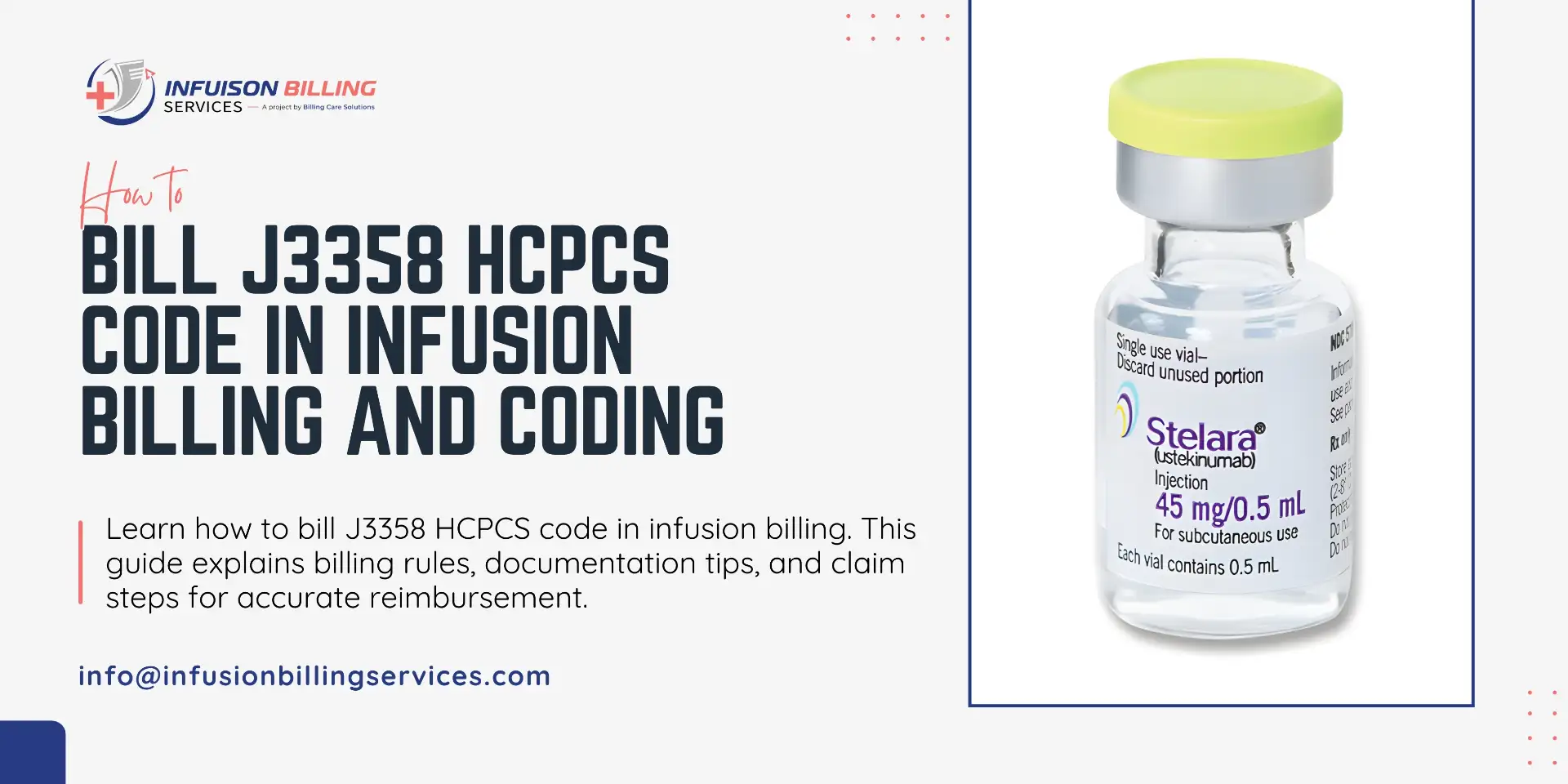
How to Bill J3358 HCPCS Code in Infusion Billing and Coding
Properly billing on J3358 is a key component in effective revenue cycle management for infusion services. Claim acceptance and accuracy of reimbursement, as well as the processing of claims by payers, is impacted by HCPCS code reporting for specialty infusion services. Billing mistakes can lead to claims denial, payment delays, and lost revenues. The problems encountered are often related to wrong units, missing documentation, code mismatches, and inadequate medical necessity coverage.
When it comes to infusion practices, the key to proper reporting is that the medication prescribed matches the diagnosis, dosage, units billed and the payer requirements. A billing workflow that is structured can minimize claim complications and aid in consistent reimbursement. Infusion Billing Services is dedicated to helping healthcare providers with the complicated process of infusion billing. Through HCPCS code validation, claim review, denial prevention, and full revenue cycle management solutions.
Understanding J3358 HCPCS Code for Infusion Billing
J3358 is a HCPCS level II drug code for reporting a particular drug administered during infusion therapy. Billing teams have to double-check the drug description, dosage, billing units and payer-specific requirements to ensure accuracy in reporting. If the medication is being infused then the administrator should report to this code with full documentation of the medication administration. Billing staff are responsible for verifying that the HCPCS code is the same as the drug sent and that proper administration codes are included on the claim.
Key billing considerations include:
| Billing Component | Requirement |
| HCPCS Code | Report J3358 with the correct drug identification |
| Units Billed | Match the administered dosage and payer billing rules |
| Diagnosis Support | Use diagnosis codes supporting medical necessity |
| Administration Coding | Report applicable infusion administration CPT codes |
| Documentation | Maintain medication records and clinical support |
It takes coordination between provider, coders and billing teams to accurately bill. Misplaced documentation, units or drug coding can cause delays in reimbursement and cause payers to review. A custom infusion billing process can help ensure that claims are compliant with the requirements mandated by payers and for faster reimbursement.
Calculating Dosing and Billing Units for J3358
It is important to have the correct unit calculation when billing claims. Units are reported by infusion providers in accordance with their actual infusion of medication, according to the HCPCS code unit definition and requirements for reporting to payers. The infusion record should be checked by billing teams for the medication dose. The dose administered should then be converted to billable units based on the description of this HCPCS code.
The basic calculation follows:
Total Billable Units = Administered Drug Amount ÷ HCPCS Billing Unit Size
If the HCPCS code is J3358 and it’s 1 billing unit for a certain drug quantity, then the practice should divide the total quantity of the drug administered by the HCPCS code’s quantity to calculate the number of billing units.
| Billing Step | Requirement | Impact on Claim |
| Verify Dose | Confirm medication amount administered | Prevents incorrect unit reporting |
| Review HCPCS Unit Definition | Follow J3358 billing unit requirements | Ensures accurate claim calculation |
| Calculate Units | Convert administered dose into billable units | Supports correct reimbursement |
| Validate Documentation | Match dose, units, and infusion record | Reduces payer disputes |
Typical unit bill problems are:
- Reporting units by the size of the drug package rather than the dose of the drug administered.
- Charging the wrong amount for services, because of calculation errors.
- Lack of documentation for units billed.
- Not adjusting unit calculations for the requirements of the different payers.
Proper unit billing provides infusion practices with a way to prevent underbilling, overbilling and claim denials. A detailed review process guarantees that the units billed correspond with medication dispensed and clinical records.
Documentation Requirements for J3358 Infusion Claims
Accurate billing fully documented, and medical necessity validation by payers. Infusion claims must have clear documentation linking the given medication, patient’s condition, dosage, and services billed.
Document Medication Details
Infusion records should provide the following information: Drug name, HCPCS code, dosage administered, billing units, route, and date of administration. The information aids to validate the claim about the medication.
Support Medical Necessity
The clinical documentation should provide a rationale for the need for the therapy. Provider notes should aid in the diagnosis, treatment plan and ongoing use of the medication.
Maintain Infusion Administration Records
Records should include infusion start and stop times, administration method, patient monitoring, and response to treatment. Complete administration details support accurate CPT reporting.
Verify Diagnosis and Drug Alignment
Infusion times (start, stop), treatment methods, patient observation and reactions to treatment should be documented. Administering information is complete, which enables accurate reporting of the CPT code.
Keep Authorization Records
When necessary, documents like prior authorizations, covering approvals from payers and supporting clinical information should be kept. These records help to avoid the delays during payer review.
Documentation minimizes claims questions and facilitates speedy reimbursement of J3358 infusion services. Using specific infusion claim workflows, infusion providers can enhance documentation review, HCPCS code validation, and infusion claim accuracy with infusion billing services.
J3358 vs. J3357: Key Billing Differences
When it comes to infusion billing, it’s important to know the difference between J3358 and J3357 to prevent claim processing problems. These codes are for various biologic products and must be identified correctly in preparation for claims submission.
| Billing Factor | J3358 | J3357 |
| HCPCS Code | J3358 | J3357 |
| Drug Classification | Biologic infusion drug reporting code | Biologic infusion drug reporting code |
| Billing Purpose | Used to report the specific product assigned to J3358 | Used to report the specific product assigned to J3357 |
| Unit Reporting | Requires accurate dosage-based unit calculation | Requires accurate dosage-based unit calculation |
| Claim Requirement | Must match administered drug and medical record | Must match administered drug and medical record |
| Denial Risk | Incorrect code selection may cause payment delays | Incorrect code selection may cause payment delays |
Mismatching these HCPCS codes can result in drug code mismatch, claim denial and reimbursement delays. A pre-claim validation process will help ensure accurate coding and will safeguard infusion revenue.
J3358 Infusion Administration CPT Coding
The drug and administration service both need to be considered separately when billing J3358. The HCPCS code represents the medication, the appropriate CPT code represents the administration service. Administered and eaten should be represented by the administration code. Coders should consult the actual method of administration, clinical documentation and the CPT guidelines for applicable services prior to choosing the service code.
For claims, verify these elements before submission:
| Coding Element | What to Verify | Why It Matters |
| Drug Code | Code matches the administered medication | Prevents drug identification errors |
| Administration CPT | Matches the documented administration service | Supports accurate service reporting |
| Dose | Matches the medication record | Supports correct J3358 units |
| Route | Matches the documented administration method | Prevents coding inconsistencies |
| Documentation | Supports both drug and service | Strengthens claim validation |
Avoid choosing an administration CPT code due to the medication billed only. The clinical record should reflect what the service was. Billing teams should also review bundling and reimbursement considerations unique to each payer. There is variation in the requirements for administration services and drugs. A final claim review should include a review of the units, administration CPT code, diagnosis, and clinical documentation. This ensures uniformity throughout the entire claim, and eliminates unnecessary reimbursement challenges.
Common J3358 Billing Errors and How to Prevent Them
Drug details and units, documentation and payer requirements do not always match to create a successful claim. These mistakes can be avoided to prevent rework and delay in reimbursements.
Incorrect Billing Unit Calculation
J3358 is one milligram of ustekinumab to be given intravenously. If the entire vial is used, then the 130 mg is 130 billable units. Units should be calculated based on the documented dose by billing teams. They should not take the number of packages as the number of units to be billed.
Using J3357 Instead of J3358
The subcutaneous administration of ustekinumab is reported by J3357. J3358 is used when ustekinumab is injected into the vein. The data recorded in the medical record must correspond to the HCPCS data. A drug and administration mismatch will result if a different code was used.
Missing Medical Necessity
Claims must be clinically documented including treatment and reported diagnosis. Payer review can be triggered by the lack of treatment history or supporting records.
Incorrect Administration Coding
The amount of infusion recorded on the administration service should be the same as what was infused. For instance, CPT 96365 is listed as a guideline for the first infusion of an IV in the office setting.
Ignoring Payer-Specific Requirements
Payer policies will vary from plan to plan or product to product. There are also ongoing changes in coverage rules as biosimilars are added to payer formularies. For instance, Maine Medicaid made J3358 a non-preferred option for 2026.
How To Prevent These Errors
When submitting drug claims, billing staff should check the specific drug, the route, the dose, the units, the diagnosis, the administration code and the payer requirements. A pre-claim review is a more proactive way of identifying any inconsistencies prior to those being a costly denial.
J3358 Payer Requirements and Prior Authorization
Payer Requirements for this code are dependent upon the patient’s insurance plan, indication, product and site of care. The practices should check existing coverage policies prior to treatment. One of the points to consider is prior prior authorisation. Aetna’s 2026 coverage update adds this code to the list of ustekinumab products that will be subject to coverage criteria, including medical necessity, and step-therapy requirements for applicable commercial plans.
There’s more complexity with biosimilar policies. Some payers have now identified certain ustekinumab biosimilars as preferred products and certain ustekinumab products as non-preferred products. One example is Maine Medicaid’s policy for 2026.
Billing teams need to verify prior to an authorization request:
- Active insurance and benefit coverage of the patient.
- Treatment is approved for the following condition:
- Required clinical documentation
- Step-therapy requirements
- Preferred biosimilar requirements
- This is a site of care that has been approved.
- Authorization effective dates
- The correct dosage and how often it is taken.
- Required renewal documentation
The authorization should also be consistent with the product and service being billed. A re-verification should be conducted when there is a change in a product, route, dosage, or coverage by insurance companies. This move is becoming more critical as payer formularies and preferred drug lists keep changing. Practices should not assume previous authorizations without confirming with the current plan requirements. As a result, a strong billing workflow integrates eligibility verification, prior authorization, clinical documentation, and claims submission. This minimizes the chance of authorizations being denied, and helps keep reimbursements safe.
Administration and Modifiers: Infusion Coding Best Practices
The cost of the drug is covered under billing J3358. You should also charge professional service for giving the infusion in. This is carried out employing CPT codes under the medicine section. The major code of an infusion service is the code 96365, which includes the first hour of an intravenous infusion as a treatment. In case the infusion lasts more than an hour, you may charge +96366 per hour. Infusion of this code should be done in more than one hour with an infusion set with an in-line sterile low protein-binding filter.
Another thing you should know is wastage modifiers, particularly in a drug which is expensive such as Ustekinumab Injection. The IV vials are single-dose vials thus there is sometimes some unused medication left over. This code has been proposed by CMS to be used as a single-dose container, i.e. wastage modifiers are necessary.
JW Modifier: This modifier is utilized to charge the dose of the drug that was discarded. You charge the sum of the amount administered and the sum discarded and attach the JW modifier to the line item representing the discarded amount.
JZ Modifier: This modifier ensures that no waste has taken place due to a single dose vial. You have to prove that the full amount of the vial was taken.
There is an appropriate way to use these modifiers, which can make you reimbursed the full price of the Ustekinumab Injection you have purchased and prepared. At the same time remaining not in violation of the payer rules.
Best Practices for Accurate J3358 Billing
The first step to accurate billing is verifying medication and administration data. The documented drug needs to be the same as the HCPCS code, dosage, route and treatment record.
Verify Units Against the Administered Dose: Billing teams should calculate units from the documented dose. The billed quantity should match the medication administered during the encounter.
Match Drug and Administration Coding: Administration CPT code should match the actual service provided. Infusion history should be reviewed prior to choosing the code for infusion.
Confirm Medical Necessity Before Submission: Documentation of diagnosis and clinical care should be supportive of the treatment rendered. Full records drive medical necessity and diminishes the need for the payer to seek clarification.
Verify Authorization and Payer Rules: Teams should check patients’ authorization status prior to treatment. They should also check the existing policies, coverage eligibility, and product needs of payers prior to submitting claims.
Complete a Pre-Claim Review: This is a final review that should include a comparison of the drug, units, diagnosis, administration code, authorization, and documentation. This measure will help to detect differences in advance in order to avoid claim delays.
These practices will result in an even billing of this code. It minimizes avoidable errors, enhances the correctness of claims, and aids in more stable reimbursement for infusion practices.
How Infusion Billing Services Improves J3358 Reimbursement
Keeping update of the complexities in J3358 is a large administrative burden. The variation in the range of errors between tracking new bio-similar codes, managing prior authorizations, weight-based doses and applying the correct modifiers. Each error could lead to refusal, with hours in the appeals process lost in labor time. Here specialized knowledge will be of value. Infusion Billing Services is a provider that specializes in the details of reimbursement for infusion. We are aware of the particularities of billing Ustekinumab Injection and can assist your practice in the following major ways:
Coding Accuracy: Our team will make sure that code is only utilized in cases of IV administration, units are computed accurately and NDCs are reported correctly on each claim.
Claims Management: We know how to leverage the distinction between medical benefits and pharmacy benefits, to ensure that your claims to Ustekinumab Injection are placed on the first time.
Denial Management: We have the specific expertise to swiftly resolve prior authorization, medical necessity or coding issues if they arise.
Compliance: We will stay updated of the new biosimilar entrants, and anything your payers and CMS may require, so your practice can stay profitable.
Conclusion
You should not just use the appropriate HCPCS code to correctly bill for the CPT code, J3358. The medication, intravenous administration, dosage, eligibility, diagnosis, administration service, documentation and payer requirements must be aligned with practices. A regular pre-claim review can be beneficial in identifying these issues prior to submission. Regular payer verification also assists practices in meeting changing authorization and coverage needs.
In the infusion provider’s case, a more strong billing procedure will help minimize avoidable denials and maximize accuracy in reimbursement. Specialized Infusion Billing Services can provide additional layers of protection to these controls and also decrease administrative workload.
Frequently Asked Questions
How do biosimilars affect J3358 reimbursement?
Biosimilars can alter the preferences and coverage policies of payers. Billing departments must confirm that the product administered is correct, the HCPCS code is correct and the payer policy is valid before filing any claim.
When should you use a JW modifier?
When an eligible drug amount is discarded from a single dose container, the JW modifier will be used. Before reporting wastage practices should record the amount of medicines administered and discarded.
Why does weight-based dosing matter here?
For some indications, the dose of ustekinumab is based on weight. If a patient's weight is entered incorrectly, it will result in incorrect J3358 units or create payer reimbursement problems.
Is J3358 billable for subcutaneous injections?
No, J3358 reports ustekinumab administered intravenously. Subcutaneous ustekinumab uses a different HCPCS code, so incorrect route reporting can cause claim denials.
What documentation supports J3358 medical necessity?
The documentation should be able to provide evidence for diagnosis, clinical history, treatment indication, prescribed dosage, and treatment. Records also should facilitate authorization issues and medical necessity for IV therapy.
How do NDC and J3358 reporting differ?
J3358 identifies the drug for HCPCS billing purposes. The NDC identifies the manufacturer, product, package size, and specific medication supplied for the claim.
How do payers verify J3358 dosage accuracy?
Payers are checking that billed J3358 units are in line with documented dosage and clinical records. They can also check patient weight, treatment indication, and dosing guidelines.
What happens without prior J3358 authorization?
Without proper authorization, claims may be denied and reimbursement could be delayed. Retroactive approval is not always granted, and students must be verified for administration before taking the medication.
How are J3358 billing units calculated?
J3358 billing units are based upon how much ustekinumab is administered. Billing teams should split the documented dose for the HCPCS billing unit prior to submission.
Can J3358 and J3357 be billed interchangeably?
NO, J3358 and J3357 are not the same route of administration. J3358 is for IV ustekinumab, and J3357 is for subcutaneous ustekinumab administration.