
Correct Use of Place of Service Codes for Infusion Claims
April 24, 2026
How to Bill Remicade Infusion Correctly in Infusion and Coding?
May 4, 2026Correct Use of Place of Service Codes for Infusion Claims
April 24, 2026How to Bill Remicade Infusion Correctly in Infusion and Coding?
May 4, 2026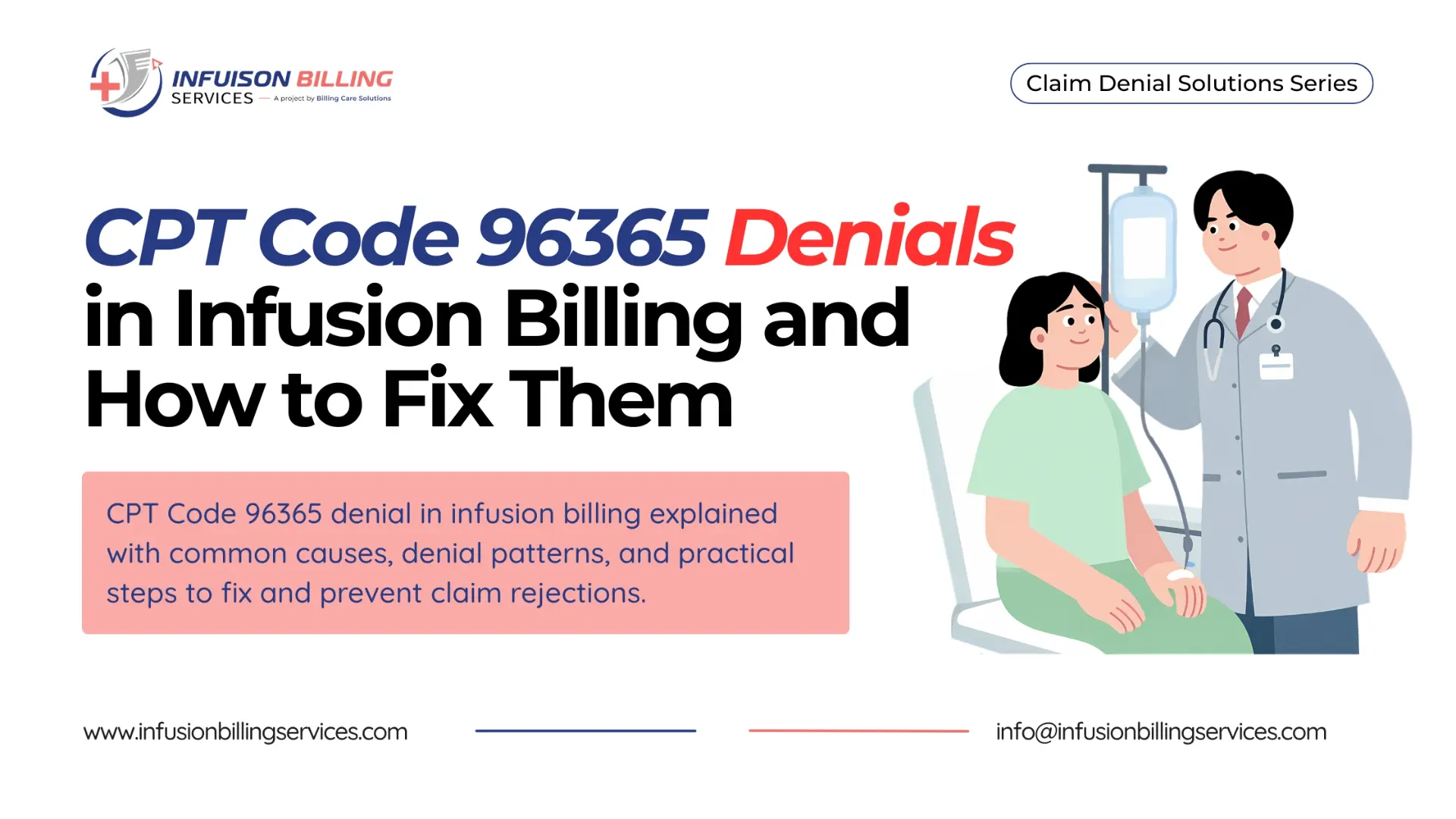
Infusion services are among the most extensively documented and the most commonly denied claims in medical billing. If an intravenous infusion service was rendered in the office, hospital outpatient setting, or any other infusion center, the healthcare provider would have to bill CPT Code 96365 to receive reimbursement for the performed service. CPT 96365 includes the first hour of a therapeutic, prophylactic, or diagnostic intravenous infusion, which is not classified as chemotherapy treatment.
Although it is a very commonly applied code, CPT Code 96365 is the code that has one of the highest numbers of denials in the sphere of infusion billing. Reasons for denials include a lack of documentation, improper use of diagnosis codes, potential bundling problems, and issues with prior authorizations.
This blog explains the most frequent denial causes associated with CPT Code 96365, one at a time, and provides you with practical ways to solve them. If you are a medical biller, coder, or office manager, then this blog post will teach you exactly how to deal with the issues that cause denials associated with CPT Code 96365.
Denial Reason 1: Missing or Incomplete Documentation
Why It Happens
This is one of the most frequent causes for which claims under CPT Code 96365 get rejected by insurance companies. Insurance providers require evidence to show that the procedure is justified and has been carried out. This is because, without proper documentation, there is nothing to substantiate the claim.
Common documentation gaps include:
- No physician order attached to the claim
- Nursing notes missing start and stop times
- No explanation for why IV route was chosen over oral medication
- Diagnosis not clearly linked to the infusion service
- No record of the drug name, dose, or route of administration
How to Fix It
- Attach the signed physician order with every claim
- Record infusion start time and stop time in the nursing notes
- Document why oral or other routes were not suitable for this patient
- Make sure the clinical note connects the patient diagnosis to the need for IV therapy
- Include the drug administered, dosage, and how it was given
- Train nursing staff to complete infusion logs at the time of service, not after the fact
Denial Reason 2: Wrong Diagnosis Code Linked to CPT Code 96365
Why It Happens
Even when the infusion is performed correctly and documented properly, a wrong or unspecified ICD-10 code can trigger an automatic denial. Payers use diagnosis codes to determine if the service was medically necessary. If the diagnosis does not justify IV administration, the claim will be denied.
Common mistakes include:
- Using a general or unspecified diagnosis code
- Linking a diagnosis that has no coverage policy for IV infusion
- Submitting a code that does not match the physician’s documented reason for the infusion
- Using an outdated ICD-10 code that has been replaced or deleted
How to Fix It
- Use the most specific ICD-10 code available that reflects the patient’s condition
- Choose diagnosis codes that directly support the need for IV therapy such as dehydration, severe infection, autoimmune conditions, or medication administration requiring IV access
- Cross-check the diagnosis against the payer’s Local Coverage Determination or coverage policy for infusion services
- Never use unspecified codes when a more detailed code is available
- Review ICD-10 updates each October to make sure your codes are current
Denial Reason 3: Bundling Issues with Other Infusion Codes
Why It Happens
There exists a certain hierarchy of codes for infusion billing purposes. For example, CPT Code 96365 has been specified as the first code for therapeutic infusion. If there is more than one infusion or injection administered during the same day, insurers will bundle the services. In such cases, insurers may reject CPT Code 96365.
Common bundling conflicts include:
- Billing 96365 alongside 96374 without proper sequencing
- Billing 96365 as an add-on when it should be the primary code
- Not following the correct order of primary and sequential infusion codes
- Billing 96365 and 96360 together when only one can be the primary service
How to Fix It
- Learn the infusion coding hierarchy before building your charge sheet
- CPT Code 96365 should be billed as the primary code when a therapeutic infusion is the main service of the visit
- If hydration and therapeutic infusion are both given, the therapeutic infusion takes priority as the primary service
- Use add-on codes like 96366 for each additional hour of the same therapeutic infusion
- Review CMS and AMA infusion coding guidelines to understand when each code applies
- Audit your claims monthly to catch bundling errors before submission
Denial Reason 4: Modifier 59 or XU Not Applied Correctly
Why It Happens
If there are two separate infusion services claimed on one day and both claims are valid, the payer must verify that the infusion services are different from each other. If the proper modifier is not used, then the second claim is considered a duplicate by the system.
Common modifier mistakes include:
- Skipping modifiers entirely when two infusions are given
- Using Modifier 59 when a more specific X modifier is required by the payer
- Placing the modifier on the wrong line of the claim
- Not knowing which payer requires which modifier
How to Fix It
- Apply Modifier 59 to show that CPT Code 96365 is a distinct and separate service from other infusion codes billed on the same date
- For Medicare claims, use the more specific X modifiers such as XU for unusual non-overlapping services when applicable
- Check each payer’s modifier policy because commercial payers and Medicare do not always follow the same rules
- Place the modifier on the correct CPT line and verify it is visible in the claim before submission
- Keep a payer-specific modifier reference guide in your billing department for quick lookup
Denial Reason 5: Prior Authorization Was Not Obtained
Why It Happens
Many of the insurance policies used commercially will need authorization prior to administering a therapeutic infusion. Failure to acquire the necessary authorization prior to the date of service will mean that the claim under CPT code 96365 will be denied irrespective of documentation and coding accuracy.
Common authorization failures include:
- Assuming authorization is not needed because it was not required previously
- Obtaining auth for the drug but not for the administration code
- Auth obtained under the wrong provider or facility
- Auth number not included on the claim form
- Auth expired before the infusion date
How to Fix It
- Verify prior authorization requirements for every patient and every payer before scheduling the infusion
- Confirm that the authorization covers both the drug and the administration code including CPT Code 96365
- Make sure the auth is tied to the correct provider, facility, and date of service
- Enter the authorization number in the correct field on the CMS-1500 or UB-04 form
- If authorization was missed, file a retro-authorization request immediately and attach clinical documentation showing medical necessity
- Set up calendar alerts for authorization expiration dates to avoid gaps in coverage
Denial Reason 6: Place of Service Error
Why It Happens
The CPT code for 96365 may be billed in many locations such as doctor’s office, outpatient facility within hospitals, and ambulatory infusion centers. The only problem here is that each location has its own unique Place of Service code, and if the wrong code is submitted, then the payer rejects the claim because reimbursement rates differ based on the location.
Common POS errors include:
- Billing POS 11 for a service performed in a hospital outpatient department
- Using POS 22 for a service done in a freestanding infusion center
- Not updating the POS when a practice opens a new infusion suite
- Billing professional and facility claims with mismatched POS codes
How to Fix It
- Use POS 11 for infusions performed in a physician office setting
- Use POS 22 for hospital outpatient department infusions
- Use POS 24 for ambulatory surgical or infusion center settings
- Confirm the correct POS with your facility administrator when setting up new service locations
- Cross-check the POS on every claim before submission as part of your pre-billing audit
- When in doubt, call the payer to confirm which POS code they expect for your specific provider type and location
Denial Reason 7: Timely Filing Limit Exceeded
Why It Happens
The deadline for filing the claim always follows the day of service on which the medical services are performed. In case of late submission of a claim related to CPT code 96365, it will automatically get rejected due to untimely filing. Such type of rejection is one of the most avoidable but costly rejections as well.
Common timely filing failures include:
- Claims sitting in a queue due to missing information
- Authorization delays pushing the submission past the deadline
- Staff not tracking submission deadlines by payer
- Rejected claims not being corrected and resubmitted in time
- New patients with insurance that has a shorter filing window than expected
How to Fix It
- Track the filing deadline for every payer in your system and flag claims approaching that limit
- Most Medicare claims must be filed within 12 months of the date of service
- Commercial payers may allow anywhere from 90 days to 12 months, so verify each payer’s specific deadline
- When a claim is rejected, correct and resubmit it within 24 to 48 hours to protect your filing window
- If a timely filing denial is received, appeal it with proof of original timely submission such as a clearinghouse report or electronic submission confirmation
- Do not let unresolved claims age past 30 days without follow-up
Denial Reason 8: Credentialing or Provider Enrollment Issues
Why It Happens
A claim for CPT Code 96365 will be denied if the billing provider is not credentialed and enrolled with the patient’s insurance plan. This happens more often than most practices realize, especially when new providers join a group or when a practice opens a new infusion location.
Common credentialing issues include:
- Billing under a provider who is not yet enrolled with the payer
- Provider enrolled at one location but infusion performed at another
- Rendering provider and billing provider mismatch on the claim
- Group NPI and individual NPI conflicts
- Delays in credentialing causing services to be rendered before enrollment is complete
How to Fix It
- Verify provider enrollment status with every payer before scheduling infusion patients under that provider
- Do not render services under a new provider until credentialing is confirmed in writing
- When a new infusion location opens, ensure the facility is also enrolled separately with each payer
- Follow incident-to billing rules where applicable to bill under an enrolled supervising physician while a new provider’s credentialing is pending
- Keep a credentialing tracker that shows each provider’s enrollment status by payer and renewal dates
- Submit credentialing applications at least 90 to 120 days before the provider is expected to begin seeing patients
Denial Reason 9: Drug or Supply Code Missing from the Claim
Why It Happens
CPT Code 96365 covers the administration of the infusion but it does not include the drug itself. Payers expect to see both the administration code and the corresponding HCPCS drug code on the same claim. When the drug line is missing, incomplete, or inaccurate, payers often deny the administration code as well because they cannot verify what was administered.
Common drug billing errors include:
- Submitting CPT Code 96365 without the HCPCS drug code
- Using the wrong drug code or an outdated J-code
- Not including the NDC number when required by the payer
- Incorrect drug units that do not match the dosage documented in the chart
- Billing the drug under a different date than the administration code
How to Fix It
- Always bill the HCPCS drug code alongside CPT Code 96365 on the same claim
- Use the correct J-code that matches the specific drug administered as documented in the clinical notes
- Include the NDC number in the correct claim field when required, especially for Medicare and Medicaid claims
- Make sure the drug units match the actual dosage given and reflect what is documented in the physician order and nursing notes
- Ensure the drug code and administration code share the same date of service on the claim
- Update your drug code reference list regularly because J-codes and NDC numbers change frequently
Let Infusion Billing Services Handle CPT Code 96365
Handling denial of claims under CPT code 96365 requires expertise and experience. At Infusion Billing Services, we have all of that when it comes to claims denials.
Being an infusion billing specialist, we have handled many different cases involving denial of claims under CPT code 96365. This is because we only provide billing services to practitioners of infusion therapy. Therefore, we know the reasons behind all the denials, as well as, the required solutions. Our team handles everything from start till end when it comes to handling denials.
If CPT code 96365 denials are causing a dent in your revenues, then contact us at Infusion Billing Services to fix things for you.
Conclusion
Denial of CPT Code 96365 can be an annoying issue, yet one that is completely avoidable in many cases. Each of the above reasons of the CPT Code 96365 denial presented in the blog post have been solved based on a proper approach prior to submitting the claim. Documentation, coding, understanding of payers, and a proper appeals process are four cornerstones of clean infusion billing.
Understanding each and every reason for denial and having a procedure in place aimed at detecting problems during the process of coding makes it possible to minimize the number of denials. In case a denial does occur, an immediate and documented appeal will increase the chances of reimbursement rather than loss of revenue.
Infusion billing is all about being organized, meticulous, and consistent. It is recommended to audit the last 90 days of your CPT Code 96365 claims and identify the main reason behind denial in order to reduce the number of CPT Code 96365 denials.