

Is It Time to Outsource RCM for Your Infusion Practice? 8 Signs You Shouldn’t Ignore
August 10, 2026
How Administrative Errors Were Fixed to Reduce Claim Denials in Infusion Billing
August 11, 2026Is It Time to Outsource RCM for Your Infusion Practice? 8 Signs You Shouldn’t Ignore
August 10, 2026How Administrative Errors Were Fixed to Reduce Claim Denials in Infusion Billing
August 11, 2026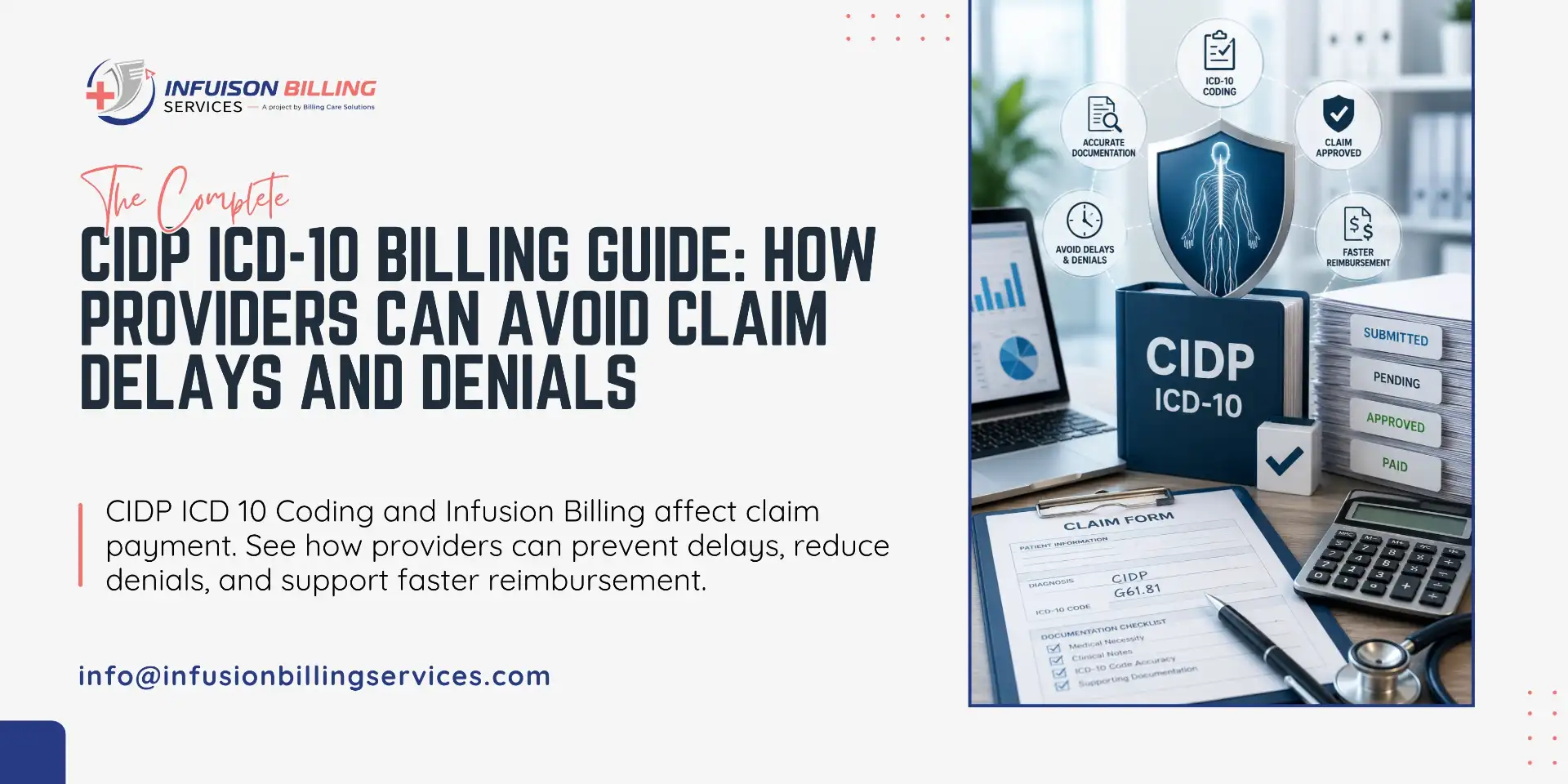
The Complete CIDP ICD 10 Billing Guide: How Providers Can Avoid Claim Delays and Denials
Accurate CIDP ICD 10 coding plays an important role in successful infusion billing. The chronic inflammatory demyelinating polyneuropathy tends to need specialty care and careful payer consideration. Claims may be subject to medical necessity questions when the diagnosis code doesn’t support the billed therapy. An error in coding also can delay when a payer asks for additional clinical information.
More than just choosing the right diagnosis code is required during billing. Providers are also responsible for linking the diagnosis to the treatment plan, type of drug administered, dosage, administration of the drug and their requirement from the payer. These details are particularly relevant to infusion practices when accounting for high cost therapies, like IVIG. Claim processing and reimbursement can be impacted by a minor coding or documentation error.
This guide covers the correlation of CIDP ICD 10 code with infusion billing. It also includes documentation, medical necessity, authorization, coding issues, and strategies to minimize claim delay and denials.
Understanding CIDP ICD 10 in Infusion Billing
Chronic inflammatory demyelinating polyneuritis is coded G61.81 in ICD-10-CM. Correct reporting aids in establishing the diagnosis used for the treatment and medical necessity of the patient. The diagnosis for infusion billing should match the provider’s clinical evaluation and treatment plan. The code should also comply with the coverage parameters of the payer that are used for the therapy.
No identification of infusion drugs or administration service (code does not specify). Services must be separately reported on the claim using the HCPCS and CPT codes.
For example, an infusion claim may include:
- ICD-10-CM: G61.81 for CIDP
- HCPCS: Drug-specific code for the medication administered
- CPT: Applicable code for the infusion administration service
These coding elements have different functions. The ICD 10 is used to identify the patient’s condition and HCPCS identifies the drug and the CPT reports the administration service. All of these should be backed by the clinical documentation. If the diagnosis, the medicine or the treatment does not match with the diagnosis, medicine or treatment record, the payer may ask for more information or refuse the payment of the claim. Therefore, billing staff should look at the infusion record and coding ICD 10 for CIDP. This method assists providers in solving issues with claims prior to filing and assists with consistent reimbursement.
Why CIDP ICD 10 Coding Affects Infusion Reimbursement
Financial effects of CIDP coding for CIDP are not limited to a single rejected claim. Documentation and coding weaknesses may impact various treatment encounters since CIDP can be treated multiple times. CMS mandates records for Medicare IVIg claims to document the diagnosis of CIDP, when to initiate IVIg treatment, and the necessity for ongoing treatment. Continuous treatment is also based on clinical improvement documented.
This creates several financial risks for infusion providers.
| Billing Risk | What Happens | Financial Effect |
| Diagnosis mismatch | Payer questions the CIDP indication | Payment review or denial |
| Weak medical necessity | Records do not support IVIg treatment | Delayed reimbursement |
| Missing treatment response | Continued therapy lacks measurable support | Risk to future claims |
| Recurring documentation gap | Same issue appears across multiple visits | Repeated rework and revenue delays |
| Authorization mismatch | Approved treatment differs from billed service | Claim correction or denial |
If the treatment is to be continued over several months, the risk increases. If the same issue does not get resolved, it may have an impact on several claims. A practice with 40 CIDP patients treated by 4 encounters per month would have a total of 160 CIDP related encounters per month. For this reason, a frequent coding or documentation issue carries a much greater dollar impact than a denied claim.
The primary control is to review the CIDP coding in conjunction with medical necessity, treatment response, authorization and the therapy billed. This enhances the support for claims of recurrent infusion. An RCM team should not only report G61.81 accurately. The diagnosis, clinical evidence, treatment plan and claim must be the same throughout the course of the patient’s treatment.
Linking CIDP Diagnosis With Infusion Therapy Codes
Each CIDP ICD 10 code addresses a different question on the claim in CIDP ICD 10 billing. The diagnosis is the reason for the treatment. The HCPCS code is the identification of the IVIg product and quantity billed. The CPT code records the way the medication was given.
The structure of a claim by a CIDP patient on IVIg typically is as follows:
G61.81 → IVIg HCPCS code → IV infusion CPT code
Here is how the coding connects:
| Claim Level | Code Example | Connection to CIDP Treatment |
| Diagnosis | G61.81 | Establishes CIDP as the condition being treated |
| Drug | J1561 or J1569, depending on product | Reports the specific IVIg product administered |
| Administration | 96365 | Reports the initial therapeutic IV infusion service |
| Additional Administration | 96366 | Reports qualifying additional infusion time |
For instance, if the provider records the diagnosis of CIDP on the encounter and provides an IVIg product in the outpatient infusion encounter, G61.81 supports the diagnosis. The appropriate IVIg HCPCS code identifies the drug. When service is performed that complies with the code requirements, the initial IV infusion is reported in CPT 96365. CPT 96366 may be used for qualifying additional time if the infusion is continued beyond the initial time period.
The actual start and stop times need to be compatible with the administration coding. The drug code should also correspond with the drug that was administered. J1561 cannot be used in place of J1569. Provide the billing team with a copy of the specific IVIg product prior to choosing the HCPCS code and determining units.
Documentation Requirements for CIDP Infusion Claims
Excellent documentation provides the supporting clinical information required to consider CIDP infusion claims. The record should describe the system of diagnosis, treatment and response to treatment for the patient. Documentation for CIDP ICD 10 billing should include documentation for G61.81 and the actual infusion therapy being reported on the claim. The diagnosis code should not be the sole basis for the record.
Important records include:
| Documentation | What It Should Support |
| Neurologist Evaluation | CIDP diagnosis and clinical findings |
| Treatment History | Previous therapies and treatment response |
| IVIg Treatment Plan | Reason for therapy, dosage, and frequency |
| Infusion Record | Drug administered, dose, route, and administration details |
| Progress Notes | Ongoing response and reason for continued treatment |
| Authorization Records | Payer approval and approved treatment details |
When IVIg is given repeatedly, treatment responses should be documented in particular. Documentation of continued medical necessity and measurable clinical improvement for ongoing IVIg therapy is included in the CMS coverage guidance. Before processing recurring claims, billing teams need to audit these records. When the clinical record fails to support a claim for the treatment, it will take longer to fix the problem after it has been denied, and then the payment will be delayed. It is therefore important that the CIDP ICD 10 code, treatment documentation and billed infusion remain the same throughout the patient’s treatment course.
Prior Authorization for CIDP Infusion Therapy
One of the key steps in the CIDP infusion billing process is prior authorization, particularly for expensive drugs like IVIg. Payers may look at the diagnosis, treatment recommendations, history and proposed therapy before approving coverage. If a patient has CIDP ICD 10 code G61.81, the request for authorization of the infusion therapy should definitely make a clear link between the diagnosis and the requested infusion treatment. The information that is turned in should also be consistent with what is sent to the payer as a claim.
Common authorization checkpoints include:
| Authorization Detail | What Billing Teams Should Verify |
| Diagnosis | G61.81 and supporting clinical records |
| Drug | Authorized IVIg product matches treatment |
| Dosage | Approved dose matches the treatment plan |
| Frequency | Approved schedule matches planned infusions |
| Authorization Dates | Treatment falls within the approved period |
| Patient Coverage | Authorization applies to the active insurance plan |
One issue that is frequently encountered is when an authorization is granted and the actual claim includes different data. An IVIg product, dosage or treatment frequency change without an updated authorization can result in a payer review, for example.
Billing staff should check for authorization prior to every therapy offered, particularly for reoccurring therapy. This will help to determine whether the approval has expired, the payer’s requirements have changed, or there is a discrepancy between the approved treatment and the intended infusion.
In CIDP ICD 10, authorization management should be performed along with coding and clinical documentation. By maintaining such alignment, unnecessary delays are avoided and the claim becomes more compelling to submit.
Common CIDP ICD 10 Billing Errors
When CIDP ICD 10 billing errors take place, they are frequently related to problems in the diagnosis coding, infusion services and payer requirements. These become more expensive when the patient is treated repeatedly with IVIg.
Using an Unsupported Diagnosis: Reporting G61.81 without sufficient clinical documentation can create a medical necessity issue. The diagnosis code should reflect the provider’s documented diagnosis and support the treatment being billed.
Mismatching Drug and Diagnosis: Diagnosis, IVIg product and treatment plan should be clinically logical together. If there is a mismatch, there is the possibility of further payer review, particularly for high cost infusion therapy.
Incorrect IVIg HCPCS Units: When using HCPCS code, the HCPCS code is always the correct unit and the units are the amount billed under the code’s billing definition. Underpayment, overpayment or claim correction can result from incorrect units calculated.
Billing the Wrong Administration Code: The administration CPT code should reflect the actual infusion service and documented time. Selecting a code without reviewing the infusion record creates avoidable billing risk.
Continuing Therapy Without Updated Support: Recurring CIDP requires continuous clinical support of treatment. Progress notes that lack of medical necessity or treatment response increase the risk of review for future claims.
Therefore, a pre-submission review should address the CIDP ICD 10 code, IVIg HCPCS code, administration CPT code, units, authorization, and supporting records in one claim and not look at each individual element.
Financial Impact of CIDP Infusion Claim Denials
When the same error occurs for multiple infusion claims the financial consequence of the CIDP ICD 10 billing error rises. If a problem arises in one encounter, it is very likely that there is a workflow problem in future claims. A recurring billing problem, for instance, on a practice with 20 CIDP patients who are being treated monthly, won’t impact 20 claims the first time around. Can impact 20 claims per month, until the underlying problem is resolved.
| Recurring Claim Issue | Potential Revenue Impact |
| Incorrect CIDP diagnosis support | Multiple claims placed under review |
| Missing medical necessity evidence | Repeated payment delays |
| Authorization inconsistency | Multiple treatment claims affected |
| Incorrect drug or administration reporting | Repeated corrections or underpayments |
The greater the number of treatments, the higher the financial risk. If a patient has a documentation or coding issue for one month, then for the next six months, six encounters will be created instead of one. Hence, it is important to track the accuracy of CIDP ICD 10 at the patient level. If the same issue is being identified in multiple encounters, the RCM team should address the root cause of the problem and not each denial individually.
The challenge for infusion providers is to detect patterns for repeat claims as early as possible. This reduces the potential for rework, safeguards reimbursement and ensures that a single billing error doesn’t persist through the patient’s treatment.
How RCM Teams Can Reduce CIDP Billing Delays
Inconsistencies can be identified to prevent claim denials in CIDP ICD 10 claims. There should be focus on the areas of clinical, authorization and billing information change between treatment cycles. In a recurrent IVIg patient, for instance. Treatment frequency, dosage, product, authorization period or clinical response may change, but not the diagnosis. These changes should get to the billing workflow.
A practical review should focus on three points:
| Review Point | What RCM Teams Should Check |
| Before Treatment | Active coverage, authorization, approved therapy |
| Before Claim Submission | Diagnosis, drug, units, administration service |
| During Follow-Up | Denial patterns, payer requests, treatment changes |
The aim is to not take each refused claim as an individual claim. If multiple claims for CIDP are being returned for the same payer and for similar reasons, the team should determine if there’s a common cause. For instance, if there are multiple requests for medical records, it may be a problem with the way medical records are handled. If there are repeated authorization discrepancies, this may be a sign of inadequate tracking of authorization changes.
Knowing these trends, by payer, patient, drug, and denial reason, provides RCM leaders a better understanding of where delays are coming from. This approach renders ICD 10 billing for CIDP more proactive. Teams proactively solve issues before they impact the next treatment cycle rather than fix them after payment problems are experienced.
Modifiers in CIDP Infusion Billing
Modifiers are significant when there is a need to provide more details regarding the drug given or rejected on the IVIg claim. The diagnosis code is not used to determine the modifier for CIDP ICD 10 coding. The modifier is based on the drug billing situation and the rules of the payers. JW and JZ are among the key examples of drugs covered under Medicare drug wastage reporting requirements, if they are separately payable.
| Modifier | When It Applies | Billing Purpose |
| JW | Drug amount discarded from a single-dose container | Reports the discarded amount |
| JZ | No drug discarded from a single-dose container | Confirms zero drug wastage |
An eligible single dose IVIg product, for instance, which is 50 units, requires the bill to show the number of units given as well as any eligible number of units discarded from the container. JW is then considered based on the applicable wastage reporting requirements. Requirements for payers are also a factor. JW and JZ should not be treated the same as every commercial payer without verifying its current policy as it pertains to Medicare rules. Therefore, for CIDP ICD 10 claims, modifiers should be considered as an independent step in claims validation. The diagnosis identifies the condition, and the modifier provides additional details of billing circumstances associated with the service or drug.
Payer-Specific Considerations for CIDP Infusion Billing
The process of CIDP ICD 10 billing is not the same with all payers. Medicare, Medicaid, and commercial plans may have different coverage criteria, authorization requirements, documentation requests, and IVIg policies. The risk for RCM teams is when they adapt the workflow of one payer to another’s claim.
| Payer Factor | What RCM Teams Should Verify |
| Coverage Policy | Whether CIDP and the requested therapy meet coverage criteria |
| Prior Authorization | Required approval and renewal conditions |
| Drug Policy | Covered IVIg product and billing requirements |
| Documentation | Records required to establish medical necessity |
| Reauthorization | Requirements for continuing treatment |
For instance, Medicare has coverage criteria for IVIg treatment of CIDP. Some commercial payers may have their own authorization forms and supporting documentation requirements or may have different clinical criteria. These differences matter when patients switch to a new health insurance plan, or if a practice has more than one payer contract. A process that is efficient for a particular payer may cause an unnecessary delay for another.
RCM teams should ensure that each payer has their own requirements for CIDP ICD10 claims and monitor for changes in policies. This helps to avoid that “legacy” of outdated authorization, documentation, or billing rules to be passed into new claims.
How Infusion Billing Services Supports CIDP Claims
Coordinating the clinical documentation, authorization, coding, drug billing and payer follow-up for CIDP ICD 10 claims is required. Such tasks are more challenging when practices administer repetitive IVIg treatments to many payers. An infusion billing support system provides a specific review point for each claim part.
| RCM Function | CIDP Claim Support |
| Eligibility Review | Confirms active coverage before treatment |
| Authorization Management | Tracks approvals and renewal dates |
| Coding Review | Validates diagnosis, drug, units, and administration codes |
| Claim Review | Identifies inconsistencies before submission |
| Denial Analysis | Finds recurring CIDP claim problems |
| Payment Review | Identifies unresolved or underpaid claims |
It is the interconnection of these functions and not the individual billing functions that add value. The same patient can make claims over a period of several months for CIDP treatment. By maintaining continuity across those encounters, changes in treatment, authorization or payer requirements can be identified. RCM teams that are focused on infusion can also track the common denial patterns. This allows practices to deal with the root rather than the symptom, which is the claim, and saves them from continual correcting of the same claims. This is useful for providers who administer high-value infusion therapy as it helps to generate cleaner CIDP ICD 10 claims and helps to maintain consistent reimbursement.
Conclusion: Strengthening CIDP Infusion Billing
CIDP ICD 10 coding is just a part of the bigger infusion billing process. The diagnosis should not be changed from the clinical record, treatment plan, authorization, drug billing and administration service. This alignment is even more important to consider when given as a recurrence maintenance dose of IVIg. There can be more than one treatment encounter that is impacted by a small billing weakness that hasn’t been resolved.
Therefore, it is important that a provider review CIDP claims throughout the revenue cycle. Each of these categories plays a role in determining diagnosis accuracy, documentation, tracking and authorization, HCPCS units, administration coding, modifiers, and payers. It is not just about rectifying denied claims. This is to catch the source of the vulnerability and correct the workflow in advance so it doesn’t impact the next treatment cycle. When billing for CIDP ICD 10 and infusions is structured, providers will have reduced avoidable delays, better claim support and safeguard recurring infusion revenue.
Frequently Asked Questions
What CIDP ICD 10 code supports infusion billing?
Chronic inflammatory demyelinating polyneuritis is coded as G61.81. The medical record should support the diagnosis and relate it to the billed infusion therapy.
How does CIDP coding affect IVIg reimbursement?
CIDP coding aids to confirm the condition for treatment. Payers also check clinical records, drug billing, administration details, medical necessity and authorization.
Which codes accompany CIDP ICD 10?
G61.81 reports the diagnosis. The claim separately reports the applicable IVIg HCPCS code and CPT administration code for the service.
Can incorrect CIDP coding delay payments?
Yes, inconsistent diagnosis coding can trigger medical necessity reviews or documentation requests. These reviews delay reimbursement and increase billing staff workload.
What documentation supports CIDP infusion claims?
Records should support the diagnosis, treatment rationale, prescribed therapy, administered medication, dosage, and ongoing treatment response. Documentation should remain consistent across encounters.
Does IVIg require prior authorization for CIDP?
Authorization requirements depend on the payer and treatment circumstances. Teams should verify approval, covered product, dosage, frequency, dates, and renewal requirements.
How should RCM teams review CIDP claims?
Teams should compare diagnosis, documentation, authorization, drug codes, units, administration codes, and payer requirements before submitting recurring infusion claims.
When do JW and JZ modifiers apply?
JW reports eligible discarded drug amounts. JZ reports zero discarded amounts. Billing teams should follow current Medicare requirements and payer-specific policies.
Why do recurring CIDP claims need monitoring?
Recurring treatments create repeated billing opportunities and repeated risks. One unresolved coding or authorization issue can affect several future infusion claims.