
E0781 Billing Guide: How to Prevent Infusion Pump Denials & Maximize Medicare Reimbursement
August 18, 2026
Understanding the Differences between Infusion Billing vs Injection Billing
August 19, 2026E0781 Billing Guide: How to Prevent Infusion Pump Denials & Maximize Medicare Reimbursement
August 18, 2026Understanding the Differences between Infusion Billing vs Injection Billing
August 19, 2026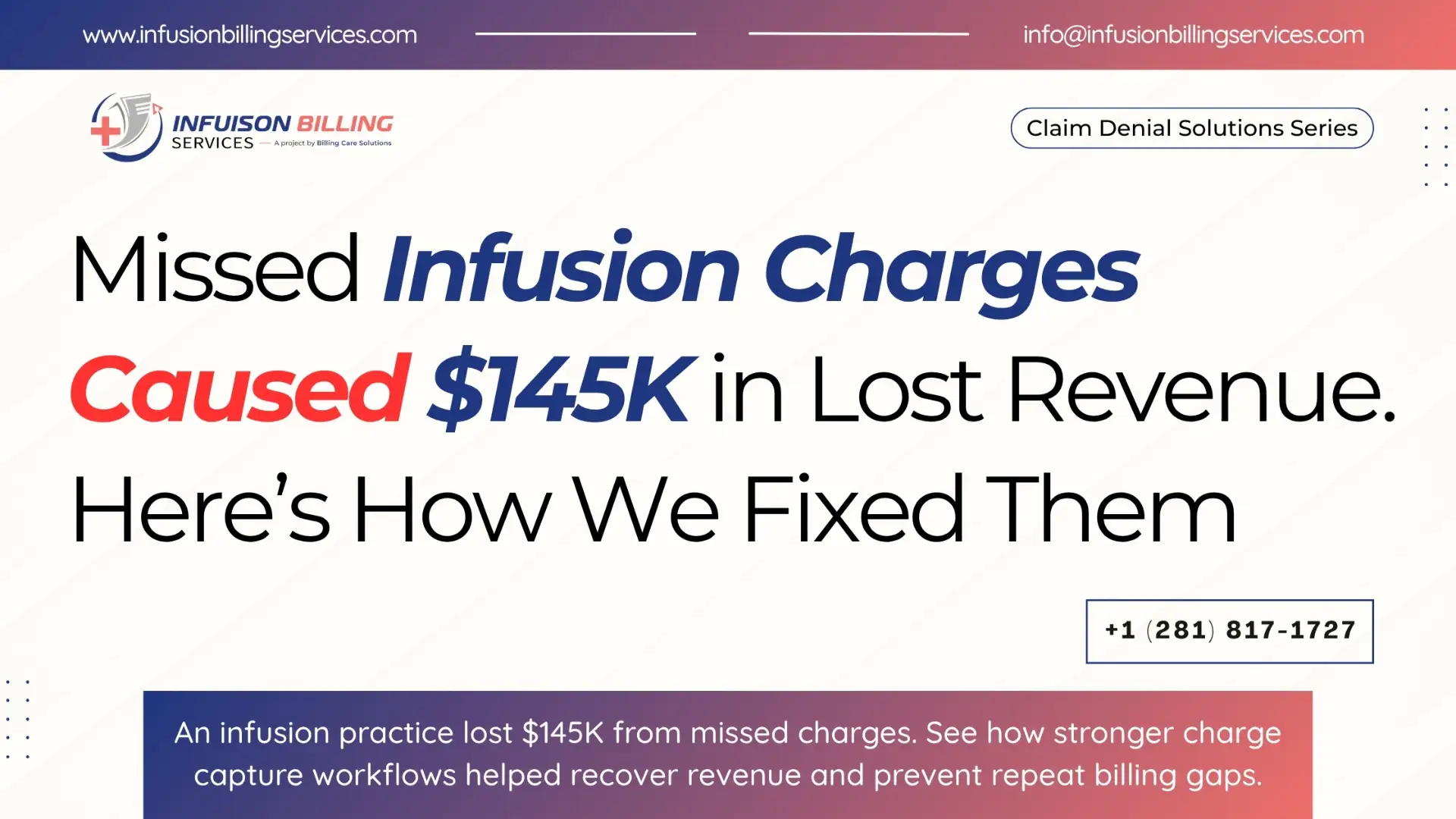
Charge Capture failures differ fundamentally from claim denials. A denial is a claim the payer actively rejected after review. A missed charge is a claim that was never even created. Charge Capture gaps are often invisible in standard denial reports. There is no claim to track when nothing was ever billed. A service gets delivered, and the charge simply disappears. This makes Charge Capture one of the hardest revenue leaks to spot.
At Infusion Billing Services, we recently completed a full audit for a client. Their practice had strong denial rates but still lost significant revenue. This case study explains five specific Charge Capture gaps we found. Together, these gaps had cost the practice $145,000 over one year.
Client Snapshot
Our client was a mid sized infusion practice with two locations. They administered roughly 750 infusion visits across payers each month. Monthly drug spend under buy and bill exceeded 280,000 dollars. The payer mix included Medicare, commercial insurance, and Medicare Advantage plans. Commercial payers accounted for close to 45% of total claim volume. We conducted a full nine month audit across clinical and billing records. This went well beyond the practice’s standard denial tracking reports. Standard reports had shown a denial rate of just 9%. The full Charge Capture audit revealed $145,000 in charges that were never even billed.
Charge Capture Gap 1: Drugs Administered but Never Entered Into the Billing System
Some drugs were pulled from inventory and given to patients directly. The charge was never entered into the billing system afterward. This happened due to a breakdown between clinical notes and charge entry. Inventory records showed the drug was used, but no claim existed.
Problem:
- Drug was administered but never entered as a billed charge
- Clinical documentation and charge entry were disconnected
- Inventory draw showed usage with no corresponding claim line
Fix:
- Built a daily reconciliation between inventory and billed charges
- Flagged any drug draw without a matching claim entry
- Reviewed discrepancies before the end of each business day
This single fix recovered the largest share of the $145,000 in losses.
Charge Capture Gap 2: Add On Infusion Time Not Billed for Extended Visits
Some infusion visits ran longer than the initial billed code covered. Additional time should have been captured as a separate add on charge. This extra time was sometimes never billed at all, a common Charge Capture failure tied to visit length. The visit simply ended without the extended time being reflected.
Problem:
- Extended infusion time was not captured as an add on charge
- Start and stop times were not reviewed against billed codes
- Additional time was documented clinically but never billed
Fix:
- Required start and stop times reviewed before claims finalized
- Compared documented time against the codes actually billed
- Added missing time based charges before claim submission
This fix recovered revenue tied directly to actual time spent treating patients.
Charge Capture Gap 3: Supplies and Equipment Used but Not Billed Separately
Certain supplies used during infusion visits are separately billable items. Tubing, needles, and specialized equipment fell into this category here. These items were consumed during visits but not billed as separate lines, a Charge Capture gap that repeated quietly across many routine infusion visits.
Problem:
- Billable supplies were consumed but not billed separately
- No checklist confirmed which supplies were used per visit
- Supply usage was not cross checked against submitted claims
Fix:
- Built a supply usage checklist tied to each visit type
- Confirmed billable supplies were captured before claim submission
- Reviewed supply documentation against the final claim regularly
This fix recovered smaller charges that added up significantly over time.
Charge Capture Gap 4: Nursing Visit Charges Missed During Home Infusion Services
Home infusion services sometimes include a separately billable nursing visit. This component is distinct from the drug administration charge itself. Several visits delivered this nursing service without billing it separately, another clear Charge Capture gap tied to home based care. Documentation blended both services together, obscuring the missed charge.
Problem:
- Nursing visit component was delivered but never billed separately
- Documentation combined nursing and drug administration together
- No process separated these two distinct billable services
Fix:
- Separated nursing visit documentation from drug administration notes
- Confirmed each component was captured as its own charge
- Reviewed home infusion visits for complete charge capture
This fix uncovered a home infusion specific gap unique to this care setting.
Charge Capture Gap 5: Same Day Add On Drugs Not Captured When a Visit Ran Over Schedule
Unscheduled additional drugs were sometimes given during a busy visit. In the rush to move to the next patient, the added charge was missed. This happened most often on heavily booked infusion days, a classic Charge Capture failure driven by pace rather than process. The drug was administered, but billing never reflected the addition.
Problem:
- Unscheduled add on drugs were administered during busy visits
- Added charges were missed in the rush between patients
- No end of day check caught these missed charges
Fix:
- Built an end of day audit comparing drugs to charges
- Reviewed each day’s administered drugs against submitted claims
- Added missing charges before the billing cycle closed
This fix caught charges that would have otherwise gone unnoticed permanently.
How the $145K in Missed Charges Was Identified
Standard denial reports only capture claims that were actually submitted. This Charge Capture audit compared clinical documentation, inventory records, and claims together. Comparing inventory draw against billed charges revealed the biggest gap first. Reviewing infusion time documentation against billed codes uncovered the second gap. Supply usage records were then cross checked against claim line items. Home infusion visits were reviewed separately for nursing component capture. Each category was quantified individually to build the full $145,000 total. This process took seven weeks to complete across the full year of data.
Financial Recovery Results
The table below shows the loss breakdown and the improvement achieved. These results reflect what a full spectrum Charge Capture audit can uncover.
| Gap Category | Annual Loss Identified | Prevention Rate After Fix |
| Drugs administered but never billed | 61000 dollars | 96% |
| Missed add on infusion time | 34000 dollars | 93% |
| Supplies and equipment not billed | 22000 dollars | 91% |
| Missed home infusion nursing visits | 18000 dollars | 90% |
| Same day add on drugs missed | 10000 dollars | 89% |
| Total losses identified | 145000 dollars | 92% average |
These losses never appeared on a standard denial report. Only a full Charge Capture audit surfaced the complete financial picture. This confirms why denial rate alone does not measure true revenue health.
Key Takeaways
These lessons highlight why Charge Capture needs its own dedicated review.
- Reconcile inventory draw against billed charges on a daily basis
- Compare infusion start and stop times against billed codes
- Track billable supplies separately with a per visit checklist
- Separate nursing visit documentation from drug administration notes
- Run an end of day audit to catch same day add on charges
Conclusion
Charge Capture failures represent revenue that was earned but never billed. Drug administration, infusion time, supplies, and nursing visits all carry risk. As this case shows, a full audit uncovered $145,000 in missed charges. Preventing these gaps going forward protects revenue the practice already earns.
If your practice has never audited Charge Capture beyond denial tracking, we can help. Infusion Billing Services conducts full spectrum audits across clinical and billing records. Hidden losses often exceed what standard denial tracking ever reveals.
Contact Infusion Billing Services today for a complete Charge Capture audit. Start uncovering revenue your practice may not know it is missing.